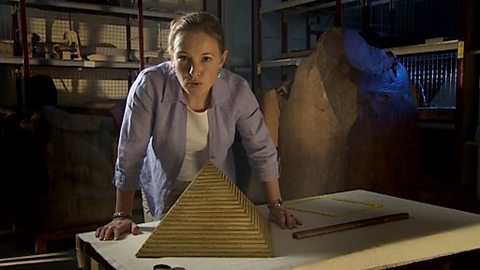
MIRANDA KRESTOVNIKOFF: The ancient Egyptian cubit was 52.3cm long. It was divided into seven palms, and each palm was divided into four fingers.
The pyramid builders must have measured incredibly accurately. There is only a few centimetres' difference in length between the four sides of the Great Pyramid.
When they'd marked out one line the right length, the builders could mark out three more the same to create the four-sided shape of the pyramid's base.
This had to be a square. This is four-sided shape and the sides are the same length, but it's not a square. To make it a square, each of these angles needs to be a right angle.
You can check that they are by measuring across the diagonals - here to here and here to here. If these measurements are the same, then the angles are right angles and the shape is a square.
Archaeologists think that the builders checked the base of most pyramids by measuring the diagonals. Once the base was laid out, they could begin building.
The Great Pyramid is made up from more than 200 horizontal layers of limestone blocks. The area of each layer is slightly less than the one below.
If you could take a pyramid apart, you'd see something like this. Each layer is a square and the squares get smaller as you go up, until you get a pyramid.
But it isn't quite as easy as that. Things can go wrong. As you build, you have to keep the corners of the layers lined up. If you don't, it will twist. And you have to make sure the incline - the pyramid's slope - stays the same all the way up. If you don't, this is what happens…
This is the Bent Pyramid. It's called that because its incline changes part-way up. It becomes less steep. Archaeologists think the builders changed the incline because the pyramid started to collapse during building.
The incline of the Great Pyramid of Khufu is the same all the way to the top. Archaeologists don't know how the pyramid builders built so accurately, but the evidence seems to show they used a tool like this - a plumb bob.
This is a modern one, and this is an ancient Egyptian one, like the one Nuht used. If you suspend a plumb bob on a line it will show you whether or not something is vertical. So you can see this isn't vertical, but this is. This is a modern builder's tri-square. Using this right-angle, builders check they are building at the right angle.
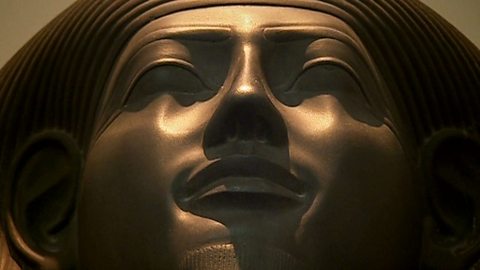
Ancient Egyptians used these too. Archaeologists think the king may be holding one in this carving. By using these two tools, separately and together, the pyramid builders could check that they were building accurately.
That explains how they were built, but why? The answer to that can be found in ancient Egyptian beliefs about life and death and the beginning of the world.
Video summary
The Great Pyramid of Khufu is made up from more than 200 layers of horizontal limestone blocks. In this clip, Miranda Krestovnikoff shows how the area of each layer is slightly less than the one below.
The Egyptians had to be very precise when building the pyramids to get them to the shape they are. The 'Bent Pyramid' in Egypt gets its name because the incline changes part-way up. The Egyptians used a plumb bob and a tri-square to check they were building accurately.
This clip is from the BBC Primary History series, Pyramid - The Great Pyramid of Khufu.
Teacher Notes
Before watching this clip, pupils could come up with explanations for how the Egyptians built the pyramids so accurately.
After sharing the clip, pupils could make their own cubit rods using their palms and fingers. Pupils could mark out a large square on the ground using string and their cubit rod. How can they be sure it is a perfect square?
Pupils could try out some Egyptian methods as described in the clip. Can they get it right the first time or did it take several attempts? Pupils could discuss the difficulty involved and the talent of the early Egyptians.
Pupils could also be challenged to find the height of each layer of horizontal limestone blocks, given that there were 200 in total.
For a greater challenge, they could find the indent taken at each level and therefore find the area of the second, third, fourth layer and so on. Pupils could also carry out further research into the 'Bent Pyramid' and find out what went wrong.
This video is relevant for teaching KS2 History in England, Wales and Northern Ireland and second level in Scotland.
Building the pyramids - part 1 of 5. video
How were the mighty pyramids built? This reconstruction shows how a young Egyptian boy is recruited to leave his family and work on an incredible project.
Building the pyramids - part 2 of 5. video
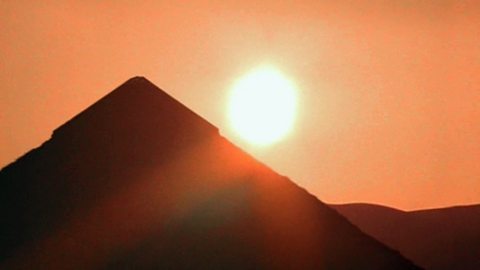
In this reconstruction, Nakht and Deba take a boat up the River Nile with other slave workers to start work on the building of the pyramid.

Building the pyramids - part 3 of 5. video
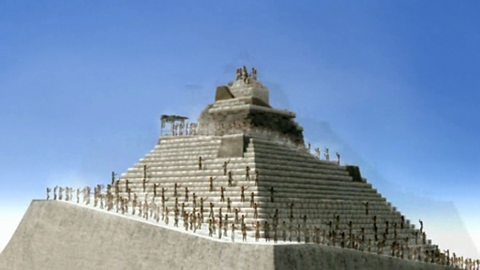
This reconstruction shows the young enslaved workers join an army of haulers dragging blocks of stone into position as the building of the pyramid begins.

Building the pyramids - part 4 of 5. video
This clip presents an explanation of the kind of tools the ancient Egyptians used in fashioning stone blocks for the pyramids as the workers get a first glimpse of the huge project they are working on.
Building the pyramids - part 5 of 5. video
A video reconstruction describing how the final touches were added to the Great Pyramid of Khufu.
Ancient Egyptian beliefs and the construction of the pyramids. video
The ancient Egyptians believed in a God of the Sun who could be reborn in the afterlife. They also believed the position of the stars pointed the way to the afterlife.
Building the pyramids accurately - part 1 of 2. video
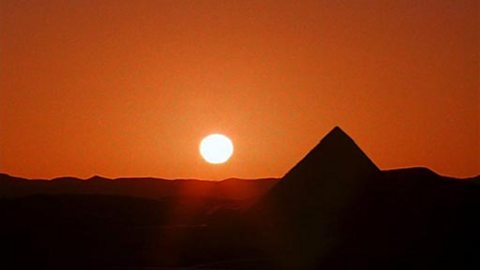
To build the pyramids, the ancient Egyptians had to use incredible precision and exact measurements. In this clip, Miranda Krestovnikoff explains how they did this.