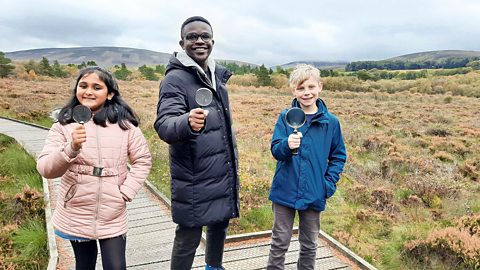
De-Graft visits Lake Windermere to find out about lakes, lochs, reservoirs and the water cycle.
De-Graft: There are more than 40,000 lakes across the UK, and what better way to explore a lake than by boat?!
This is Lake Windermere, the largest natural lake in England. It’s the same length as around 180 football pitches! Later locals Martha and Benj are going to be helping me explore all the activity that happens on the lake. But first, let’s zoom out.
Lake Windermere is part of an area called the Lake District in the north of England. The biggest lake in the UK in terms of the area covered is actually in Northern Ireland, it’s called Lough Neagh.
Lakes are large bodies of either salt water or fresh water, that are surrounded by land and not part of an ocean. Compared to rivers with flowing water, lakes are slow moving and sometimes even completely still.
A reservoir is a man-made lake, rather than a natural lake like Windermere. In upland areas you often find a dam by a reservoir or a lake - It’s a large barrier that stops the flow of water and can help prevent flooding.
Lakes are an important part of the water cycle. Water warms up, evaporates and rises into the atmosphere as water vapour. When it reaches a mountain, it’s pushed up and over the peak into colder air. It condenses and turns back into a liquid, and clouds are formed. When water droplets in clouds get too heavy they fall as rain, sleet, hail or snow and this is precipitation. When rain hits the ground it either runs straight into rivers and streams, this is called surface run off, or sinks straight into the ground, this is called infiltration, or is intercepted by vegetation. The water might find its way back into a lake and the process starts again.
I’m joining Benj and Martha at the edge of Lake Windermere and I’ve set them the challenge of recording all the different activities they can spot on the lake and keeping a tally.
Oh, look. If you look out there in the distance, it looks like we’ve got some kayakers. How many kayakers can we see?
Child: I see two, maybe three in the distance.
De-Graft: So, guys, I think this is a pretty, incredible view. What do you make of it?
Child: It’s incredible. Even living here, you never get tired of being surrounded by this much beauty.
De-Graft: It’s so incredible to know that a place like this literally exists on our doorstep. Now, what animals do you think might live around the lake?
Child: I think there are quite a lot of otters around here. I’ve seen them here sometimes.
Child: And some ducks and birds.
De-Graft: Yeah, those are fantastic suggestions! One animal that we haven’t mentioned yet are fish. Now this lake has loads of different species of fish, we’ve got brown trout, arctic char, white clawed crayfish and very slippery eels.
Now I’m gonna hit you two with another big fact and this one might blow your mind, ok? So, it’s said that five hundred million years ago, the Lake District was filled with volcanoes and bubbling lava. But during the ice age which happened 12,000 years ago, we had massive rivers of ice called glaciers. Now the glaciers eventually melted to create the lakes we know today. What do you think of that?
Child: For us now, seeing a frozen over lake would be incredible but a whole glacier… Boom!
De-Graft: Mind-blowing. Now guys tell me what have you spotted on your tally charts so far?
Child: I’ve spotted a few sailing boats, a few swimmers and surprisingly a steamboat.
Child: Yeah, I’ve got boats, swimmers and steamboat as well.
De-Graft: Nice. OK, time to compare… Lake Windermere holds 300 billion litres of water. That’s the same as 900 billion mugs of tea. One of the largest lakes in the world is Lake Superior, which goes across North America and Canada. It’s over 5000 times bigger than Lake Windermere and would cover more than 60% of England.
So, what’s the biggest lake in your region? It might not be quite as big as this but I bet you can still find out some interesting facts about it. Zoom in and have a look for yourself.
Oh look, another boat.
Video summary
Download/print a transcript of the video.
De-Graft is on Lake Windermere, in the Lake District, to find out about lakes, lochs, reservoirs and the water cycle.
There are thousands of natural lakes across the UK, as well as man-made lakes called reservoirs, which often have dams.
De-Graft explains how lakes are part of the water cycle - when water warms up, evaporates, rises into the atmosphere as water vapour, condenses, and falls as precipitation. When the rain hits the ground it either runs straight into rivers and streams, which is called surface runoff, sinks into the ground, which is called infiltration, or is intercepted by vegetation. The water might end up finding its way back into a lake and the process starts again.
Teacher Notes
Download/print the Teacher Notes for this episode (pdf).
Teacher Notes prepared in partnership with the Geographical Association.
Questions to consider:
- Have you ever visited a lake? What was it like? What wildlife did you see?
- What is the process of the water cycle? Do you know the different components of the water cycle?
- What do you think about the Lake District once being the site of bubbling volcanoes? What about when it was completely frozen and full of glaciers carving their way down the mountainsides?
- What potential hazards are there in lakes, reservoirs and rivers? How would you stay safe?
- What’s the purpose of a reservoir? And of a dam?
- What activities do you think people can do on a lake? Have you ever tried any water activities?
- Do you think lakes are important? Do you think it’s nice to have lakes across the UK? Why?
Suggested activities to further explore learning:
1. Tourism poster
- Pupils could design an illustrated information tourist poster or even a short booklet for Lake Windermere (or a different lake near you).
- Describe some of the wildlife tourists can keep an eye out for whilst visiting. What are some of the dangers to consider whilst being close to water? What activities could people try on the lake? Include some facts about the size or depth of the lake, and how the lake was formed.
- There will need to be a combination of informative and persuasive writing and images.
- Encourage pupils to think of the different ages of tourists that might be visiting and what might be appealing to families, younger children, older individuals for example. Pupils might wish to target one demographic or design an advert that will capture all ages.
2. Water cycle demonstration
- Ask pupils to create a demonstration of the water cycle in groups. They could use different methods, for example one group could act out the different stages of the cycle through movement and actions, another could create posters or large diagrams, and another group could create a poem or a rap to explain the water cycle from the perspective of a water droplet.
- Which ever form of presentation style the group chooses they should emphasise the vocabulary associated with each component.
Key terminology:
Condensation – the process of water vapour turning into liquid. In the water cycle it’s when water vapour in the atmosphere reaches colder air and turns back into a liquid which then forms clouds.
Evaporation – the process of liquid changing to a gas. In the water cycle it’s when water in a lake or sea, for example, warms up and rises into the atmosphere as water vapour.
Glaciers – glaciers are large areas of thick ice that remain frozen all year round and flow very slowly.
Infiltration – when rain water sinks into the ground.
Precipitation – the process of water droplets in clouds becoming too heavy and falling as either rain, sleet, hail or snow.
Surface runoff – when rain water falls, hits the ground, and runs straight into rivers and streams.
Water cycle – the journey of water from bodies of water on the ground, to clouds, to rain, and back into rivers, lakes or oceans.
Water vapour – water in the form of a gas after having gone through the process of evaporation.
Suitable for teaching geography at KS2 in England and Northern Ireland, Progression Step 3 in Wales and 2nd level in Scotland.
Food, farming and agriculture. video
Exploring farming and agriculture - a key UK industry. Includes arable, pastoral and mixed farming and examples of rural and urban farms.
UK settlements and navigating using maps. video
Exploring the different types of settlement in the UK - including villages, towns and cities - and how to navigate using maps, including symbols, compass points and co-ordinates.
Urban settlements - living in a city or megacity. video
Exploring key aspects of cities and megacities - building use, population density, environmental impact and sustainable choices.
Coasts and sustainable use of natural resources. video
Examining a coastal region of North Wales, including a local wind farm and examples of the sustainable use of natural resources.
Rivers - the course of a river from source to mouth. video
Exploring the key aspects of rivers - the source, tributaries, streams, meanders, ox-bow lakes, river mouth and estuary.
Mountains - how tectonic plates create mountain ranges. video
Exploring how tectonic plate movement creates mountains where the plates collide and single peaks formed by volcanoes.
Forests - deciduous and coniferous woodland and biodivsity. video
Exploring a forest region in the Lake District to discover the rich biodiversity of woodland habitats.
Shore, coast and ocean. video
Visiting a marine reserve in Scotland to discover the biodiverse habitat it offers, but also the importance of conservation.
Peatlands, wetlands and the carbon cycle. video
Exploring the significance of peatland and wetland habitats to store water and absorb carbon or CO2.