MATT: Welcome to the Maths Show, with me MattParker. Today we’re doing fractions, decimalsand percentages. We’re going to troubleshootsome of the more common mistakes peoplemake. Because while fractions and percentagesmay seem a bit daunting, they’re justmathematical operations, like all of Ed Sheeran’salbum titles…
MATT: Plus, his follow up Multiply – or as I call it, of –and Divide. We’ve also just heard that his nextalbum is going to be called ‘always show yourworking out’.
MATT: Ha, so, first up Fractions…
MATT: People often get stuck when they havesomething like a half, times five. One way to dothis is to just remember that multiply is ‘of’.We’re asking for a half of five, which is 2.5.
MATT: Or you can look at the fraction as a division, onedivided by two. And because when you’remultiplying things the order doesn’t matter.
MATT: Three times seven is the same as seven timesthree…
MATT: we can rearrange this to be five times one, whichis just five. Divided by two, 2.5, that’s the correctanswer.
MATT: Next up, the advantage of converting a decimalinto a percentage.
MATT: Lets say you’re asked to turn 0.85 into a fraction,go via a percentage!
MATT: 0.85 is 85%. Percent is out of 100, so we can put85/100. Now we simplify it down to get ourfraction of 17 out of 20.
MATT: We can also use percentages if we have tomultiply a decimal by a whole number.
MATT: Lets say when I release my album from my bandA2B2. We’re a tribute band that plays simplifiedversions of Abba songs…
MATT: and I managed to sell 10 copies at £30 each.That’s £300 of which I get 0.85. I could use acalculator to work out 0.85 times 300,
MATT: or I remember that 0.85 as a percentage is 85%.
MATT: I split 300 into it’s sections. 50%, 10%, 5%. I add150, three 10’s and a 5, to get the total of £255.
MATT: A final word about calculators, if you’re in anexam where you’re allowed calculators, youdefinitely should be using them. They wouldhave written the questions assuming you have acalculator.
MATT: Even in every day life, they reduce the risk of youproducing a silly numerical error. In things likecompound interest, they help with doing all thecalculations.
MATT: You’ll come across compound interest in thingslike savings and investments. I’ve actually gotquite a good retirement investment fund goingon, let’s just check in on how it’s doing…… 7moths and two buttons! Alright.
MATT: Now if I’m getting 8% interest on my moths andbuttons, I can calculate the compound interest ofwhat I will have in ten years time. So if I get 8% a year, and I get to keep the originalamount, at the end of the year I have 108% ofwhat I started with. I can just put this straightinto a calculator.
MATT: 7 moths, times 108, and then I just hit thepercent key… equals, and I get an answer of 7.56moths after a year.
MATT: I could keep hitting enter to keep multiplying by108%, but if I want to do all 10 years at once Ican just do 7 times 108%, and now I raise that tothe power of 10. So I’m multiplying by that 10times… I get an answer of
MATT: 15.11… that’s over 15 moths! Alright.
MATT: I’m going to be pretty set when I retire and I sellthose on the open moth market…
CREW MEMBER: Um, Matt? Moths aren’t worth anything, it’sbutterflies.
MATT: Oh no I put all my money in moths. Well thankgoodness I diversified into buttons…
Video summary
A guide to converting fractions, decimals and percentages, applied to real-world problems for students struggling to achieve grade 4 pass in GCSE maths.
Looking at key errors highlighted in examiners’ reports, the topic of fractions, decimals and percentages is presented for revision of these key skills looking at calculator and non-calculator approaches.
Matt Parker take students through some of the basics of handling fractions and decimals and percentages, converting between different representations and examining real life applications
This short film is from the BBC series, The Maths Show.
Teacher Notes
Before watching
Ensure students are comfortable with the basic approaches to fractions of an amount and non-calculator questions of percentages of an amount. Explore the difference of simple interest and compound interest.
During watching
Ensure students have a scientific calculator.
Pause the video at key moments and see if your students can work out the calculation which will be explained by Matt. When pausing the video, can students think of other mental or written methods that they prefer? Compare strategies.
Pause at the introduction to compound interest. You may wish to pause and explain in more detail what this term means.
Explore the methods that Matt has shown using the calculator - would students use that method? Some students may use a different approach, elicit confidence in what they % key on the calculator is doing if students use the method shown in the video. Which method links well to non calculator methods?
After watching
Explore different conversions between fractions, decimals and percentages. Students could use a number line, either using notes posted around the room or other active learning techniques. Extend the use of decimals and fractions to include numbers greater than one and negative numbers.
Compound interest has many interesting real-life situations which could be explored, students could investigate different savings options currently available, population growth or half-lives.
Suitable for teaching maths at GCSE in England, Wales and Northern Ireland and National 4/5 or Higher in Scotland.
Algebra and Negative Numbers. video
Negative numbers are made easy as Matt breaks down his top five problems with negative numbers.
Algebra - Formulae and Graphs. video
Matt offers tips on identifying different graph types and their uses, as well as tips to avoid common mistakes when working with formulae.
Statistics. video
Matt simplifies the use of lines of best fit for students struggling to achieve a passing mark on the maths GCSE.
Probability. video
Matt demonstrates how to handle probabilities using probability and frequency trees.
Geometry. video
Matt breaks down key GCSE angle problems into easy steps, including internal angles of polygons and bearings.
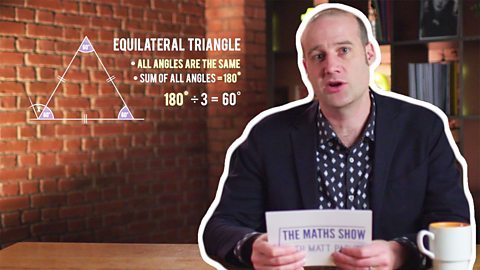
Exam Techniques for GCSE Maths. video
Matt offers advice for teachers and students on test-taking techniques specifically for the maths GCSE.
Ratio and Proportion. video
Matt explores ratio and proportion including converting ratios into fractions and graphical representation of ratios.