MATT:Welcome to The Maths show with me Matt Parker, today exploring ratio and proportion.
MATT:Ratio is when you have different amounts ofingredients in a recipe or a pie… and proportion iswhen you scale up or down a fixed relationship. Sothe mix stays the same, you just have less or moreof the total amount. Isn’t that right Matt?
MATT:That’s correct, but let’s confirm it with Matt…
MATT:Correct… todays topic is ratio and proportion.
MATT:Up first, using ratios… When deploying a ratio it’soften convenient to turn it into a fraction first - alsoexaminers love that kind of thing.
MATT:So for example the word ratio contains three vowelsand two consonants, so that’s a ratio of 3:2. So thefraction of the word ratio which is made of vowels,is three fifths. People often forget to add togetherthe two parts of the fraction to get thedenominator.
MATT:If you ever forget just write the word ratio out andcheck. This can now be used in more complicatedsituations.
MATT:For example my autobiography, Matt Parker –Numbers I Have Known, contains 90,000 letters in aratio of 2:7, vowels to consonants.
MATT:If you wanted to work out the total number ofvowels, well that’s two ninths of the letters
MATT:and if we multiply that by 90,000 we get 20,000vowels…
MATT:Available in all good book shops, that I’ve managedto sneak it in to.
MATT:In problems involving proportion you can usesomething called the Singapore Bar Method… nowthe crew very kindly got me some props so that Ican demonstrate the bar…. A pie? Why would you? Ican’t use that to do a… oh this is… you try and workwith professionals and you get a pie instead of abar, unbelievable…
MATT:Actually can I get a bar in graphics? That’s better! Sothe Singapore Bar Method, you have a bar for thetotal. In this case we’re got Priti and she’s buying acomputer for £1,200, that’s the whole bar.
MATT:She then has to make an initial deposit of £200 andthen 12 repayments. Those are going to be 12repayments of £80 each to give us the remaining£960.
MATT:We can simplify this down until eventually you get aratio of 1:4, deposit:repayments. Five partsaltogether.
MATT:So the deposit was originally one fifth – five parts –of the total cost of that computer.
MATT:If you’re asked to give that as a percentage, you canjust take the fraction… we want it to be over 100 forpercent, so we multiply the bottom by 20 and thenthe top by 20 as well, so there you are 20%.
MATT:As a final treat we can use ratio and proportionwhen dealing with pie charts, so here we’ve got abar of… oh! Sorry! We’re just going to have toimagine a pie…
MATT:So earlier today I surveyed a number of people ontheir opinions on pie charts. Answers included, ‘yaypie charts’, ‘oh no pie charts’ and ‘who are you, whyare you talking to me’.
MATT:The category of ‘who are you, why are you talkingto me’, involves 40 degrees on this pie chart and itcorresponds to 80 people.
MATT:If we want to get the total number of people Iannoyed about pie charts, we can divide 80 by 40,so we have 2 people per degree.
MATT:We can then scale that up to the full 360 degrees,giving us 720 people who answered my surveyabout pie charts.
MATT:Which means I actually really fancy some pie now…although, actually does anyone want some bin pie? Ithink it’s probably still good. Bin pie? Bin pie?In a recent survey 0% of people wanted some binpie.
Video summary
Over the course of this short film, mathematician and comedian Matt Parker explains different approaches to ratio and proportion questions for students who are struggling to gain a passing mark on their maths GCSE.
Traditional ratio questions and proportional reasoning questions are solved using a unitary method, finding a multiplier and also with a graphical aide demonstrating simple uses of the Singapore Bar Method. Finally, he shows how the concepts of ratio and proportion can be helpfully applied to other topics such as pie charts.
This short film could also be used in a more piecemeal approach to introduce a topic, as such this could be used for an earlier Key Stage.
This short film is from the BBC series, The Maths Show.
Teacher Notes
During watching
This video can be paused in many places to ask students to attempt the question that Matt will explore.
When the bar method is explored, pause the video to elicit different representations from students. Students often struggle drawing their own diagrams. In this case, you can draw different diagrams and ask students which suitably represent the problem and which don’t work - include diagrams split in to the wrong proportions.
After watching
Explore the many areas of the exam papers that uses ratio and proportion, building up from simple ratio questions to the triple ratio questions that are common on exam papers where students are asked to combine two different ratios. Repeatedly refer to the video, asking students how the different (but not necessarily more complex) example relates to the examples shown in the video.
Next steps after gaining confidence in the method would include looking at scale drawings, converting between metric units or metric and imperial units and looking at similar shapes.
Suitable for teaching maths at GCSE in England, Wales and Northern Ireland and National 4/5 or Higher in Scotland.
Fractions, Decimals and Percentages. video
A guide to converting fractions, decimals and percentages, applied to real-world problems.
Algebra and Negative Numbers. video
Negative numbers are made easy as Matt breaks down his top five problems with negative numbers.
Algebra - Formulae and Graphs. video
Matt offers tips on identifying different graph types and their uses, as well as tips to avoid common mistakes when working with formulae.
Statistics. video
Matt simplifies the use of lines of best fit for students struggling to achieve a passing mark on the maths GCSE.
Probability. video
Matt demonstrates how to handle probabilities using probability and frequency trees.
Geometry. video
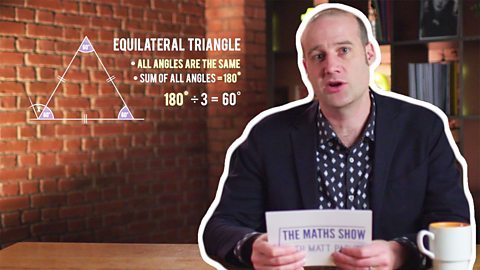
Matt breaks down key GCSE angle problems into easy steps, including internal angles of polygons and bearings.
Exam Techniques for GCSE Maths. video
Matt offers advice for teachers and students on test-taking techniques specifically for the maths GCSE.