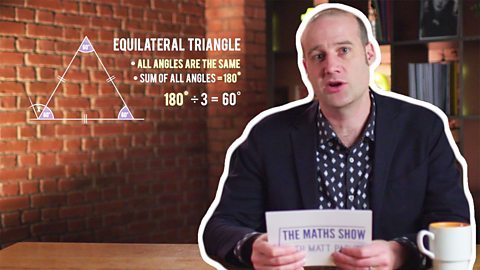
MATT: Hello, here on the maths show with me MattParker, we normally hit you with a barrageof relentless mathematical advice. But wethought as a change of pace, we would giveyou some exam technique advice.
MATT: Some tips and tricks you can use in an examto maximise your chance of getting as manymarks as possible.
MATT: So everyone on the cast and crew havesubmitted their favourite suggestions,including mine,
MATT: which is to always estimate your answers.Get a sense in advance of how big or smallthe answer to a question might be.
MATT: This avoids orders of magnitude of mistake ,where you get something that’s ten timestoo big or ten times too small.
MATT: Take a complicated calculation, and beforeyou do it,
MATT: round all of the numbers. How much nicerdoes that look. You can now very easilycomplete the calculation and get a sense ofhow big or small the answer should be.
MATT: The research and graphics departmentsuggested that you should always check yourunits. You need to know your units, youneed to develop an intimate understandingof units.
MATT: Maybe print out a whole sheet of them.
MATT: Maybe invite an absolute unit out for tea…not that sort of unit, this sort of unit.
MATT: You need to know your units, you need tocheck your units. Thank you very much,graphics and research department
MATT: Up next our director has prepared astatement about how you should lay yourworking out, out.
DIRECTOR: Yeah, so first of all you need to remember tostart a new line for each new stage ofworking, and when crossing out, you shouldonly cross out things if you know it’s wrongand you’re replacing it with something else.If you’re not replacing it, just leave it there,some of it might be right and you can pick upsome extra marks.
MATT: Excellent, so… no that’s my thing!
MATT: You also need to remember that examiners,the people marking your exams are realpeople
MATT: and they have hundreds of exams to getthrough in an attempt
MATT: to pay for their holidays.
MATT: So you need to make their lives as easy aspossible.
MATT: And to remind you that examiners are real,legitimate humans, I’m going to welcomeback the maths show’s favourite examiner,Carl.
MATT: Examiners read your answers ona scanned screen. Make it easyfor them to read your work. Lay itout clearly and make the finalanswer obvious.No comment, no comment, no comment, nocomment, no comment, no comment, nocomment, no comment, no comment, nocomment, no comment, no comment, nocomment…
MATT: We also put out a suggestion box, so anyonecould submit suggested techniques to use inyour exam. Lets see what the crew put in.
MATT: Check algebra questions by re-substitution.That’s a good suggestion.
MATT: If you’re faced with something like 3X + 10 =25 and you think you’ve got a solution for X,don’t just write it down,
MATT: substitute it back in and make sure you get25 out the other side.
MATT: Up next, how many marks is it worth? If aquestion is worth one mark and you’vewritten a novel length answer, you’veprobably done too much. Likewise, if aquestion is 6 marks and you’ve just written‘No’, you should probably expand on that alittle bit.
MATT: Circle useful info, when you’re reading aquestion, circle any information that youthink might be useful when you’re answeringthe question. You won’t necessarily need touse every single thing from the question, butyou should be using most of it. Make sureyou haven’t missed anything vital.
MATT: Multi-choice guess. If you’re facing amultiple choice question and you’re not sureof the answer… have a guess. You’re notgoing to lose marks for getting it wrong.
MATT: And finally, lunch breaks. Lunch breaks? Isthat just a general suggestion? You’re nothaving lunch breaks!
MATT: Although, that’s good advice. You can’t havea lunch break in the exam, but you canoccasionally have a rest, just keep an eye onthe time. Make sure you can see a clock oryou’ve got a watch.
MATT: You should be spending on average 1 minuteper mark that a question is worth.
MATT: So if you’ve spent ages on a question that’sonly worth 2 or 3 marks, maybe leave it andif you’ve got time at the end come back andhave another go. The examiner should giveyou a 10-minute warning before the end ofthe exam.
MATT: So as well as what we’ve covered here,there’s more advice and help online. Ifyou’re feeling stressed or worried, The MindSet probably know what you’re goingthrough so you can check them out, they’vegot loads of help and advice.
MATT: And from everyone here at The Maths Show,with me Matt Parker, we wish you all thebest.
CREW: Good luck!
Video summary
In this teacher support video Matt Parker offers tips and advice in how best to support students struggling with the maths GCSE.
Matt talks plainly about common mistakes test takers often make based on feedback from examiners reports.
These techniques are aimed at helping students get as many marks as possible.
Matt suggests students always estimate their answers before working out a question to avoid orders of magnitude mistakes when the answer they find is nowhere near their estimation.
He also reinforces that while preparing you should always revise units and make sure you have a clear understanding of what any unit you are presented with on the exam means.
He advises students to always start a new line for each problem and to display their working out clearly, while taking care not to cross anything out unnecessarily.
There is even advice from a “real” examiner, to make all work easy to read and laid out as clearly as possible.
It’s also a good idea to check algebra questions by re-substituting the answer into the equation to see if it works.
Finally, there are more general tips like, don’t spend too long on a low value problem, take a break if you have time and to use The Mind Set as a resource for more test taking advice.
Suitable for teaching maths at GCSE in England, Wales and Northern Ireland and National 4/5 or Higher in Scotland.
Ratio and Proportion. video
Matt explores ratio and proportion including converting ratios into fractions and graphical representation of ratios.

Fractions, Decimals and Percentages. video
A guide to converting fractions, decimals and percentages, applied to real-world problems.
Algebra and Negative Numbers. video
Negative numbers are made easy as Matt breaks down his top five problems with negative numbers.
Algebra - Formulae and Graphs. video
Matt offers tips on identifying different graph types and their uses, as well as tips to avoid common mistakes when working with formulae.

Statistics. video
Matt simplifies the use of lines of best fit for students struggling to achieve a passing mark on the maths GCSE.

Probability. video
Matt demonstrates how to handle probabilities using probability and frequency trees.
Geometry. video
Matt breaks down key GCSE angle problems into easy steps, including internal angles of polygons and bearings.