MATT: Welcome to The Maths Show with meMatt Parker. Today we’re doing algebra,specifically negative numbers. Nownegative numbers can be quite tricky, infact for a long time mathematiciansrefused to admit that they even existed.
MATT: It wasn’t until the 3rd century in China,and the 7th century in India, thatmathematicians started to use them.
MATT: In Europe Greeks considered any solutionthat had a negative value, to be false,absurd and deeply uncool.
MATT: In Europe they didn’t start using negativenumbers until the 17th century. Havingsomehow remained positive through theentire dark ages…
MATT: So in order to be better at negativenumbers than this guy was, I present toyou the top negative five things aboutnegative numbers.
MATT: In at negative five, it’s correctly addingand subtracting negative numbers. Imean, this was always going to be in thetop five because people get it wrong andthe secret is, just draw a number line…
MATT: Mark positive in one direction, negative inthe other. You start with the first numberand then you move either up or down theline,
MATT: so negative four, subtract two… start atnegative four and go two in the negativedirection.
MATT: Or if you wanna add five, go five in thepositive direction. Just always use anumber line…
MATT: Hopping in at negative four, it’s twonegatives make a positive… you’ve got toremember that two negatives give you apositive. This happens when you’remultiplying and dividing.
MATT: So negative four times negative three…four by three gives you 12… and becauseyou’re multiplying two negatives theanswer is a positive.
MATT: This also occurs if you’re subtracting anegative number. So seven minusnegative three, the two negativescombine to give you a positive. Seven plusthree is 10… two negatives make apositive.
MATT: And at negative three, when twonegatives don’t make a positive. Soserious we’ve got a lighting change. Nowsometimes people will see something likenegative one sub… We don’t need it thewhole time do we? Can we? Thank you…
MATT: People will see this and go, oh look twonegatives, it must be a positive… butwe’re not multiplying or dividing, we’renot subtracting a negative… you can justwork this out on a number line.
MATT: You start at negative one, you subtractfour, so you go four in the negativedirection. You end up at negative five.
MATT:Sometimes two negatives don’t make apositive, and I don’t think we need thelights a second time… thank you.
MATT: In at negative two it’s expanding brackets.Just because you see brackets doesn’tmean you can forget everything you knowabout negative numbers. Pay closeattention to where the negatives go.
MATT: The first bit is reasonably straight forward,three times two x, six x, and three timesnegative four, is negative 12. For thesecond section you need to multiplyeverything inside the brackets bynegative two. Negative two times x,negative two x… and then negative twotimes negative four gives you positiveeight.
MATT: Make sure you follow every single step,and then simplify it down and you’redone. Pay very close attention tonegatives when you’re simplifyingexpressions.
MATT: Finally, in at negative one, it’s negativenumbers… hate your haircut and thinkyou’re going to f… who wrote this one?
MATT: No, it’s actually squaring negativenumbers.
MATT: Because, negative three squared is verydifferent to
MATT: negative, three squared.
MATT: One is negative three times negativethree,
MATT: and the other is the negative of threetimes three.
MATT: You get different answers.
MATT: So if you’re substituting into x squared,it’s the first one. It’s the negative numbertimes itself, it will give you a positiveanswer…
MATT: And that’s it, that’s our top negative fivethings about negative numbers. If you’vepaid close attention you are now officiallybetter at negative numbers than anyancient Greek mathematician.
MATT: And don’t forget the number one goldenrule about negative numbers, always staypositive!.. That doesn’t sound right?
Video summary
Negative numbers are made easy in this handy guide for maths GCSE students from Matt Parker, who breaks down his top five problems with negative numbers.
The mathematician and comedian uses this video to explain the sometimes confusing topic of negative numbers.
A mixture of graphics and jokes help break down negative numbers into Matt’s “Top Five” categories of negative number errors.
Matt also explains the history of negative numbers, including how Europeans didn’t use them until long after Chinese and Indian mathematicians.
He also reinforces the importance of order of operations when dealing with an equation and the use of acronyms such as BIDMAS and BODMAS in revision.
While the videos have been designed as revision tools for GCSE level students, they could also be used in part to introduce topics for earlier Key Stages.
This short film is from the BBC series, The Maths Show.
Teacher Notes
During the video:
- As Matt sets up the various examples using brackets and powering negative numbers, pause before he answers and test your students on the questions. See if they can set up number lines correctly to solve equations that require adding and subtracting negative numbers.
- Use Always/Sometimes/Never to elicit discussion of negative number ‘rules’ during the pausing of the video.
- Students could use whiteboards or think pair share to encourage collaboration of checking methods that some students may already utilize.
- A calculator emulator or similar would be useful to look at calculator skills.
After the video:
- Look at other past exam questions that highlight the use of negative number skills. Use ‘spot the mistake’ questions to ensure use of appropriate checking skills. Explore different ways of creating number lines to use in a timely manner with sufficient but not excessive information.
- Use a matching activity or similar to substitute negative values into formulae - ensure a mix of the four operations. For students that need negative number reinforcement before approaching algebra, a similar activity with sums alone will help students.
- Students could create an odd one out activity where either two answers are the same and one is different, or two answers are correct, and one is wrong (breaking one of the top -5 rules).
- Ask students to create a poster or display using their own examples for Matt’s “Top -5 mistakes with negative numbers”, including how to check that they haven’t made the errors. Students could start with a simpler substitution expression then slowly build it using various positive and negative terms.
- Ask your pupils if they find any parts of negative numbers tricky that Matt didn’t mention?
Suitable for teaching maths at GCSE in England, Wales and Northern Ireland and National 4/5 or Higher in Scotland.
Algebra - Formulae and Graphs. video
Matt offers tips on identifying different graph types and their uses, as well as tips to avoid common mistakes when working with formulae.
Statistics. video
Matt simplifies the use of lines of best fit for students struggling to achieve a passing mark on the maths GCSE.
Probability. video
Matt demonstrates how to handle probabilities using probability and frequency trees.
Geometry. video
Matt breaks down key GCSE angle problems into easy steps, including internal angles of polygons and bearings.
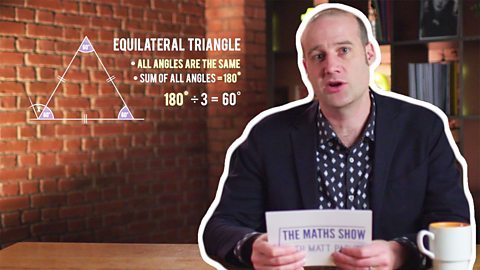
Exam Techniques for GCSE Maths. video
Matt offers advice for teachers and students on test-taking techniques specifically for the maths GCSE.
Ratio and Proportion. video
Matt explores ratio and proportion including converting ratios into fractions and graphical representation of ratios.
Fractions, Decimals and Percentages. video
A guide to converting fractions, decimals and percentages, applied to real-world problems.