Steph McGovern:Hello, I'm Steph McGovern, and I report for the BBC on all sorts of issues and news to do with business, jobs and money.
Steph McGovern:Now because of my job, I get to spend a lot of time visiting places like this, this incredible car factory, to look at how businesses work and how things are going for them.
Steph McGovern:This is the Toyota car factory in Derby, where around 600 new cars are produced every single day.
Steph McGovern:Now if you're making that many cars, you want to be sure that people will buy them, and so car manufacturers like Toyota employee teams of designers to come up with models where everything about the car, from the way it drives, to the way it looks, to how much it costs, is attractive to as many potential buyers as possible.
Steph McGovern:Getting it right can mean huge sales and financial success. Getting it wrong can spell disaster. So with this in mind, let's check out this clip featuring Ant Anstead and some designers who spend their days trying to anticipate what people will want to drive in the future.
Ant Anstead:Hidden under the Westway Flyover in Central London, lurks the unusual home of a top secret international design studio. Where they've been trying to read your mind. Well, the mind of a future car-buyer anyway. Stewart Callegari is General Manager for product planning at Nissan.
Ant Anstead:So sitting here today, in the crazy, Bond-lair camera room, you're the man at Nissan with a crystal ball.
Stewart Callegari:Yeah, yeah we look at what the customers want. We try and live part of their day-to-day lives and visiting them at their house and understanding what those customers need, and what they do day-to-day with their cars.
Ant Anstead:Do the needs vary from country to country?
Stewart Callegari:Yeah, we do change the vehicle depending on the local market requirements. So for example, the roof for Russia, it takes far, far more load. And the reason that we have to strengthen the roof, is because of the amount of snow that you'll get in the Russian market.
Ant Anstead:In 2003, when this design studio opened, they were handed a challenge. To replace the aging Almera, a fairly average family car. They needed to predict what would be popular in four years' time. And they decided to be bold. The concept they came up with went on to sell in the millions. The Qashqai.
Ant Anstead:So with the Qashqai concept, who was the customer you were targeting?
Stewart Callegari:What we had seen was more and more customers were moving towards buying four-wheel drive vehicles.
Ant Anstead:Why?
Stewart Callegari:Basically a feeling of safety. Families were becoming more disenchanted with conventional hatchback vehicles. They were looking for something a lot more exciting.
Ant Anstead:So the word Qashqai?
Stewart Callegari:It's a nomadic Persian tribe. To represent the fact that the vehicle feels comfortable, both in the hills and both in centre of the city as well. And we used that to create some of the key words that the design guys used to create the design.
Ant Anstead:The market research man's dreams for the Qashqai were handed over to designers like Daryl Scriven.
Daryl Scriven:With Qashqai, we've got "seductive" and we've got "durable", really contrasting key words. Mixing those two languages together as a design was challenging. We did a lot of sketching first, and understanding how the design of the lower portion of the car and the upper portion of the car were slightly different.
1900:03:19:13 00:03:30:03Daryl Scriven:So the lower was much more durable, rugged, robust, strong. All those sort of key words that we wanted to get across, but the upper was still trying to be dynamic. And that was new to the market.
Ant Anstead:Do you drive one?
Daryl Scriven:Yeah, I do drive one.
Ant Anstead:Of course you do, why wouldn't you.
Daryl Scriven:But I'm always picking up things that are wrong with it.
Ant Anstead:What, sitting in the drivers' seat?
Daryl Scriven:Well I'm always wanting to improve it, design-wise.
Ant Anstead:It's hard to get this hands-on experience when so much work is now done on a computer. So to see how a car will look in the real world, they still like to make a life-sized model.
Ant Anstead:This is the height of technology, this is a full-sized car being modelled in clay.
Ant Anstead:The mechanical milling machines work a block of thick clay, passing over with a rough drill, before completing another pass in finer detail. It all takes around 30 hours, but slowly, a new car starts to emerge. Today they're modelling the new Infiniti Q30.
Ant Anstead:Feels like chocolate.
Ant Anstead:I guess at this stage you don't want to put a dent in it.
Ant Anstead:Whoa! [LAUGHS] You nearly damaged it!
Ant Anstead:Skilled clay modelling artists now craft the life-sized design. Ensuring every feature translates well from computer screen to reality.
Ant Anstead:Are you given a measurement or is it purely by eye?
Master Craftsman:No purely by eye. Usually. So it will just be what angle looks right with the surface.
Ant Anstead:Right so no one in an office is going to say to you, "I want the angle of the screen to be 27 degrees." You kind of feel it?
Master Craftsman:Yeah because it's just a feeling, you know what looks right and what feels right, so.
Ant Anstead:Yeah but you're determining how the end car's going to look purely by going, "Kind of feels right."?
Master Craftsman:Yeah.
Ant Anstead:I like it!
Ant Anstead:Such is the demand for clay modelling, that an apprenticeship scheme has been created to pass on skills before they're lost.
Ant Anstead:What made you choose clay modelling?
Apprentice Crafter:I think it's amazing. It's like an art, isn't it? It's really creative, it's really nice to do. I think it's better than doing it on the computer.
Ant Anstead:See that's what fascinates me the most, is that in this industry, which is heavily driven by computer-aided design, actually comes down to the craft of someone.
Master Craftsman:It's nice because at the end of the day, you've created something and it's part of you that's in that creation. And you've put something of yourself into it.
Ant Anstead:To help the design team visualise the finished car, the clay is covered with a plasticised film.
Master Craftsman:So you start at the top. Pull it tight, get a little bit of tension on it. Okay and then we just roughly put it on with our hand. So it's just a matter of getting all of the water and the air out.
Ant Anstead:It's amazing because it feels like a piece of plastic, but actually it gives a presentation of like a painted panel.
Ant Anstead:They even have a 3D printer on-site to try out new designs, or to print parts for reference.
Ant Anstead:So I can see in the window here, that the wing mirror's now finished printing. Now this is like an oven, so it's going to be really hot. Here you go, chaps. Obviously it's not for this car. Master Craftsman: No, it's the wrong car. And it's the wrong side.
Ant Anstead:Yeah. Cheers for that guys.
Ant Anstead:Okay so maybe I'm not quite ready to join the crack modelling team.
Ant Anstead:When that's all finished we actually get to this stage.
Ant Anstead:Fully painted up, a concept car like this is the culmination of the visual designer's dreams.
Ant Anstead:It's amazing, it actually feels like a car now.
Ant Anstead:And it will go on show to the public as a vision for the future.
Steph McGovern:Whoa, isn't that amazing? Even though they're working with pioneering modern technology, they still end up getting down and dirty with one of the oldest materials known to man - clay. Mad, eh?
Presenter Ant Anstead visits a top international design studio to see how Nissan set about designing new car models.
The General Manager of Product Planning explains that design focuses on identifying customer needs.
One way is to observe the every-day use customers make of their vehicles.
In 2003 the design studio set about creating a replacement model for the Nissan Almera.
The first step is to identify customer needs and market gaps.
For instance, what features and appearance are likely to appeal in four years’ time?
Market research results suggest customers increasingly buying four-wheel cars to make them ‘feel safe’.
Buyers express a desire to buy more ‘exciting vehicles’ than conventional hatchbacks.
Designers are given two words to combine to create a new car: seductive and durable.
The result is the multimillion selling Nissan Qashqai.
The outline of the concept car is chisled out of a clay block by milling machines and finished by hand by skilled clay modelling artists.
The final curves of the car are decided by the clay modelling artist rather than the computer.
Some parts are 3D printed. The car is covered with a plastic silver film to make it look real.
Teacher Notes
This could be used introduce the concept of the design mix and the need to use market research as a basis for design decisions.
Students can investigate the design concept of prototype self-driving cars and then compare their function and aesthetic with conventional vehicles.
Curriculum Notes
This short film is suitable for teaching GCSE (KS4) / National 5 business.
Students and teachers over the age of 16 can create a free Financial Times account. For a Financial Times article about self-driving cars from 2025, click here.
More Business with Steph McGovern:
Logistics, stock control and car manufacturing. video
James May visits Mini in Oxford to investigate 'just-in-time' logistics.
Lean car production. video
James May visits Nissan to investigate modern methods of production.
The challenge of running a theme park. video
Declan Curry investigates business strategies used by Pleasure Island, a family owned theme park in Cleethorpes.
Kaizen - new ideas to improve productivity. video
How workers at Toyota come up with new ‘kaizen’ ideas every month.
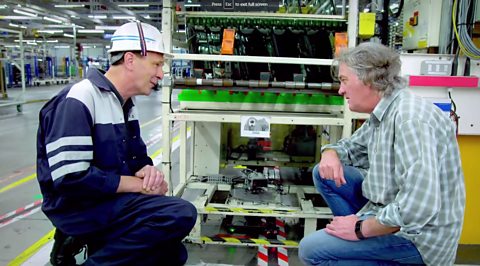
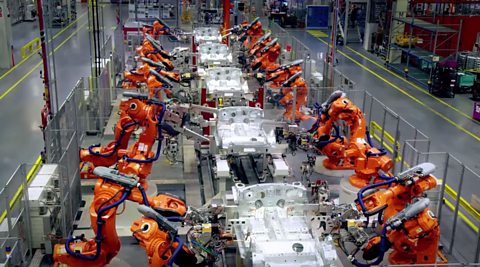
Robots and automation in car manufacture. video
James May finds out how dancing robots are used to make Minis.
The rise and fall of Sunny Delight. video
Evan Davies explores why Sunny Delight took the market by storm but soon faded away.

How to market a new cereal. video
How Kellogg’s use marketing to launch a new product.

The challenge of launching a new café video
Theo Paphitis advises a struggling café on how to adapt and survive.