Steph McGovern:Hello, I'm Steph McGovern, and I report for the BBC on all sorts of issues and news to do with business, jobs and money. Now because of my job, I get to spend a lot of time visiting places like this, this incredible car factory, to look at how business work and how things are going for them.
Steph McGovern:And this is the factory where the Japanese car company Toyota make their cars in the UK. Now actually, the cars' bodies are made here but the engines are made in Wales, and then they're brought here to Derby where they're all put together, and eventually are driven away.
Steph McGovern:Now in the world of car manufacturing, Toyota is known for pioneering changes that they introduced to car production lines. They applied lessons from Japanese philosophy to the workplace that resulted in incredible improvements in speed and efficiency.
Steph McGovern:Their techniques are now commonly used by other car companies too, like another Japanese firm, Nissan. And their factory in Sunderland is where this report from James May begins.
James May:Ship building. Coal mining. The North-East of England is a traditional heartland of British industry. 'So Sunderland was an ideal place for Nissan to open their British manufacturing HQ in 1986. And ever since they've helped spearhead a modern industrial revolution in the nation's car making.
James May:This factory makes more cars than anywhere else in Britain. It fires out over half a million of them every year. That's more than the whole of Italy.
James May:Henry Ford famously said you could have his car in any colour you liked, as long as it was black, because that was the only colour he had. Now you can have all sorts of colours.
James May:You can have different models on the same line, here comes the Leaf. These are all Qashqais, we've had bronze and aubergine, now we've got some reds, and we've got some silvers, and the interiors are different colours, they're left and right-hand drive. They have different options fitted and so on, and so on.
James May:But the system knows everything. It knows… that that bit was going on that car. And that bit. It's amazing.
James May:So how do car factories perform this modern magic? Well the current system of making cars efficiently and affordably is actually a Japanese method. More a Japanese philosophy. Pioneered by Toyota in the 1950s, it's known today as lean production.
James May:And it has a simple goal: to completely eliminate waste from the production system. To see how, let's start at the beginning.
James May:The bulk of the car, the bit that everything else hangs off, is obviously the bodywork. The bodywork of the car is made of mild steel sheet. So this can be considered the start of the whole process.
James May:The steel arrives in coils directly from the rolling mill, into one end of the factory, it's picked up, that's about 18 tons in that coil, off it goes into the production process.
James May:Using lean production, it takes just 24 hours to transform the steel sheet into a brand new car. After it's pressed into doors, bonnets and roofs, thousands of parts arrive at the line exactly when they're needed.
James May:This process, which avoids wasting space, money and materials, is a principal of the Japanese philosophy called just-in-time.
James May:Right, we're going to have a perfect illustration of a little bit of just-in-time. Because this chap fits the rear bumper and that tailgate trim. He's got no bumpers left and his next car is there behind him.
Ian:There's a man working behind the scenes there, and he's getting some more bumpers which are delivered just-in-time.
James May:But if you'd never seen it before you'd think, "right, they've cocked that up."
Ian:Yeah.
James May:And maybe they have, because supervisor Ian is getting a bit nervous.
James May:There it is.
Ian:There it is, it's here.
James May:It's here, look.
James May:It's always here.
Ian:It's always handy when the parts turn up on time.
James May:Yeah.
James May:Henry Ford made the same car with the same parts over and over again. Today mass-produced cars are built to over a million customer specifications.
James May:The black car's approaching. The first bumper on the new stack is the black one. That's brilliant, isn't it?
Ian:We find that the customers are never happy when they've got things wrong with the car.
James May:Really?
Ian:We try to get it right.
Ian:Wrong colour bumpers–
James May:Wrong colour bumpers is a no-no, yeah.
James May:Nissan's Sunderland plant is one of the most productive in Europe. They can make a car every 30 seconds. With all the technology around, it's tempting to think Nissan maximise efficiency by using robots and automation. But actually the key to Nissan's productivity is people.
James May:In the central control room, they manage the flow of vehicles through the factory. It's the factory's nerve centre. And here more than anywhere, the Japanese philosophy is king. Or perhaps I should say Emperor, as production planner, Claire, explains.
Claire:When we say douki seisan, that's our bread and butter here. So we will make sure that we create–
James May:Sorry, when you say what?
Claire:Douki seisan, so this is the Japanese philosophy in terms of manufacturing. What it's basically doing is making sure we build the right car at the right time.
James May:You don't mean this week, you're talking about 10 minutes, half an hour.
Claire:Yeah, we are to the second.
James May:Now this is real brinksmanship. It's very edgy. But that is better than simply having a nice big pile of engines, and a nice big pile of cars and just thinking, "OK, we'll make a blue one now." "Alright, we'll make a grey one now."
James May:When a vehicle is delayed in the paint shop, it needs human intervention from operators like Alex to plug a costly gap.
James May:As if by magic, a chair.
James May:Time to press some buttons.
Alex:So in terms of the control screen, I'll just select it into manual. What we'd need to do is grab sequence number 338.
James May:Press and hold.
Alex:Click and hold, and then there you go.
James May:Operation completed successfully. No, okay.
Alex:That's your vehicle, that's the one that you sent to the line. If we look out the window it's physically travelling towards us.
James May:That's amazing, isn't it? So you do a few clicks on your computer and a half-made car appears outside the window.
Alex:A car with no wheels travels towards us.
James May:All the just-in-time stuff can go completely mental everywhere else and make sure the right seats are going to come, the right wheel trims, and all those little bits that make that car that car, rather than some other car.
Alex:Absolutely.
James May:With all the right bits.
Alex:Picked by James.
James May:That's incredible.
James May visits the Nissan factory in Sunderland to investigate modern methods of car production.
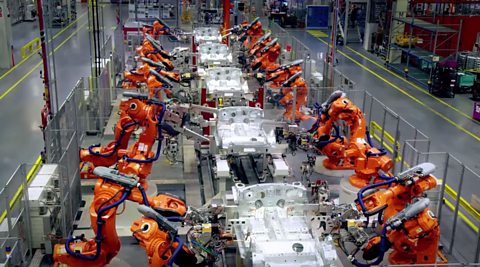
The Sunderland plant is the largest car manufacturing factory in Europe and annual production of 500,000 automobiles is capital intensive. The use of flow production, conveyor belts and robot arms is shown.
IT systems are used to ensure that each car is built to individual customer needs even though production flows on a conveyor belt. The production philosophy of lean production, developed by Toyota in the 1950s, is explained.
James then watches how cars are made from scratch, starting from rolled coils of mild steel sheets. It takes 24 hours to make one car.
Great care is taken to ensure that thousands of components arrive on the production line, exactly as they're needed. James discusses how individual bumpers appear just when needed with line supervisor, Ian.
Contrast is made between early 20th century manufacturing techniques where Henry Ford mass produced identical cars, and modern factories where individual cars are mass produced. The importance of people in raising productivity is emphasised.
For example, production manager Clare explains to James why building the right car at the right time is key, and how a control centre can remove a car for the production line that fails to meet quality standards.
Teacher Notes
Key Stage 4
Students might discuss the relative importance of labour and capital in the mass production of cars. What are the likely impacts of components failing to arrive at the right time on the production line? Students might undertake an investigation of automated and car washing facilities in the local region - how do price and quality of automated v hand washed options compare?
Key Stage 5
Potential topics of discussion include the relative importance of labour and capital in the mass production of cars. What are the likely impacts of components failing to arrive at the right time on the production line? Students might undertake research into productivity figures for car factories in different countries – what factors might explain differences in productivity between different car factories in different countries?
Curriculum Notes
This short film is suitable for teaching GCSE (KS4) / National 5 business.
Students and teachers over the age of 16 can create a free Financial Times account. For a Financial Times article about Toyota's supply chain from 2024, click here.
More Business with Steph McGovern:
Logistics, stock control and car manufacturing. video
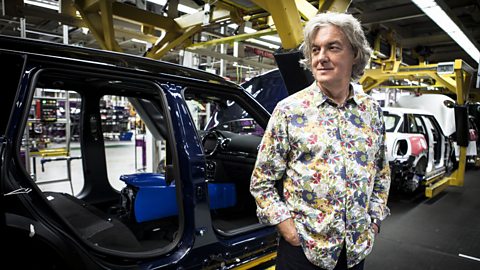
James May visits Mini in Oxford to investigate 'just-in-time' logistics.
The challenge of launching a new café video
Theo Paphitis advises a struggling café on how to adapt and survive.

Market research and new car design. video
Exploring how Nissan uses market research to make design decisions.

The challenge of running a theme park. video
Declan Curry investigates business strategies used by Pleasure Island, a family owned theme park in Cleethorpes.

Kaizen - new ideas to improve productivity. video
How workers at Toyota come up with new ‘kaizen’ ideas every month.
Robots and automation in car manufacture. video
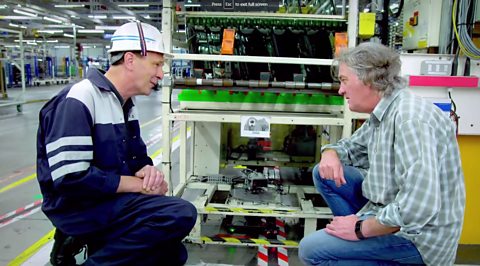
James May finds out how dancing robots are used to make Minis.
The rise and fall of Sunny Delight. video
Evan Davies explores why Sunny Delight took the market by storm but soon faded away.

How to market a new cereal. video
How Kellogg’s use marketing to launch a new product.