ARCHIVE:
Speaking
VO:
At his trial in Jerusalem in 1961, Nazi war criminal Adolph Eichmann looked every bit the smart professional, in his sharp suit, studious spectacles and rigorous manner.
But did this cold correctness conceal a ruthless character.
DAVID CESARANI:
At one point Eichmann said, “I delivered them to the butcher”. And by that he meant I wasn’t responsible for the mass shootings in Russia, I wasn’t responsible for the extermination camps, but I was responsible for registering Jews, for rounding them up, for getting them on the trains, for transporting them across Europe to places where they would be unloaded and murdered within an hour.
ARCHIVE:
Hitler rallying.
VO:
In the 1930s, before the outbreak of the Second World War, Eichmann was a senior figure in the Security Service of the Nazi Party in Germany, with responsibility for what was described as “de-Jewification” of the country. From 1939 onwards, as perception of the Jews in Nazi Germany changed, so the policy of forced migration changed over time to one of extermination.
DAVID CESARANI:
Eichmann and the men around him believe they’re in a war to the death, it’s them or us. We exterminate the Jews or they exterminate us. The Jews were the enemy. They were a global power involved in a great international conspiracy against the German people and the Aryan volk, the Aryan people.
VO:
Six million Jews – about two thirds of the Jewish population of Europe – died in the systematic programme of state-sponsored mass murder that followed. Almost half of these were killed in extermination camps.
The remainder in ghettos that isolated Jews from non-Jews across the continent. By mobile killing squads and by the forced movement of prisoners.
Eichmann was blamed for it all.
EICHMANN TRIAL. HAUSNER:
After everything had been rung out of them. That he was the one who planned, initiated and organised or instructed others to spill this ocean of blood.
VO:
Eichmann’s defence: he was an unfortunate middle ranking officer in state security, responsible solely for the transportation of Jews.
ARCHIVE:
Eichmann speaking
DAVID CESARANI:
He depicted himself as hapless, as – as someone who really had no choice in the matter. He wasn’t making up the policy, he was simply implementing it and it wasn’t up to him to question what the big bosses, as he used to call them, had decided should be the fate of the Jews.
VO:
Through most of the trial, Eichmann sat and listened to proceedings, alone, unmoved, looking at times almost removed.
ARCHIVE:
Eichmann: I could never had anticipated when I joined the Nazi Party.
VO:
Under cross-examination, his responses were detailed – very detailed.
ARCHIVE SYNC:
Eichmann speaking
DAVID CESARANI:
Eichmann’s defence lawyer told him be boring. Be bureaucratic. Be pedantic. You don’t want to look a slavering monster who wants to grab Jews and tear them limb from limb, you want to present yourself as a sort of middle manager, a rather harassed bureaucrat. That you’re dealing with genocide is something that should be as far away from your expression of your concerns as possible.
VO:
At trial, Eichmann and the wider world was exposed to the horror of Nazi murder when films shot at the time of the liberation of the concentration camps were shown to the court.
ARCHIVE:
Someone asking Eichmann a question.
VO:
Cross-examined for fifty hours, Eichmann’s defence finally buckled.
ARCHIVE:
Had been told by the… No if the Fuhrer had been told that he was. Would you have shot him?
Eichmann answering (Speaking German)
Prosecutors demonstrated that he threw himself into tasks with fervour. He seized the initiative. He had a choice.
DAVID CESARANI:
If there was one moment, it was the moment when the court heard that he had told his colleagues in Berlin in the last weeks of the war that if he was going to have to jump into his grave he would jump into his grave gladly knowing that he was taking five million Jews with him. Now, that disrupted any image people had of him as someone who just took orders in a rather mindless way. And I think after that for him there was – there was no going back, there was no getting him out of that.
VO:
On 11 December 1961, the three judges at trial presented their 211 page judgement. It took them fifteen hours to read. Eichmann was guilty of crimes against the Jewish people, against humanity, against Slovenes, Poles and Gypsies, guilty of war crimes– and he was sentenced to death.
Video summary
The televised trial of Adolf Eichmann brought to a global audience many of the previously unknown horrors of the Holocaust.
And on 11th December 1961, Eichmann, sitting impassive and unemotional, was pronounced guilty of all charges against him and sentenced to death.
But how far can responsibility for the Holocaust be attributed to Eichmann? Was it right to blame Eichmann for it all?
This short film explores the background to the Nazi paranoia about a Jewish conspiracy to take over Germany and Eichmann's responsibility for the 'de-Jewification' of Germany leading up to World War Two.
Historian, Professor David Cesarani examines the evidence, analysing how Eichmann presented himself as hapless, with no choice, following orders, and it was not for him to question the instructions of the ‘big bosses’.
However, he eventually gave away his personal hatred for the Jewish people under the pressure of cross-examination.
This short film is from the BBC series, The Eichmann Show.
Due to the sensitive nature of the subject matter, we strongly advise teacher viewing before watching with your pupils.
Teacher Notes
Nazi bureaucrat, Adolf Eichmann, organised the killing of thousands, without a sense of its wrongness. And his defence was reasonably straightforward: Adolf Eichmann was sincere in thinking his acts were defensible – following orders, inability to ignore his superiors, what could he have done otherwise, etc.
Possible questions for class:
- Did Eichmann believe he had a reasonable chance of being found innocent by the court?
- Once in Israel, why did Eichmann cooperate in the judicial process?
- Were the three judges presiding over the Eichmann trial likely to give him a fair trial?
- Why did the United Nations vote to accept Israel's right to keep Eichmann and put him on trial?
- Discuss the sentence handed down to Eichmann. Would there have been any value in giving him a life sentence?
- The trial of Adolf Eichmann in 1961 was at a time when many Nazi war criminals were still on the run from justice. Is there any value in continuing to search for Nazi war criminals in the 21st century? Is there a value in putting old men, or women, on trial?
This short film will be relevant for teaching history. This topic appears in OCR, Edexcel, AQA, WJEC KS4/GCSE in England and Wales, CCEA GCSE in Northern Ireland and SQA National 4/5 in Scotland.
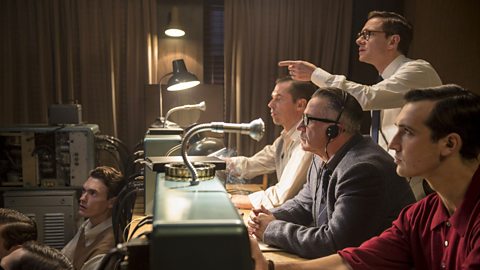
Adolf Eichmann: Architect of the Holocaust. video
Using a combination of archive footage, dramatisation and interviews with people involved in the television production and the trial, this short film introduces students to the groundbreaking trial of Adolf Eichmann.
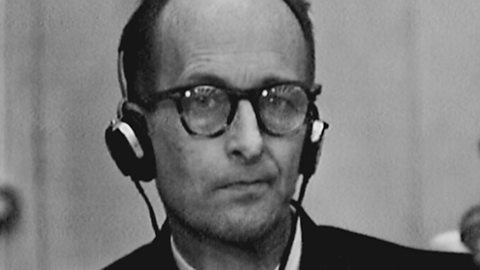
How Adolf Eichmann's trial revealed the horrors of Auschwitz. video
Historians and witnesses explain how the Adolf Eichmann trial was a turning point for Holocaust survivors who found that their testimonies were being taken seriously for the first time.
The Eichmann trial and the State of Israel video
The trial of Adolf Eichmann was an important moment in the development of the State of Israel which was just 13 years old in 1961.
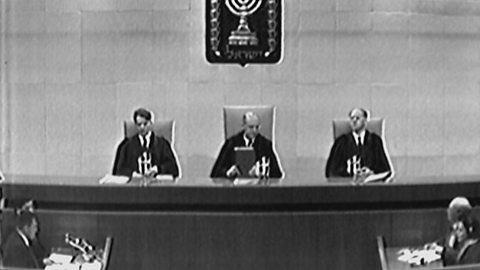
Managing evidence and the challenge of recording the trial of Adolf Eichmann. video
The trial of Adolf Eichmann in 1961 was the first documentary television series to be broadcast around the world. It was a ground-breaking moment and revealed the tragedies of the Holocaust and the deaths of some six million Jews.