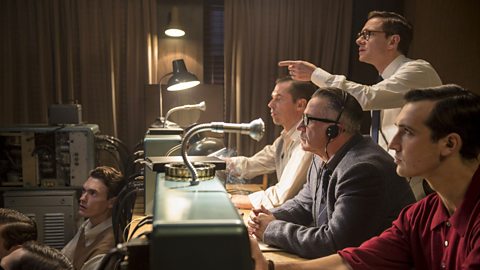
EXTRACT REPORTER AT COURT HOUSE:
I am standing in front of the building when in only a few hours time, what has been described as the trial of the century will begin. And the eyes of the world will fall upon Adolph Eichmann, the Nazi responsible for organising the mass murder of six million European Jews…
VO:
On April 11, 1961, former Nazi Obersturmbannführer Adolph Eichmann of the German paramilitary organisation known as the SS, entered the District Court of Jerusalem to be tried by the Government of Israel.
Eichmann had been a Senior State official in Germany during the Second World War.He was in charge of the forced movement of millions of Jews across the continent of Europe. Many were transported and killed in concentration camps.
One of the survivors of the camps and a witness at the Eichmann trial was Yehuda Bacon. At the age of fourteen, Bacon had been an inmate of Auschwitz.
SYNC YEHUDA BACON:
There was this very famous glass cell where they put in Eichmann. He couldn’t look longer than a very short time. He didn’t want to look into my eyes.
EXTRACT FROM TRIAL YEHUDA BACON TESTIMONY:
The Commander took pity on us. Children it’s very cold outside, perhaps you can get warm in the gas chambers.
VO:
The trial of Adolph Eichmann was recorded for television and shown in thirty-seven countries.
DRAMA:
Stay in close on Eichmann.
VO:
It was the world’s first global TV documentary series.
DRAMA SYNC:
Camera one on the judge’s bench.
VO:
A member of the production team who sat in the control room was Alan Rosenthal. He was just twenty-one years old at the time.
ALAN ROSENTHAL:
When I came into the Gallery and looked at him, a man in a black suit, quite tall rather scrawny rat-like fellow, thin-faced, twitching eyes, gestures that he was trying to control.
VO:
The trial of Eichmann lasted four months.
ARCHIVE:
Hitler speaking.
VO:
A committed member of the Nazi party, in 1933 Eichmann was appointed head of the Department of the SS responsible for Jewish affairs.
In 1942, the policy of the German state towards the Jews in all the territory that they controlled changed dramatically. A policy of forced migration became one of mass murder.
ARCHIVE:
Gabriel Bach speaking at the Trial.
VO:
Gabriel Bach was deputy prosecutor at Eichmann’s trial.
GABRIEL BACH:
The Gestapo, the SS and the Nazi regime. The only one who was kept all during the war as Head of the Jewish Department of the SS was Eichmann.
VO:
In court, Eichmann was accused of helping to organise the mass murder of millions of Jews. A programme of murder that cost the lives of some 1.5m children. The charge sheet reflected the deep hatred Eichmann felt for the Jews – a remarkable hatred noticed even by his fellow officers.
GABRIEL BACH:
I was sitting in my office in this prison and I was reading the autobiography of Rudolph Hess, he was the commander of Auschwitz. Hess explained when I and my colleagues had to push the children into the gas chambers, my knees were getting a bit wobbly. But I was always afterwards ashamed of this weakness of mine because Eichmann explained to us that it was especially the Jewish children that had to be killed first. He says because where is the logic that you kill a generation of older people and you leave alive a generation of possible avengers who can afterwards create that race again.
VO:
In his glass box, Eichmann’s manner was lifeless and unemotional. His voice: sharp and high-pitched.
ARCHIVE:
Eichmann speaking at trial.
VO:
These traits made it hard for people at the time to read his mind – and form part of the living memory of people today who were involved in the Trial.
ALAN ROSENTHAL:
When you looked at him, of course you wondered what was he thinking. You were wondering who is this man. What’s going through his mind?
YEHUDA BACON:
For me, it was a question of how could such an evil arise and get so much power? He can do everything. Kill, do this do that. Our generation has to tell of the abyss which is in my opinion in every human being.
ALAN ROSENTHAL:
Who is Eichmann? What really was this man and how on earth could this situation of the Holocaust come about? Those are the questions that start off from the trial that go with you forever, not just on a day or a week, but are totally resounding with you. How could this happen? How could people behave that way?
Video summary
Using a combination of archive footage, dramatisation and interviews with people involved in the television production and the trial, this short film introduces students to the ground-breaking trial of Adolf Eichmann.
The trial was the first global television documentary series, as each day, a summary of the trial was flown to 37 countries. The Eichmann trial shed light on the horrors of the Holocaust for millions around the world for the first time.
Alan Rosenthal, who was just 21 when he worked on the television production, discusses his memories of Eichmann and the intense atmosphere of the trial.
Gabriel Bach, deputy prosecutor at the trial, explains that Eichmann was charged with causing 'the mass deportation of Jews to death camps and their murder' and how the policy of the forced migration of six million Jews became 'The Final Solution'.
This short film is from the BBC series, The Eichmann Show.
Due to the sensitive nature of the subject matter, we strongly advise teacher viewing before watching with your pupils.
Teacher Notes
Why is Eichmann so unknown in Holocaust histories? Using this short film and a variety of sources and images, students can build up a picture of Adolf Eichmann.
It is important to use material from pre, during and post World War Two so that students can assemble a chronological narrative as well as points that highlight key episodes in Eichmann’s life.
This short film will be relevant for teaching history. This topic appears in OCR, Edexcel, AQA, WJEC KS4/GCSE in England and Wales, CCEA GCSE in Northern Ireland and SQA National 4/5 in Scotland.
How far can one person be held responsible for the Holocaust? video
On 11th December 1961, Adolf Eichmann was pronounced guilty of all charges against him and sentenced to death. But how far can responsibility for the Holocaust be attributed to one man?
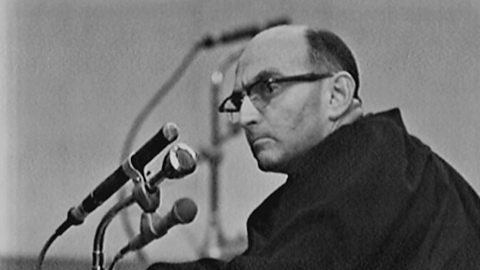
How Adolf Eichmann's trial revealed the horrors of Auschwitz. video
Historians and witnesses explain how the Adolf Eichmann trial was a turning point for Holocaust survivors who found that their testimonies were being taken seriously for the first time.
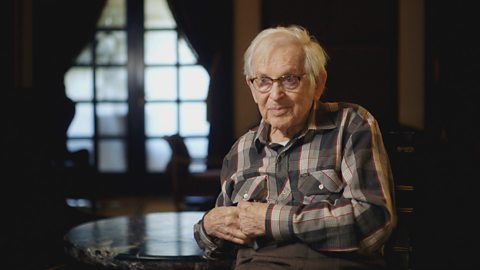
The Eichmann trial and the State of Israel video
The trial of Adolf Eichmann was an important moment in the development of the State of Israel which was just 13 years old in 1961.
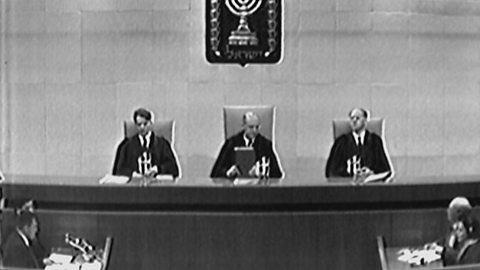
Managing evidence and the challenge of recording the trial of Adolf Eichmann. video
The trial of Adolf Eichmann in 1961 was the first documentary television series to be broadcast around the world. It was a ground-breaking moment and revealed the tragedies of the Holocaust and the deaths of some six million Jews.