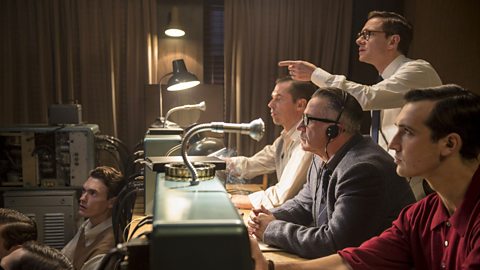
ARCHIVE:
I felt him take the child from my arms. The child cried out and was shot.
DRAMA:
Leo: “Get close on his eyes…get close on his eyes…”
VO:
With statements from over a hundred witnesses and consideration of 16000 documents, the prosecution took fifty-six days to make it’s case in the trial of Nazi war criminal, Adolph Eichmann, in Jerusalem, 1961. It was a comprehensive record of what was described at the time as “a gigantic human and national disaster”.
DAVID CESARANI:
Gideon Hausner, the Attorney General of the State of Israel, in his opening address, said “I am speaking in the name of six million who are not here to accuse you because you killed them.” So that was the main thrust of the prosecution.
VO:
Eichmann had been an important figure in the Nazi regime of Adolph Hitler in Germany. He had been responsible for managing the deportation and forced migration of Jews from their homes, right across the continent of Europe.
When Germany was defeated by the Allied powers in 1945, Eichmann escaped into hiding in Argentina, South America, taking the name, Ricardo Klement. Investigators tracked him down and in 1960 he was snatched by secret agents and brought to Israel to be tried for his crimes against humanity.
ARCHIVE:
Question: Do you know now what these trucks were? Answers: Yes, now I know what they were. They were trucks where people were locked up inside and where gas was piped into the trucks.
YEHUDA BACON:
The survivors were very happy that somebody showed an interest in them. Before that nobody really took a serious interest in us.
VO:
At the trial, Yehuda Bacon shared his experience of the extermination camp of Auschwitz and the suffering and humiliation of those selected for murder in its eight gas chambers. Bacon was fourteen years old at the time.
YEHUDA BACON:
There were people who didn’t know what it is and where they were going - nothing….the SS told them hurry up, where you put your clothes, put your shoes nicely together, there’s soup and coffees waiting for you. And they went in and then what they saw, they saw a shower. It has no holes. So there was a shower, only to bluff you in the first minute… People who were cripples – I mean who had artificial legs and so on and so forth – there was a kind of slide and they would throw the people and they landed just before the gas chamber.
VO:
Auschwitz, Treblinka, Belzec, Sorbibor and Chelmno, were some of the most important extermination camps listed in the indictment of Eichmann. Chief Prosecutor Hausner’s assistant remembers the testimony of one camp survivor in particular – a memory made famous by the feature film Schindler’s List. The survivor had been deported by freight train from Hungary to Auschwitz in May 1944 with his wife, twelve-year old son and two and a half year old daughter.
GABRIEL BACH:
The SS Commander when he came there… he sent his wife to the left clearly that went to the gas chambers….the little girl to the left…and your son….your son run after your mother…and the witness said I looked my wife was swallowed up in the crowd, I couldn’t see her any more…and my son was swallowed up I couldn’t see him…but my little daughter, she had a red coat. And that little red dot, getting smaller and smaller, this is how my family disappeared from my life. Now I heard this for the first time and my little daughter was exactly two and a half years old and I had bought her a red coat two weeks before that and when I heard the witness say this, it cut off my voice completely. I suddenly couldn’t utter a word. The television was on me and I started playing with my documents for perhaps two or three minutes –
ARCHIVE:
Gabriel Bach speaking in court.
GABRIEL BACH:
That was a feeling that hasn’t left me until this very day.
ALAN ROSENTHAL:
There was one witness who summed up everything for me… His name was Yehiel Dinur and on the stand he was asked to describe Auschwitz. And he said for us Auschwitz was like another planet.
ARCHIVE:
If I, out of this planet of Aushwitz.
ALAN ROSENTHAL:
Auschwitz was another dark, malevolent planet casting its evil shadow on the earth. And he said this…and then he collapsed on the stand.
Video summary
Over 100 witnesses, 16,000 documents and 56 days of prosecution evidence were presented against Adolf Eichmann at his trial in Jerusalem.
Historian, Professor David Cesarani discusses the power of the opening statement by the lead prosecutor, Gideon Hausner, who stated:
“I am speaking in the name of six million who are not here to accuse you, because you killed them.”
This, Professor Cesarani points out, was the main thrust of the prosecution's argument against Eichmann.
Yehuda Bakon, who survived Auschwitz, recalls how the trial was a turning-point for survivors who now found that their experiences and testimony were being taken seriously for the first time.
This short film is from the BBC series, The Eichmann Show.
Due to the sensitive nature of the subject matter, we strongly advise teacher viewing before watching with your pupils.
Teacher Notes
Ask students to locate evidence about Eichmann's personal involvement with deportations.
The journalist Hannah Arendt, who attended the trial, claimed that Eichmann was a formal and hard-working bureaucrat whose work was genocide.
Evidence of Eichmann the ‘evil man’ is difficult to locate in the trial papers, however, events in Hungary in 1944 and the deportation of 437,000 Jews from ghettos to Auschwitz-Birkenau was not done from Eichmann’s desk in Berlin. He travelled personally to Hungary to supervise.
Students can use various sources to learn about how, in a matter of hours, Jews were selected, absorbed, processed and murdered. Using photographs and witness testimonies, students could build up an understanding of how industrialised murder took place in order to understand the wider role played by faceless administrators like Adolf Eichmann.
This short film will be relevant for teaching history. This topic appears in OCR, Edexcel, AQA, WJEC KS4/GCSE in England and Wales, CCEA GCSE in Northern Ireland and SQA National 4/5 in Scotland.
Adolf Eichmann: Architect of the Holocaust. video
Using a combination of archive footage, dramatisation and interviews with people involved in the television production and the trial, this short film introduces students to the groundbreaking trial of Adolf Eichmann.
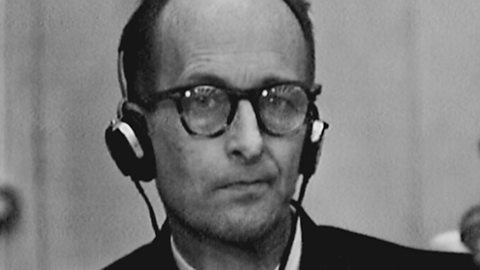
How far can one person be held responsible for the Holocaust? video
On 11th December 1961, Adolf Eichmann was pronounced guilty of all charges against him and sentenced to death. But how far can responsibility for the Holocaust be attributed to one man?
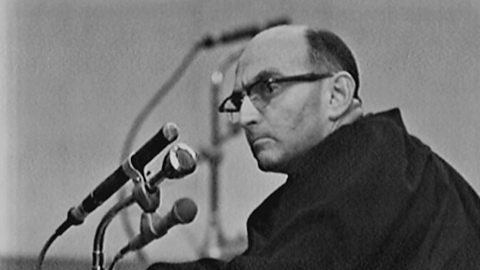
The Eichmann trial and the State of Israel video
The trial of Adolf Eichmann was an important moment in the development of the State of Israel which was just 13 years old in 1961.
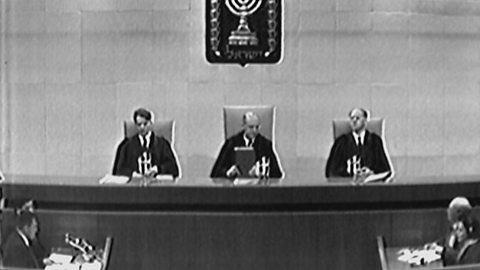
Managing evidence and the challenge of recording the trial of Adolf Eichmann. video
The trial of Adolf Eichmann in 1961 was the first documentary television series to be broadcast around the world. It was a ground-breaking moment and revealed the tragedies of the Holocaust and the deaths of some six million Jews.