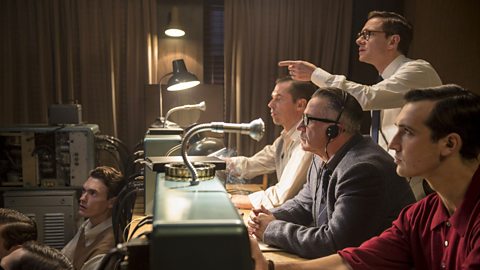
VO:
The trial of Adolph Eichmann was a key moment in the development of the State of Israel. It opened a new chapter in the country’s history just twelve years after the War of Independence ended in 1949.
ARCHIVE:
Man shouting
GABRIEL BACH:
I’ll never forget the first moment of that trial when these judges came into the courtroom with the emblem of Israel behind them and that man who’s only object in life had been to destroy that people when he stood up to attention before a sovereign Jewish nation and southern state….the importance of the creation of the State of Israel suddenly became clearer to me.
VO:
The trial was intentionally framed to influence public opinion, to raise awareness of the scale of the murder of Jews.
ARCHIVE:
Prosecutor; But it was his word that put gas chambers into action. He lifted the telephone and railroad carts left to extermination centres.
DAVID CESARANI:
Gideon Hausner made it appear as though there were only two Adolph’s responsible for the destruction of the Jewish people during the Second World War: Adolph Hitler and Adolph Eichmann, with almost nothing and no one in between. So it was an extraordinarily powerful case.
ARCHIVE:
Witness speaking
VO:
It had taken some six months to carefully select 112 survivors to testify at the trial - for maximum impact upon the viewing public.
WITNESS ESTHER GOLDSTEIN:
Esther: The SS man came up. He took the baby from my sister’s arms and handed it over to my mother. Then he also took the five year old boy to my mother.
Proescutor: And they are no longer alive?
Esther: No.
Prosecutor: And no longer is your mother?
Ester: No.
VO:
In the words of an Israeli journalist who covered the trial for a national newspaper, “What had been silenced and repressed gushed out and became common knowledge.”
ARCHIVE:
Member of the audience shouting out.
VO:
Over eighty thousand Israelis attended court during the Trial and the stories of the atrocities that were shared shocked the world.
ARCHIVE:
‘One hundred and forty’ ….Speaking
VO:
At the heart of many of the testimonies lay the terrible truth about the largest extermination camp of all: Auschwitz.Prosecutor Gabriel Bach remembers the testimony of one survivor in particular.
GABRIEL BACH:
He was one of 200 children who were put in a gas chamber, the doors locked, …and then he described how the children began to sing in order to give themselves courage… and when at first nothing happened, the children began to shout and to cry. A train had arrived with potatoes, at Aushwitz, and there were not enough SS men to unload it. So the commander of the SS there, had the glorious idea…”Why not use one of the children to help unload the train, before they are killed.” So they opened the door, took out twenty of the nearest the door, he was one of those, and then they closed the door and the other 180 were killed right away.
DAVID CESARANI:
Auschwitz was a filthy, dirty place run by barbaric, sadistic, murderous men, in which the lives of ordinary human beings were made utterly miserable, tortured, humiliated before they were killed.
VO:
The recording of witness’ experience for television by producer Milton Fruchtman and his team, and its broadcast to audiences around the world, sharpened global understanding of Nazi murder as genocide and as a distinct chapter of history.
MILTON FRUCHTMAN:
We recorded over one thousand miles of videotape. Excerpts of the trial were sent to fifty-six countries throughout the world that had television. Eighty per cent of the German population had seen between thirty minutes and one hour of television excerpts of the Eichmann trial.
VO:
The accused also sought to influence public opinion through his appearance and manner in court. During extensive interrogation and cross-examination, he sought to portray himself as a particular kind of character.
ARCHIVE SYNC:
Eichmann speaking.
DAVID CESARANI:
Eichmann saw himself as a soldier, a warrior. He believed that he was an honourable man doing a difficult but important job. He was a good citizen, not a monster. And that’s what he wanted the world to understand and posterity to understand.
VO:
Influencing public opinion was central to the trial, for both the prosecution and Eichmann himself. But this was a judicial process; and if Eichmann failed in his defence, one fate awaited him: execution.
Video summary
The trial of Adolf Eichmann was an important moment in the development of the State of Israel which was just 13 years old in 1961.
The television broadcast was symbolic of how the balance of power had changed since World War Two, with a formerly powerful SS officer on trial in an Israeli court.
We hear from historian, Professor David Cesarani, who explains that this was the moment when two Adolfs were seen as responsible for the Holocaust – Adolf Hitler and Adolf Eichmann.
For many people around the world, this was their first introduction to the details of the Holocaust itself.
This short film is from the BBC series, The Eichmann Show.
Due to the sensitive nature of the subject matter, we strongly advise teacher viewing before watching with your pupils.
Teacher Notes
This short film could be used to stimulate a debate about the role of the Holocaust (1939-45) in the creation of the State of Israel (1948) and how this trial defined the existence and maturity of the state by 1961.
Possible questions for class:
How did the Holocaust change what it meant/means to be Jewish?
Eichmann and his role were not discussed at the Nuremburg Trials (1945-46). Why do you think this was the case?
This short film will be relevant for teaching history. This topic appears in OCR, Edexcel, AQA, WJEC KS4/GCSE in England and Wales, CCEA GCSE in Northern Ireland and SQA National 4/5 in Scotland.
Adolf Eichmann: Architect of the Holocaust. video
Using a combination of archive footage, dramatisation and interviews with people involved in the television production and the trial, this short film introduces students to the groundbreaking trial of Adolf Eichmann.
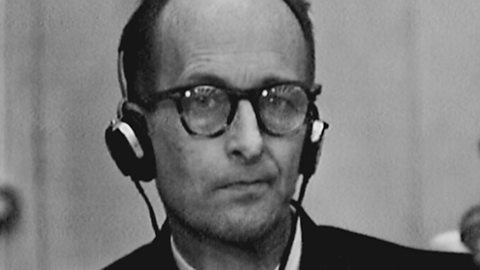
How far can one person be held responsible for the Holocaust? video
On 11th December 1961, Adolf Eichmann was pronounced guilty of all charges against him and sentenced to death. But how far can responsibility for the Holocaust be attributed to one man?
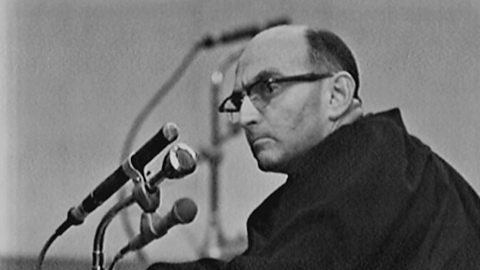
How Adolf Eichmann's trial revealed the horrors of Auschwitz. video
Historians and witnesses explain how the Adolf Eichmann trial was a turning point for Holocaust survivors who found that their testimonies were being taken seriously for the first time.
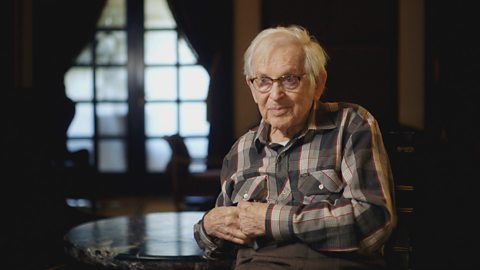
Managing evidence and the challenge of recording the trial of Adolf Eichmann. video
The trial of Adolf Eichmann in 1961 was the first documentary television series to be broadcast around the world. It was a ground-breaking moment and revealed the tragedies of the Holocaust and the deaths of some six million Jews.