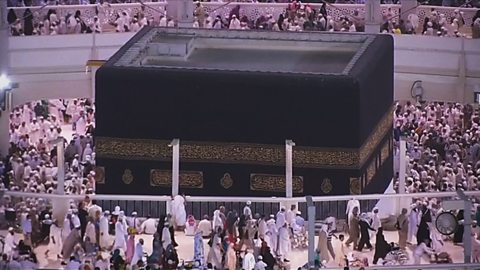
SARA: Muslims can pray anywhere. It doesn't have to be in a mosque. But no matter where you are in the world you always face towards the same place the Kaaba in the city of Mecca in Saudi Arabia. You just have to know which direction it is in.
KAISAN: If you are anywhere you can always pray. You just have two figure out the direction of Mecca. So you put a compass on the floor and check how many degrees it is. First action of prayer is your intention so you stand on the prayer mat and you think who are you praying to and what are you praying? And you raise your hands like this and then you say 'Allahu Akbar' and once you've said that you've started your prayer. When you are making the intention you are remembering that God is in front of you and is listening to you while you are praying. He can hear you and is listening and will respond. We do a set number of actions in a certain order. This is to unite your mind and soul and body all together. The first thing I say in my mind is:
HE RECITES PRAYER IN ARABIC
This means 'In the name of Allah the most gracious the most merciful.' There are 99 names of Allah. All of them they all describe him but one of my favourite names is probably Al-Khaliq which means The Creator. That really has a big impact on the way I live life and refer to him as because when you pray if you think he is the Creator you don't have any other doubts or anything you just know he is the Creator so he deserves to be prayed to.
SARA: When Muslims kneel down in prayer only the palms knees forehead and nose touch the ground. At the end of the prayer ritual we bless the two angels who keep an eye on us and everything we do. There is one angel on your right shoulder and one on the left. The angel that records the good deeds is on your right and the angel that records your bad deeds is on the left.
HE PRAYS IN ARABIC
You feel this kind of connection with Allah like you're talking to him.
HE PRAYS IN ARABIC
The morning prayer is really early in the morning so that can get a bit tiring but you shouldn't think 'Oh no it's prayer time.' You should think 'Yes it's prayer time! Now I can pray.' The feeling of everyone is doing the same thing and you are all praying to the same God in the same way in the same language. The way that you call a Muslim a brother and a Muslim lady a sister it is like you have a connection with everyone and you feel like all the Muslims are together and you are praying to one thing so it feels like really united.
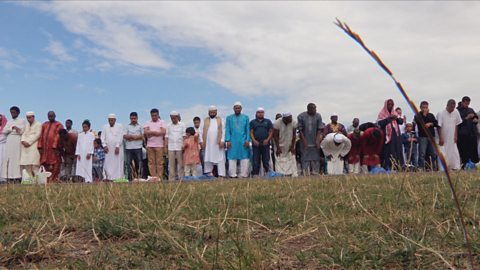
SARA: The prayer ritual is over 1400 years old. It is repeated five times a day by millions of Muslims like Kaisan all over the world.
Video summary
The Muslim prayer ritual is performed five times a day, always facing in the direction of Mecca.
Twelve-year-old Kaisan demonstrates his prayer positions and describes how praying gives him a feeling of connection to Allah, and to all the other Muslims around the world.
We see Muslims taking part all over the world - ask pupils to look out for people from different continents as they watch.
This is from the series: My Life, My Religion - Islam
Teacher Notes
Teach pupils, through the clip, why Muslims follow the second of their Five Pillars of faith every day by praying, and why it inspires them to say things like: 'When I pray, it reminds me to be thankful.
'In the prayer, I ask Allah to guide me. I believe he listens to every prayer.'
'I actually like to pray even in the early morning, because it reminds me of the most important things in life, and not to be selfish every day.'
These clips will be relevant for teaching Religious Education at KS2 in England, Wales and Northern Ireland and First and Second Level in Scotland.
Ramadan and Eid ul Fitr. video
Sara, aged 11, explains why fasting is good: for devotion to Allah, for self discipline and for sympathy for the poor, explaining her religious practice.
Being a young Muslim. video
A young Muslim girl from London called Sara introduces herself, her Muslim faith and her family.

The Hijab. video
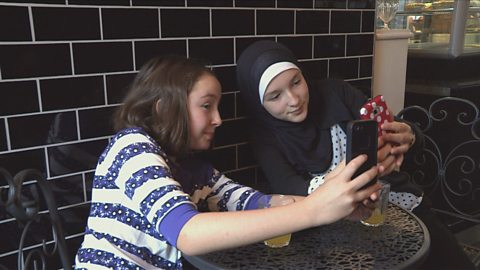
Sara, aged 11, has decided to start wearing the hijab as she begins secondary school. She explains why this matters to her and expresses her Muslim faith.
The Mosque. video
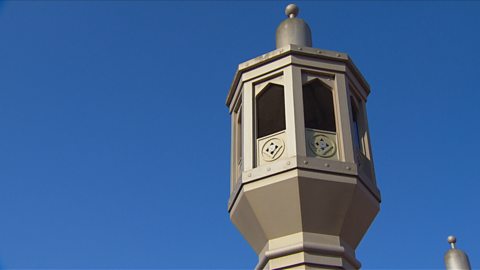
Kaisan, aged 12, shows us round the East London Mosque or Masjid, house of prayer.
The Qur'an. video
Kaisan and Naeem share ways that the Qur’an makes a difference to their lives.
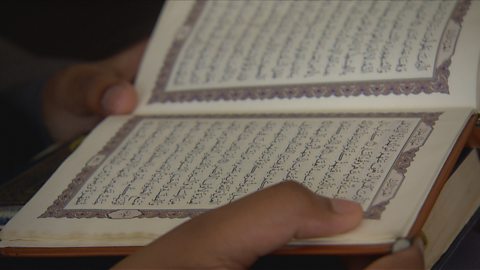
The washing ritual, 'Wudu' video
Before prayer, Muslims make sure they are clean, using the washing ritual - ‘Wudu’.
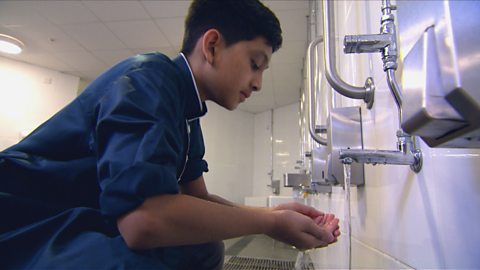
The Muslim pilgrimage, Hajj. video
Sara, aged 11, describes how the Hajj pilgrimage has an impact on Muslims.
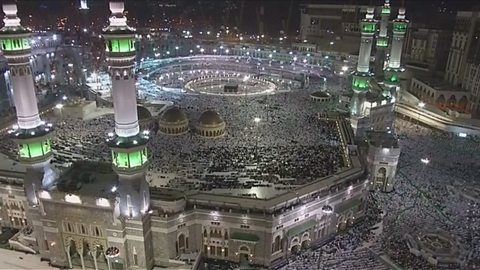
What is Islam? video
Young Muslim girl Sara gives a brief guide to the faith by describing the five Pillars of Islam: belief, prayer, giving, fasting and pilgrimage.