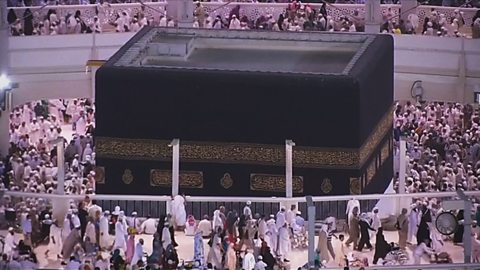
SARA: It's the month of Ramadan and I have been fasting for 21 days. That means no food or water during daylight hours. This is one of the Five Pillars of Islam so Muslims must do it if they can. The whole point of fasting is that you stop thinking about things like food and then you be a bit more spiritual. Fasting is supposed to teach us self-discipline and to remind us to think about other people around the world who are too poor to afford food. I am always snacking on things and when you do not eat food it just like makes you realise how other people feel - the people who do not have food. I do not have to fast until I am a bit older but this year I have been practising to show my devotion to God and my religion. When Ramadan falls in summer the days are really long. This year we cannot eat until nine o'clock at night.
MUM: This is shorba. It is a soupfrom Algeria where Dad is from.
SARA: Is it Algerian?
MUM: Yes. We traditionally always have shorba during Ramadan. OK can you pass me the chicken please? Thank you. We will put them in there for a bit. How many days have we fasted so far?
SARA: Erm… 20-something.
MUM: Doing all these days fasting your stomach tends to shrink. Even though you feel 'I am going to eat this I am going to eat that I can't wait for this I can't wait for that you cannot really eat much.'
CALL TO PRAYER
SARA: When the sun sets it is time to break our fast.
HE PRAYS
Ramadan falls on the ninth month of the Islamic calendar and lasts for around 30 days. It was during Ramadan all those years ago when the words of the holy book the Qur'an were first revealed by God. Ramadan is not just about fasting. Many Muslims spend more time praying and reading the Qur'an and almost all try to give up bad habits. The end of Ramadan is marked with one of the most holy festivals of the year.
It's currently half past one in the morning. Eid tomorrow so we are excited for that. Bye!
COCK CROWS
SARA: At Eid al-Fitr Muslims all over the world get together to pray and party like at these festivals in London. Eid is the best!
We are here today celebrating a Muslim celebration called Eid. There is a funfair and I am not sure what ride to go on. I am just going to go on the bumper cars. But Eid is also a time to reflect and feel close to God. It is thanking God for havingthe strength to do the fast thanking God for that opportunity and for his forgiveness because forgiveness and salvation are things upon great acts of worship… It's something we expect. The most profound form of gratitude to God is prayer right?" So we begin our gratitude with prayer.
HE PRAYS
And the rest of the day is about family. It is about eating lots of food especially at Eid al-Fitr after a month of hunger right?!
Video summary
Eleven year old Sara is a Muslim from London whose ambition is to be a fashion designer.
She introduces us to her life and family using her own video camera.
She is going without food during daylight hours because it is the Islamic fasting month of Ramadan.
Her dad (who's from Algeria, a Muslim majority country), mum, and brother and sister pray at home with her.
This is from the series: My Life, My Religion - Islam
Teacher Notes
Pupils could note six facts about Sara, and draw them onto a bubble diagram.
They could then make a similar one for themselves, to help pupils describe their own identity and community life in relation to the Muslim identity shown in the series.
A more ambitious idea could enable pupils to video themselves and create 90 second films which express their own identity in the same kind of way that Sara has done.
They might refer to their pets, sports, family, home, school and beliefs.
These clips will be relevant for teaching Religious Education at KS2 in England, Wales and Northern Ireland and First and Second Level in Scotland.
Being a young Muslim. video
A young Muslim girl from London called Sara introduces herself, her Muslim faith and her family.

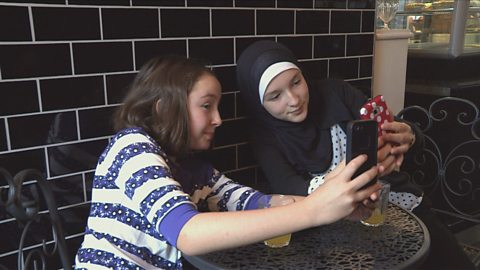
The Hijab. video
Sara, aged 11, has decided to start wearing the hijab as she begins secondary school. She explains why this matters to her and expresses her Muslim faith.
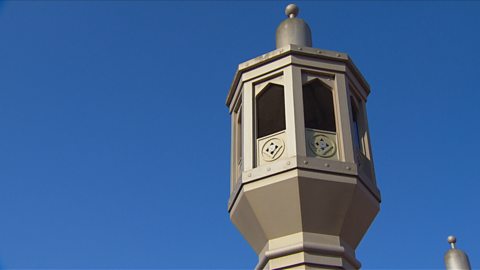
The Mosque. video
Kaisan, aged 12, shows us round the East London Mosque or Masjid, house of prayer.
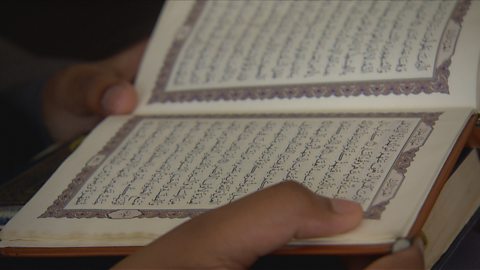
The Qur'an. video
Kaisan and Naeem share ways that the Qur’an makes a difference to their lives.
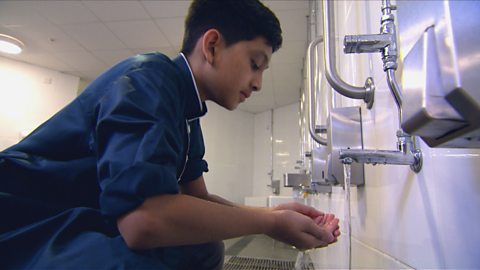
The washing ritual, 'Wudu' video
Before prayer, Muslims make sure they are clean, using the washing ritual - ‘Wudu’.
Prayer in Islam. video
Kaisan, a 12 year old British Muslim boy, explains how he prays five times a day, and says what it means to him in spiritual terms.

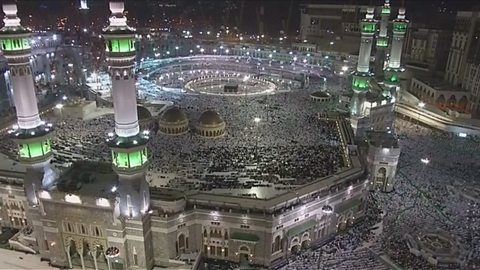
The Muslim pilgrimage, Hajj. video
Sara, aged 11, describes how the Hajj pilgrimage has an impact on Muslims.
What is Islam? video
Young Muslim girl Sara gives a brief guide to the faith by describing the five Pillars of Islam: belief, prayer, giving, fasting and pilgrimage.