Hi my name's Kaisan. I'm with the filming crew in my kitchen in my house.
SARA: Kaisan lives in East London. He and his mate Naeem try to live by the teachings of the Muslim holy book the Qur'an. This is my best mate Naeem.
Hi I'm Naeem and I love football.
We do a lot of stuff together. We play together we do our work together.
NAEEM CHANTS
SARA: They're 12 years old and have been learning the Qur'an for more than five years. Naeem has memorised about 14 chapters. That's almost half and it's all in Arabic.
CHANTING CONTINUES
Well done. You've only got like one mistake here so that's all you had to fix.
SARA: Muslims believe God has sent many messengers to people over the centuries to guide us and teach us how to follow the one true God. Muhammad was the last and final prophet. Muhammad was a spiritual man who lived in Mecca more than 1400 years ago. One night he was meditating in a cave on the mountains when he was visited by the Angel Gabriel also known as Jibreel who began to reveal messages from Allah. The Angel Jibreel he gave a revelation to him. Allah told the angel to go to him and reveal bits of the Qur'an to him so he would spread the word to other people.
SARA: The words were remembered and recorded in the Qur'an. They are the basis of Islam and teach Muslims how to follow the one true God.
KAISAN: In the Qur'an you have like little things that kind of make a big difference like little lessons that we learn - don't lie or speak nicely to your parents so we try to learn this stuff and these characters from our prophet.
SARA: It's important to learn the Qur'an in the original Arabic it was written in but you can understand the main messages through English translations.
Give thanks to Allah. Whoever gives thanks does so for the good of his own soul - meaning thank God for all the good things in life. Whoever brings God a good deed will receive ten times as much - meaning we believe God rewards our good deeds. You believers don't say one thing and do another. That is most hateful in the sight of God to say one thing then do the opposite - meaning in Islam living out what you believe matters. You must be clean to handle the Qur'an and out of respect never leave the Qur'an on the floor. The Qur'an to me is like really important because it's the words of God and Islam is a way of life. It's not only religion but it tells you how to live life. Things like little lessons that we learn and stuff like manners and stuff. These things come from the Qur'an. So we can learn these lessons and we can implement it in our life.
Video summary
Kaisan and Naeem are 12-year-old Muslim boys from London.
They are studying their holy book the Qur'an, which they know parts of by heart in Arabic.
We hear how Muslims believe the prophet Muhammad was visited by the angel Gabriel (or Jibril) in the desert near Mecca over 1400 years ago.
The angel gave him messages from God that formed the basis of the Qur'an.
The book teaches Muslims how to live good lives and follow God.
The book is kept on a high shelf above other books, and the boys wash before handling it, to show their respect for the word of God, or Allah.
This is from the series: My Life, My Religion: Islam.
Teacher Notes
Scriptures or holy books in different religions often have a lot in common.
Arrange a comparison between the Qur'an and the scriptures of another religion (good examples include the Jewish Torah, the Sikh Guru Granth Sahib, the Christian Bible).
Do the different scriptures: tell stories / give laws / explain what God is like / give advice / inspire people to be the best they can be? Do they teach the same or different ideas?.
These clips will be relevant for teaching Religious Education at KS2 in England, Wales and Northern Ireland and First and Second Level in Scotland.
Being a young Muslim. video
A young Muslim girl from London called Sara introduces herself, her Muslim faith and her family.

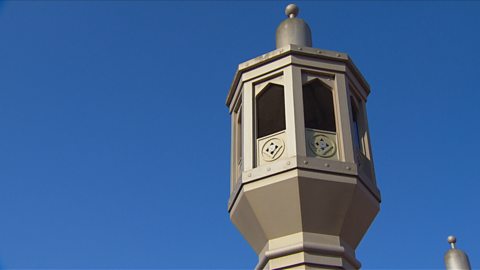
The Mosque. video
Kaisan, aged 12, shows us round the East London Mosque or Masjid, house of prayer.
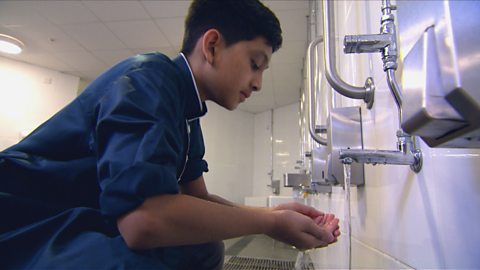
The washing ritual, 'Wudu' video
Before prayer, Muslims make sure they are clean, using the washing ritual - ‘Wudu’.
Prayer in Islam. video
Kaisan, a 12 year old British Muslim boy, explains how he prays five times a day, and says what it means to him in spiritual terms.

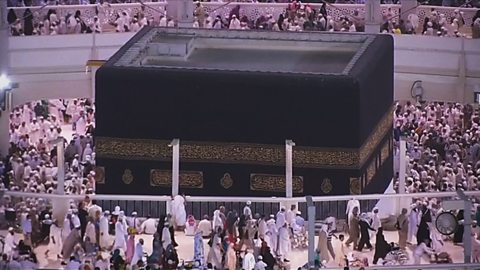
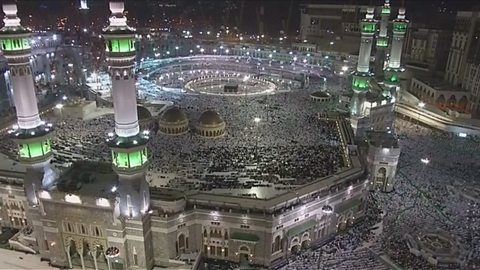
The Muslim pilgrimage, Hajj. video
Sara, aged 11, describes how the Hajj pilgrimage has an impact on Muslims.
Ramadan and Eid ul Fitr. video
Sara, aged 11, explains why fasting is good: for devotion to Allah, for self discipline and for sympathy for the poor, explaining her religious practice.
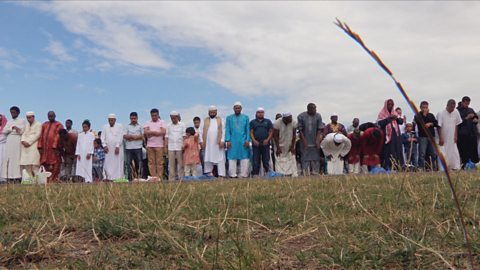
The Hijab. video
Sara, aged 11, has decided to start wearing the hijab as she begins secondary school. She explains why this matters to her and expresses her Muslim faith.
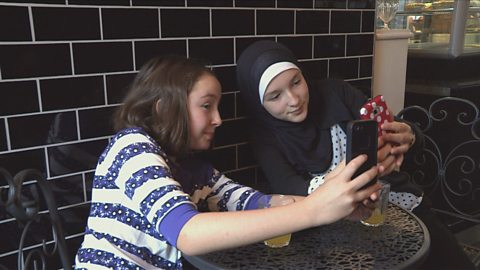
What is Islam? video
Young Muslim girl Sara gives a brief guide to the faith by describing the five Pillars of Islam: belief, prayer, giving, fasting and pilgrimage.