Deep inside your head is a remarkably beautiful structure. A maze of tunnels and caverns submerged in fluid. These are the semicircular canals and the cochlea, which are part of your inner ear. They are crucial for both your balance and hearing.
When sound hits your ear, it sets off a wonderful chain of events. It enters as pressure waves, which push and pull your eardrum, making it vibrate. On the other side of the eardrum, slowing time allows us to see how these vibrations set a series of bones jiggling. They end with the smallest bone in your entire body, called the stirrup. It is smaller than a grain of rice. These bones transmit the vibrations to a sensitive area called the oval window. They also protect your ear. If a sound is too loud, they pull the stirrup away from the most sensitive parts. Temporarily at least, you go a bit deaf, but the rest of your ear is protected.
Beyond the stirrup is a liquid-filled cavern called your cochlea. The sound waves enter the water, tickling clumps of tiny hair-like sensors on the floor, which begin to dance to the sound of the world outside. Thousands of clusters of hair cells each pick out a different part of the sound. Each sends a tiny piece of information to your brain, where it's interpreted so you can make sense of the sounds around you. The ear has evolved to be most sensitive to the sounds of another voice, allowing your brain to tune in to the words of another human.
But your ear doesn't just allow you to hear. It also plays an essential role in allowing you to walk. For you to take just one step, your brain has to coordinate the precise movement of over 100 different muscles, bones, and tendons. And there is a place where people learn to walk sooner than anywhere else on Earth.
This is Koarmba. She is mother to a baby girl called Kossini. They live in Rhumsiki, a tiny village in the remote northern highlands of Cameroon. Here, most mothers believe in actively teaching their babies to stand and walk, to get them off their backs as soon as possible. And it works. These people have trained their brains to find their feet much earlier than you. Ever since Kossini was a month old, her mother has repeated the ancient ritual of katete, which means "to make jump." Every day, she takes hold under the arms and bounces her. This daily encouragement helps the gradual development into mature walking.
But before you can stand up for any length of time, your brain must learn to understand the orientation of your body, and that's why your inner ear is so important. The semicircular canals that form three twisting tunnels inside your ear are all oriented in a different direction. In each lies a saddle-topped fleshy mountain known as your crista. The mountain's slopes are covered in a thick forest of tiny hair cells. For the moment, they lie still, waiting. But this inner sea never remains calm for long. Because every now and then, there's a tsunami. A shockwave races through the tunnel and pummels the mountain. On its flanks, the hair cells are thrown about in the turbulent waters. The pressure builds until electricity flows, creating a powerful electrical current.
Every time your head moves, the hair cells are thrown about inside one or more of the canals. And in a fraction of a second, electrical impulses are fired straight to your brain. The feeling that emerges is your sense of balance. To walk, your brain has to learn to sense when you are over-balancing to one side and then instruct your leg to bring your weight back to the centre. All of this happens within a fraction of a second. To begin with, it's a real struggle. But Kossini's half-brother is already a master of bipedalism. And he is just ten months old. From now on, and for the rest of his life, walking will be automatic.
The amazing construction of your ear allows you to both sense and explore the planet you inhabit.
Video summary
This short film provides a journey into the ear, looking at hearing and balance, plus a real-life example of how the ear helps us to walk.
Key processes are shown, including the movement of ossicles against the oval window and the way that the semi circular canals sense orientation.
The 3D visuals are placed alongside real-life footage of a child learning to walk.
This short film is from the BBC series, Inside the Human Body.
Teacher Notes
As they watch this short film, students could keep a note of all the parts of the ear and create a diagram explaining each stage of the process.
An active demonstration of the vibrations travelling through the ear could be created in the classroom, with students lined up acting as different parts of the ear, then a vibration being transferred via movements down the line to reach the brain.
With regards to balance, students could perform exercises that disrupt their sense of balance, such as spinning around a certain number of times, and relating the unbalanced sensation afterwards to what is happening inside the ear at a cellular level.
This could be discussed in terms of confusion between different sensory information.
This short film will be relevant for teaching biology at KS3 and KS4/GCSE in England, Wales and Northern Ireland and National 4/5 in Scotland. Appears in AQA, OCR, EDEXCEL, CCEA, WJEC, SQA
How humans see. video
This short film looks at how humans perceive the world and how our brain creates an image of what is around us. A real-life example of a blind climber who uses his tongue to see is shown.
Human circulation. video
This short film takes us on a journey around the circulatory system using the example of a baby's first breath.
Human circulatory and digestive system. video
This short film offers a look at respiration and a tour around the circulatory system and digestive system in the human body, through blood vessels and into mitochondria.
Human fertilisation. video
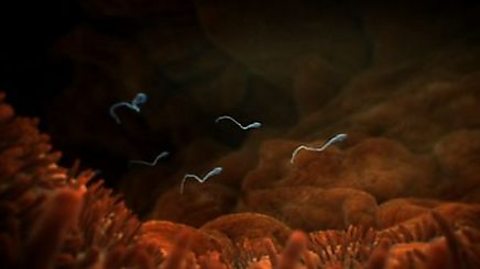
This short film uses CGI footage to help give a visual description of the process of human fertilisation, following the journey of both sperm and egg.
Human immunity and defence. video
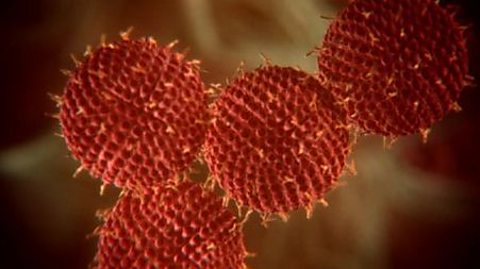
Using CGI, this short film gives students a look at the inner workings of the immune system, focusing particularly on how the body fights off viruses.
Pregnancy and multiple births. video
From a single fertilised cell to a fully grown baby, this short film mixes CGI with real-life images to paint a picture of how we develop inside the womb.
Skin - defend and protect. video
This short film provides a close-up look under your skin, focusing on two key functions of the skin - protecting the body from pathogens, and stopping the body from drying out.
Skin and sweating. video
This short film combines CGI images with a real life story about a fire-fighter to show how the body manages to control temperature by sweating.
The human eye. video
This short film offers a depiction of the inner workings of the human eye by combining CGI with a real life story of divers who can see clearly underwater.
The human heart. video
This short film uses 3D CGI images to show the movement of blood through the chambers of the heart and also the pacemaker cells.
How humans heal themselves. video
This short film offers a look at how the body heals itself. Combining CGI scenes with real life action in the boxing ring, it follows the progress of a boxer's black eye.