Narrator: During the Second World War keeping information secret became incredibly important. The intelligence service inside Britian, MI5, was concerned about people sending important information to the enemy.
Posters warned people to be careful about what they said, because 'careless talk costs lives.' British spies were also working hard to confuse the Germans. Double agents even captured secret German messages, changed them and fed them back wrong.
Confusion tactics like this were critical to the success of military operations like D-Day. And so having trustworthy information was a matter of winning or losing the war. To make sure the enemy wouldn't know what was being said, people used coded messages.
This involved taking a readable message and turning it into an unbreakable code.
This ensured that messages could be sent safely to other allies, the countries who were working together to stop the Nazis. The Allies knew the code, so they could decipher the messages without the enemy understanding it.
Bernard worked in codes and ciphers for the Royal Air Force, the RAF. He remembers first joining the unit.
Bernard: There was a machine there, it was like a large typewriter. I said to the officer I said, 'what's this machine I've notseen that before.' He said, 'that's a machine we use for decoding the messages.'
This is a Typex machine, which was used to code and decode all the secret messages which we received.
Narrator: On missions, these Typex machines were carried around in a large truck called a cipher vehicle.
Bernard: The cipher vehicle was like a mobile classroom because we had two of these Typex machines and they were so bigit took four men to lift them and we had two of those in the cipher vehicle. One to set up for the previous day in case you got any late messages and one for the current day.
Narrator: Secrecy was of utmost importance for his work and Bernard took it very seriously.
Bernard: But I couldn't tell any of that information until fifty years afterwards. We couldn't tell anybody and we were the first peopleto know two days before that the war was going to finish in two days time. The message tells you nobody to be advised but we had been so used to the secrecy all through the war, we never told anybody.
Narrator: Did you know? The German encryption machine, was called the Enigma. It had one hundred and three billion trillion possible settings for encoding messages. For much of the war it was thought to be unbreakable. However, Enigma encryption had fatal flaws. A letter could not be encrypted as itself and multiple letters could not be encoded with the same letter. So A couldn't be encoded as A, nor could A be encoded as both B and C at the same time.
Knowing this, British code breakers designed a machine that could eliminate the vast majority of possible ciphers that weren't possible with Enigma's limitations. This left far fewer to be analysed by hand.
One of the main mathematicians working on this was Alan Turing, who helped to develop multiple code breaking systems. His work also created the foundations of modern computers. He has since been recognised for this incredible work and is now the face on the new fifty pound note.
Overall however, codebreaking was a team effort. Before the invention of electronic computers, computer was a job description not a machine. Both men and women were employed as computers but women were more prominent in the field.
At Bletchley Park, the centre of British code breaking during the war, teams of both men and women worked on complicated problems round the clock, hoping to crack the German codes and bring about a quicker end to the war.
Video summary
This short film explains how cracking Nazi Germany's coded messages helped win World War Two.
A veteran called Bernard talks about working for the RAF in their code-breaking division.
He heard about VE Day 24 hours before it was announced because he received the message as a cipher - he still has the paper with the message on.
The ‘Did You Know’ section explores the German encryption machine, the Enigma, and describes the fatal flaws that allowed mathematiciansto crack it.
Created in partnership with Imperial War Museums.
Teacher Notes
This short film could form part of the following maths lesson:
- Pupils could complete some problem solving activities based on the Enigma code.
This would be part of the following section of the national curriculum in England:
- Solve problems by applying their mathematics to a variety of routine and non-routine problems with increasing sophistication, including breaking down problems into a series of simpler steps and persevering in seeking solutions.
Additional fact for class:
- Bletchley Park was the centre of British code-breaking during the war. Women were initially brought into Bletchley Park to provide administrative support. However, as the war advanced, women were increasingly recruited for their linguistics, physics and mathematical ability. Critically, women went from having their intellect dismissed, to ultimately playing a key role in code-breaking. Before the invention of electronic computers, “computer” was a job description, not a machine. Both men and women were employed as computers, but women were more prominent in the field.
Suitable for teaching history at KS2 in England, Wales and Northern Ireland and 2nd Level in Scotland.
This short film could also can be incorporated into different subjects as part of a cross-curricular lesson, especially when teaching maths at KS2 or 2nd Level.
More from World War Two:
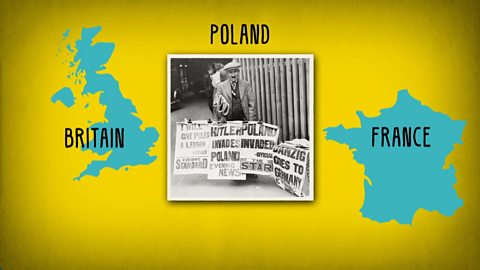
Britain declares war on Germany. video
This short film offers an overview of the events that led to Britain declaring war on Germany in 1939.
Rationing in the UK. video
This short film explains rationing in simple terms, offering a glimpse of a world that pupils may not be accustomed to.

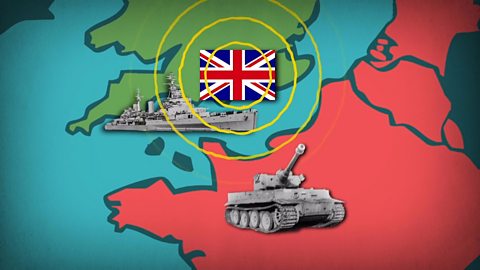
Geography of World War Two. video
This short film provides insight into the scope of the war and how many countries were involved.
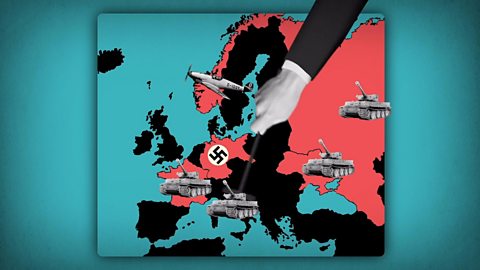
Geography of World War Two. video
This short film provides insight into the scope of the war and how many countries were involved.
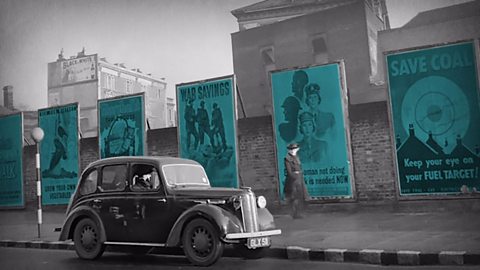
How propaganda was used during World War Two. video
This short film explains how people were persuaded to join the war effort, and the importance of motivational campaigns.
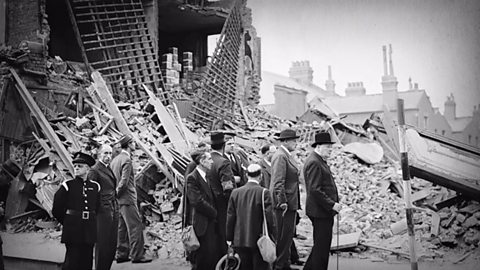
The Blitz. video
This short film offers a digestible insight into the blitz and how the British people responded.
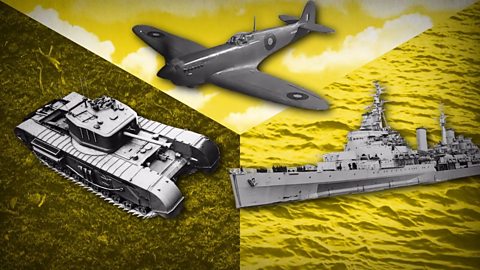
Machines of the military. video
This short film highlights the importance of technology in the war effort and the key roles that tanks, planes and ships played.
D-Day. video
This short film explores the significance of D-Day as well as highlighting what took place that day.
VE Day. video
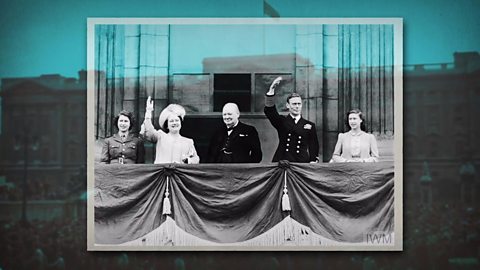
This short film explains what VE Day and VJ Day were, and the events that led to the end of the war.