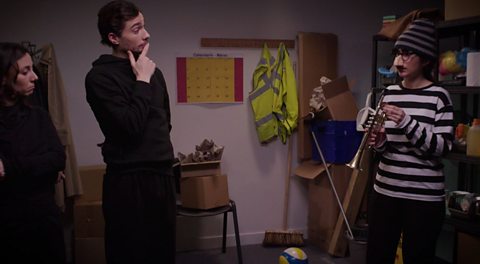
INSPECTOR:
Así que: ¿Perdiste tu gato?
ALICE:
Sí. ¿Y qué? ¿Por qué estoy aquí?
POLICIA:
Si ¿Por qué está aquí?
INSPECTOR:
ESTÁS aquí porque su gramática es terrible.
POLICIA:
Vale…Pero…
INSPECTOR:
Odio la gramática incorrecta
ALICE:
Escribí estos cartel muy de prisa
INSPECTOR:
¿Estos cartel? ¡Ves! Estos cartel, no.
Estos carteles o este cartel.
Estos carteles. Este cartel.
POLICIA:
Tranquilo
INSPECTOR:
¡No!
POLICIA:
El médico dijo -
INSPECTOR:
Ya sé lo que dijo el médico. Pero esto es importante.
Tú escribiste…
ALICE:
¿Yo escribí?
POLICIA:
¿Ella escribió?
INSPECTOR:
Tú escribiste: “Perdido. Un gato blanca”.
ALICE:
¿Y qué tiene de malo?
INSPECTOR:
¿Tu gato es hembra o macho? ¿Es gato o gata?
ALICE:
Es macho. Un gato.
INSPECTOR:
Entonces…debería ser un gato blanco.
Un gato blanco.
ALICE:
¿De verdad?
POLICIA:
El gato. Un gato blanco. Una gata blanca. Lo siento. Tiene razón
INSPECTOR :
Si es un gato, el adjetivo ‘blanco’, también tiene que ser masculino. ¿Entiendes?
ALICE:
Entiendo
INSPECTOR:
Y después, dijiste ….
ALICE:
¿Yo? ¿Dije?
POLICIA:
¿Ella? ¿Dijo…? INSPECTOR Tu dijiste: “El vi el domingo”.
ALICE:
¿Hay problema?
POLICIA:
¡Respira! ¡Respira!
INSPECTOR:
Explícaselo. Yo no puedo. Estoy ocupado… respirando.
POLICIA :
No se dice “el vi el domingo”. Se dice “Lo vi el domingo”.
INSPECTOR:
Usamos “lo” para un gato masculino y “la” para una gata femenina.
POLICIA:
Yo tuve un gato hace muchos años. Lo echo de menos.
INSPECTOR:
¡Es fácil! ¡Es fácil!
INSPECTOR:
‘’Yo vi, tú viste, él/ella vio, nosotros/nosotras vimos, vosotros/vosotras visteis, ellos/ellas vieron” ¿Entendido? ¡Repetid!
“Yo vi, tú viste, él/ella vio, nosotros/nosotras vimos, vosotros/vosotras visteis, ellos/ellas vieron.”
Shh. Ahora, viene lo peor.
Tú escribiste
ALICE:
¿Yo escribí…?
POLICIA:
¿Ella escribió…?
INSPECTOR:
Tu escribiste ‘mis gato’
POLICIA:
Uh -
INSPECTOR:
Eres cariñoso.
POLICIA:
Cuidado…
INSPECTOR:
Y.… le gusta comer muchos ratón.
¿"Muchos ratón"?
¿Por qué? ¿Por qué escribiste esto? Debería ser mi gato, no mis gato, Mi gato es cariñoso, no ‘eres’ cariñoso - es cariñoso.
Y le gusta comer muchos ratones. Ratones en plural ¿Entiendes? Muchos ratones. ¿En plural eh?
POLICIA:
Tranquilo. Tranquilo. Sólo es gramática.
INSPECTOR:
¿Solo es gramática? ¿Estás loca? Esto es muy importante, importantísimo.
ALICE:
Lo siento, soy inglesa
INSPECTOR:
¿Eres inglesa?
ALICE:
Sí, llegué aquí la semana pasada.
POLICIA:
¿Llegaste aquí la semana pasada?
INSPECTOR:
¿Y ya has perdido tu gato?
ALICE:
Se escapó. España le es nuevo.
POLICIA:
Si sólo llevas aquí una semana, hablas español bastante bien.
ALICE:
¡Gracias!
INSPECTOR:
No es excusa. La gramática es muy importante.
ALICE:
Entiendo. Vale. Pero ¿Puedo irme ya?
INSPECTOR:
Puedes irte cuando lo lees todo correctamente.
ALICE:
Vale “Perdido. Un gato blanco. Lo vi el domingo. Mi gato es cariñoso y le gusta comer muchos ratones”.
POLICIA:
¡Muy bien!
INSPECTOR:
Bien. Muy bien. Bueno, ya puedes irte a buscar estos gato.
ALICE:
No. Quieres decir este gato.
INSPECTOR:
¿Qué?
POLICIA:
Dijiste estos gato. Querrás decir este gato.
ALICE:
Lo siento Señor. Pero la gramática es importantísima.
Video summary
A suspect is interrogated by a good and bad cop on the grammar used on a poster for a missing cat.
The bad cop is a grammar fanatic and goes through her poster line by line, getting progressively more apoplectic. The good cop attempts to calm him down throughout.
Not only does the bad cop point out the incorrect adjectival agreements and dative pronouns, he also takes them through verb conjugation on the board.
The suspect finally admits that she is English and this is why she has been getting her grammar wrong. The good cop is impressed with her standard of English after only a month in the country, but the bad cop says it’s no excuse.
Before she goes she must read out the full corrected poster.
After doing this she is free to go. However, the bad cop himself makes a grammatical mistake. The good cop holds him down as the suspect puts handcuffs on him, quoting his former line that grammar is very important!
Teacher Notes
Pupils could be given a number of sentences with similar grammatical mistakes to those in the clip. They could then try to correct the errors.
This clip is relevant for teaching Spanish at Key Stage 3 in England, Northern Ireland and Wales and at Third Level in Scotland.
Spanish KS3: The heist - 'Planeando El Atraco' (part 2/10) video
Understanding infinitives and tenses are key to making sense of the criminals' heist plans.
Spanish KS3: The search begins - 'Se Buscan' (part 1/10) video
Explore greetings, vocabulary, adjectives, colours and clothing as the police try to make sense of the evidence.

Spanish KS3: The getaway - "Planeando la fuga" (Part 4/10) video
Explore Spanish grammar and vocabulary around planning directions as the criminals plan their escape.
Spanish KS3: Identity parade - 'La Rueda De Identificacion' (part 8/10) video
Consolidate knowledge around the body and identity in this Spanish comedy identity parade sketch.

Spanish KS3: The interrogation - 'El Interrogatorio' (part 9/10) video
Expand understanding around daily routines and geography as the criminal gets tickled in the interrogation room.
Spanish KS3: Undercover training - 'Como Ir De Incognito' (part 5/10) video
Explore Spanish vocabulary around truth and identity as the police go through their undercover training.

Spanish KS3: Cracking the safe - 'La Caja Fuerte' (part 6/10) video
Expand understanding around arguments, numbers and dates as the criminal gang attempts to crack a safe.
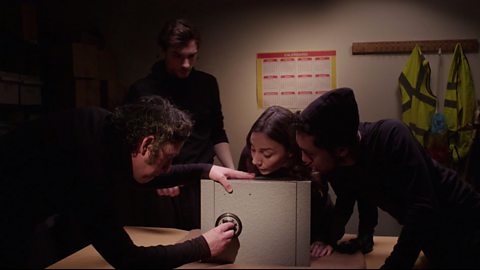
Spanish KS3: The search widens - 'Se Buscan En El Extranjero' (part 3/10) video
Explore Spanish vocabulary around travel, geography, food and paella as the police try to make sense of the criminals' movements.
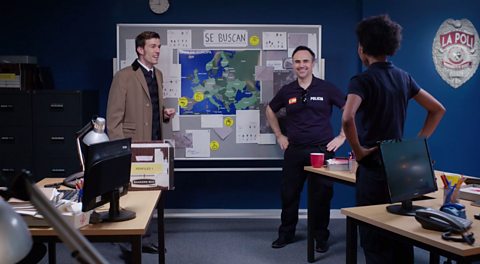
Spanish KS3: Undercover - 'De Incognito' (part 7/10) video
Expand understanding around games, hobbies and music as the police go undercover.