Have you ever heard the phrase 'All roads lead to Rome'?
Well, just over two thousand years ago, this was true. The Romans controlled a large proportion of the world. One of their many achievements was creating an interconnecting set of roads so that every part of the Empire was connected to their capital city, Rome.
When the Romans arrived in Britain, it was run by Celtic tribes, who didn't have much of a road system.
It was important for the Romans to be able to move their armies and all their equipment around quickly and easily. So they built roads that would allow them to march soldiers from one place to another by the shortest and safest possible route.
The Romans built their roads in a very particular way.
First, they would dig a trench, which they would layer with big stones, then pebbles and sand, then cement and broken stones, before using neatly cut paving stones for the surface.
The roads would slope down from the middle to ditches on either side to allow the rain to drain away.
They were unlike any other roads the world had seen before.
Some of the main towns built by the Romans, such as London, Bath and Chester, were connected by long and straight Roman roads. The roads were so well built, you can still see some of them today.
Many modern day roads are in the same place as Roman ones over two thousand years later.
Video summary
An introduction for primary pupils as to why and how the Romans built a network of roads in Britain.
This short film explores the design and construction of Roman roads. Using maps and graphics, it shows where the Roman roads were built and illustrates how many of our modern roads follow the same routes today.
Teacher Notes
This short film is an ideal tool to start exploring the changes the Romans made when they arrived in Britain.
It can be used with maps to look at the reasons why the Romans built their roads where they built them, and how towns and cities grew up along them.
The film can be used to make comparisons between how the Celtic tribes and the Romans travelled.
Pupils could also explore what happened to these roads after Romans left Britain.
Points for discussion
- How did the Romans travel?
- Why did the Romans build their roads in the way they did?
- How did the Celts travel?
- Which major cities were connected by Roman roads?
- How did the Romans change life in Britain?
Suggested activities
After watching the film, pupils could develop case studies about Roman towns and cities in the United Kingdom. They could use maps and atlases, current and historic, to explore why each location was chosen and how this impacted on life for the Celts in that area.
Pupils could use photographs, the internet and books to find evidence of the remains of Roman roads today, and then identify place names linked to the Roman roads which have survived to the present day.
This short film is relevant for teaching history at KS1 and KS2 in England, Wales and Northern Ireland and 1st and 2nd Level in Scotland.
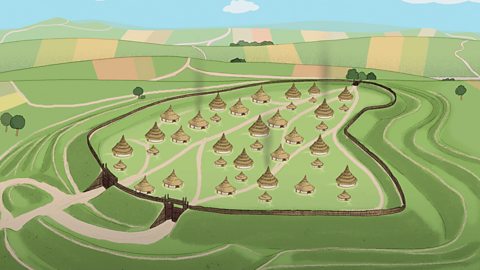
Hill forts. video
An animated introduction to Iron Age hill forts for primary pupils.
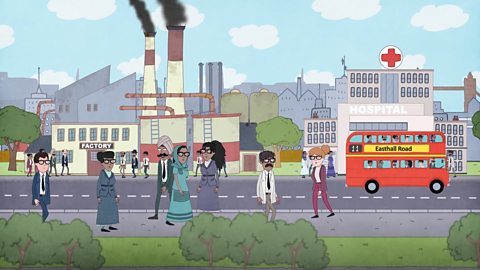
Migration. video
An introduction to migration for primary pupils, looking at how migration to and from the United Kingdom has changed over time.
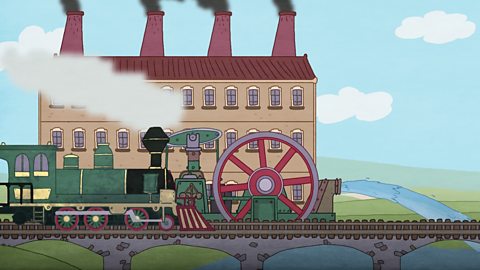
Industrialisation. video
An animated introduction to industrialisation for primary pupils.
The digital revolution. video
An animated introduction for primary pupils to the impact of the digital revolution over the past 50 years.