Iron Age hill forts were once a common sight across Britain. We can still see evidence of some of them today.
This is Maiden Castle, an Iron Age hill fort in Dorset, which historians believe was built almost three thousand years ago.
In Britain, the Iron Age began in about 800BC and, as its name suggests, it came about when people discovered how to produce iron.
Iron allowed people to make better tools for farming and daily life, as well as better weapons.
These new weapons were stronger than Stone or Bronze Age weapons and, of course, with more dangerous weapons, people needed new ways to defend themselves from attack.
At this time, most people across Britain and Ireland lived in Celtic tribes. To protect themselves, they built forts on the tops of hills.
Some hill forts were almost like small towns. They were full of wooden houses with thatched roofs made of straw.
These hill forts gave the tribes an excellent view, allowing them to see enemies coming from miles away.
To make it difficult for enemies to attack, tribes surrounded there hill forts with huge mounds of earth, ditches and wooden walls. Being above your enemy was an advantage in battle.
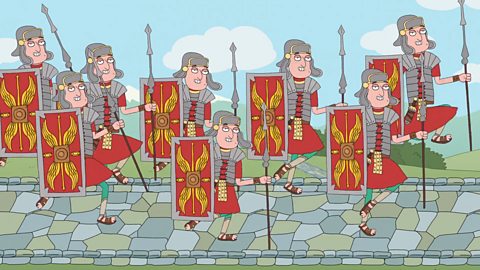
Hill forts were common across Britain until the Romans invaded in AD43. The Romans had their own ideas of how things should be done.
Video summary
An animated introduction to Iron Age hill forts for primary pupils.
It describes the Iron Age population of Britain and how they lived in tribal communities.
It explores how and where these hill forts were built and which locations and methods were used to protect inhabitants from enemy attack.
The film also shows how the remains of some of these hill forts can still be seen in the United Kingdom today.
Teacher Notes
This short film is an ideal tool to help pupils to understand how and why Iron Age hill forts were built in Britain.
It can be used alongside maps of localities to explore where pupils think hill forts might have been built and why.
It can be used to discuss the process of building hill forts and to consider the lives of people living inside them.
Points for discussion:
- What is a hill fort?
- Who built these hill forts?
- Why were hill forts built on hills? What advantage did this offer?
- What evidence of hill forts remain in the United Kingdom today?
Suggested activities:After viewing the film, you could ask pupils to create their own case studies of hill forts and to annotate maps to show where these might have been built.
Working in groups, pupils could discuss why they think these locations were chosen and how they would have offered protection from enemies to people living inside them.
Pupils could carry out fieldwork to explore the shape of the land around hill forts and see if they can find evidence of the remains of hill forts in these locations.
Teachers and pupils could develop timelines of British history, indicating in which era hill forts were built and then explore what existed before and after hill forts as part of a historical study.
This short film is relevant for teaching history at KS1 and KS2 in England, Wales and Northern Ireland and 1st and 2nd Level in Scotland.
Migration. video
An introduction to migration for primary pupils, looking at how migration to and from the United Kingdom has changed over time.
Industrialisation. video
An animated introduction to industrialisation for primary pupils.
The digital revolution. video
An animated introduction for primary pupils to the impact of the digital revolution over the past 50 years.

Roman roads. video
An introduction for primary pupils as to why and how the Romans built a network of roads in Britain.