VOICE OVER:
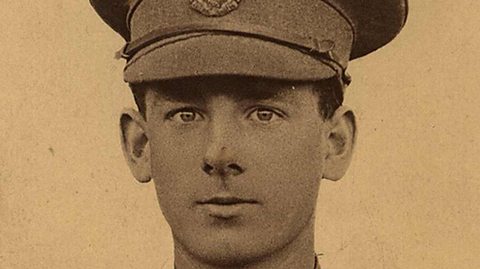
Aby Bevistein was born in Poland and came with his parents to London’s East End aged three, as part of a wave of Jewish migration from Eastern Europe.
In September 1914, he volunteered, changing his name to the British Harris.
ABY:
‘Dear mother, I did not like to leave you on Tuesday. I was very sorry to see you cry. But never mind, I will come home one day. From your loving son, Aby.’
BETTY JACOBS:
I’m sure he regretted Joining up in the army without their knowledge. They were heartbroken. Because of the religion, because they were orthodox, it’s something the only son would not do.
VOICE OVER:
Aby was posted near Loos in France. The war had sunk into stalemate. To try and break through, both sides adopted a terrifying strategy – tunnelling under the trenches to plant mines.
FERGAL:
On 29th December 1915, the Germans in their lines over there had tunnelled here, under Princes Street trench where Abi Harris and his comrades were stationed.
Two men were killed and Abi was wounded.
ABY:
‘Dear Mother, I was taken ill and I was sent to the hospital. But don’t get upset about it. I will be all right.’
VOICE OVER:
‘Sir, I regret to inform you that Private Abraham Harris is suffering from wounds and shock.’
JULIAN PUTOWSKI:
What they mean by shock is that he’s suffering from damage that cannot be accounted for by physical impacts on his body. Shell shock was the term that was used for soldiers who had become in effect militarily worthless.
ABY:
‘Dear Mother, you don’t know how I was longing for a letter from you. I would like to know what the War Office said was the matter with me.’
JULIAN PUTOWSKI:
Most doctors thought that it was a character defect. You’re damaged goods.
FERGAL:
Early in the new year of 1916, Private Abi Harris was still on the Western Front, billeted in this farmhouse at Le Flandry. He’d been injured and shell-shocked but he was passed fit for duty.
Abi arrived back at the trenches here near Vermelle on 12th February 1916.
Within a matter of hours fighting had broken out. Grenades exploded around him.
Private Abi Harris left his trench and found his way to the company headquarters. After examination by a medical officer, he was pronounced fit for duty and ordered to return to the front line.
Abi set off in the opposite direction.
He wandered the seven miles back to the farmhouse in which he’d earlier been billeted. He was arrested for desertion and brought before a court martial.
ABY:
‘Dear Mother, we were in the trenches and I was ill so I went out, and I’m in a bit of trouble now.’
JULIAN PUTOWSKI:
Abi comes in and he’s faced with four officers. So he’s in a roomful of people who he’s been educated to defer to, and he’s undefended.
Desertion means not being in your appointed place. If you don’t run very far, you’re a coward; if you run a fair distance, you’re a deserter.
In cases of desertion you have to prove intent. The court, as far as it’s concerned, once they’ve heard Cordionne, the Frenchwoman, her evidence is absolutely crucial.
VOICE OVER:
‘I recognised him as he had been billeted at the farm for three weeks. He said the Germans had been bombing our trench and he had left them and was going to England.’
JULIAN PUTOWSKI:
The moment that she says he wanted to get back to England, that’s it, that’s intent.
The court makes its decision – guilty, sentenced to death. It’s over, done and dusted, within 15 minutes, half an hour, tops.
Army law’s not about justice. Army law’s about discipline.
BETTY JACOBS:
My mother never spoke about him. But I do recall, though, when November 11th used to come around each year, she would go into dining room, close the doors and have a really good sob. It brought back memories of the brother that she lost.
Video summary
Aby Bevistein, an émigré from Eastern Europe, joined the Middlesex Regiment in September 1914 aged only 16.
Soon after being posted to northern France, his trench position exploded: a result of underground siege-mining by the Germans.
As a result of the injuries he suffered during the explosion, Aby was sent home to England. However, by 1916 he was back on the front line.
After another attack on his position, he was judged to be fit for duty and ordered back to his position. However, suffering from shell shock, he ignored the order to return to his trench and was subsequently charged with desertion. Found guilty after a swift trial, he was sentenced to death by firing squad.
Contains scenes which some viewers may find upsetting. Teacher review recommended before using in class.
This film is from the series Teenage Tommies.
Teacher Notes
As a follow up to the clip, the class could be split into two groups. One group could be asked to write a defence of Aby's actions, making a case for his acquittal; and the other group to write a case for the prosecution, arguing that he should be found guilty during the court martial.
This clip will be relevant for teaching history. This topic appears in OCR, Edexcel, AQA, WJEC KS4/GCSE in England and Wales, CCEA GCSE in Northern Ireland and SQA National 4/5 in Scotland.
Cyril Jose. video
Cyril Jose joined the Devonshire Regiment, even though he was only 15 years old.
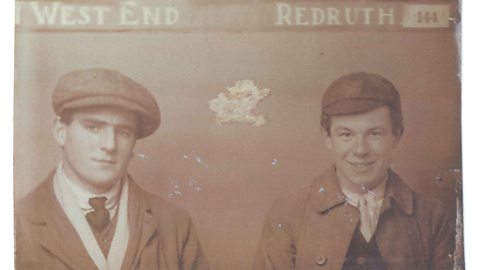
Ernest Steele. video
Ernest Steele volunteered to fight for his country in late 1914, even though he wasn't yet nineteen.
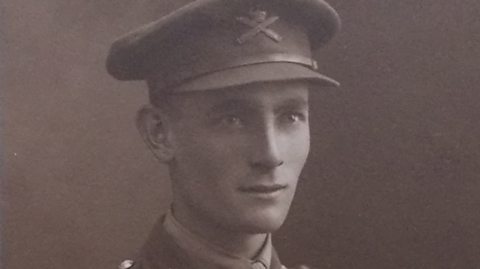
Horace Iles. video
Horace Iles was travelling on a Leeds tram when a stranger presented him with a white feather, even though he was only fourteen years old.
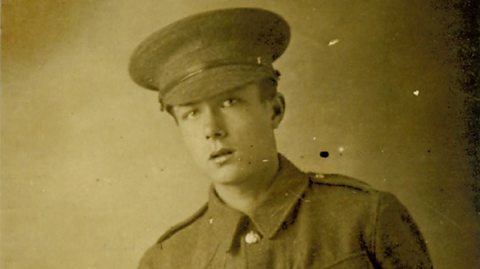
St John Battersby. video
St John Battersby, the 14-year-old son of a vicar from Blakeley in north Manchester, signed up to join the army against his father's wishes.