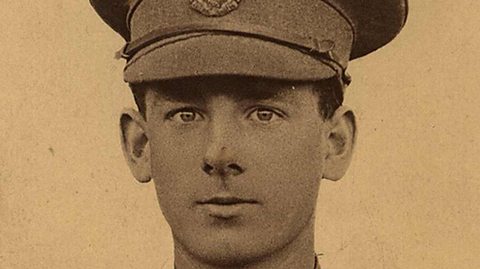
VOICE OVER:
Cyril Jose was born in Redruth in Cornwall in the shadow of redundant tin mines. His father was an out of work miner and times were hard.
FERGAL:
With no certainty of work anymore, and poverty in this area, war might have seemed like an escape to him.
PAULINE WALLACE:
Well, he was very young, of course, so I don’t know if he would have thought about it quite in the same way. It was certainly an adventure, and you can read that in his letters.
CYRIL:
‘Dearest Ivy, stand back!! I’ve got my own rifle and bayonet. The bayonet’s about two feet long from hilt to end of point. Must feel a bit rummy to run into one of them in a charge. Not ‘arf.’
PAULINE WALLACE:
There’s a lot of childhood still in him. He was asking for copies of the Magnet. And he was clearly still playing tricks and acting like a child.
VOICE OVER:
It would take a lot to put a British Tommy off his football. Here, a German shell exploded right on the field of play. To show their contempt for the enemy’s fire, they continued their game.
Cyril arrived in the Artois district of northern France in the spring of 1915.
It wasn’t long before he experienced the excitement he’d sought.
CYRIL:
‘I’ve been quite adventurous for the past few nights, having been out in front with a covering party while some others fixed up some barbed wire.’
‘The first night was quite exciting as the Gs must have spotted something once or twice, as they sent over a lot of rapid fire.’
‘They continually sent up star shells so we had to keep our nappers down low.’
‘I then rejoined my section, and on sentry I didn’t half send some ammunition over to our old friend Fritzy.’
PETER DOYLEOne of the things about Cyril’s letters is he says how exciting it is to go over the top. Others, with a sense of self-preservation, would stay back.
VOICE OVER:
One year on, and Cyril had been moved to the Somme river where a major allied offensive was planned.
The idea was to bombard the Germans with artillery and destroy their machine guns before the assault.
It failed.
On the first day of the battle the machine guns wreaked terrible havoc among the advancing troops.
CYRIL:
‘Men went down like corn before a scythe. Down went Second Lieutenant Gold. Across him fell his batman, Harry Hampden. A bullet thumped through my left shoulder and chest, knocking me down. I panicked and yelled, “I’m hit.” ‘
‘I’d seen that I was alone in a field of dead men. Made me laugh when I read old Douglas’s dispatch. “I attacked.” I’ll get a job like that in next war. Attack Johnny from 100 miles back.’
PAULINE WALLACE:
It’s exactly the way he used to talk about the generals. This is a boy who 18 months earlier had enlisted at the age of 15. Very enthusiastic about what he was going in for. And then to come to that sort of reaction.
VOICE OVER:
After the slaughter at the Somme, a campaign to bring the boy soldiers home gathered pace. Eventually those under the age of 19 were withdrawn to special camps. Cyril Jose was among them.
RICHARD VAN EMDEN:
By the time he was wounded on the 1st July, I think he was probably pretty glad to get out of it, at least for a while. He would have known he was going to go back overseas, so that may have been of some concern to him. But he was willing to go and he went back.
FERGAL:
There must have been guys dreading their birthday.
RICHARD VAN EMDEN:
There are cases where young lads have slit their own throats. I think his name’s McConnell of the 16th Highland Light Infantry, cuts his own throat because he’s hit 19 and he just cannot face it again.
VOICE OVER:
On his 19th birthday, Cyril was sent back to the front. It was 1918, and the war was drawing to a close. Cyril found himself in Épehy, where once again he was sent over the top.
CYRIL:
‘We advanced 3,000 yards to put defences around St Quentin.’
‘We took plenty of prisoners. Quite a change for me to be in such an easy stunt. Jerry put up a good resistance.’
‘I got hit. Still, must be thankful for small mercies.’
SONGHere we are, here we are again…
VOICE OVER:
The battle of Épehy saw the end of Cyril’s war. His wound was his ticket home.
But his experiences in war would have a defining influence on his life.
PAULINE WALLACE:
It explains an awful lot of his attitude towards the establishment, towards authority. He never really wanted to be part of that establishment.
FERGAL:
So there he is.
PAULINE WALLACE:
That’s him. He was a jolly person. He was always laughing. He lived in a caravan in Epping Forest for a long time. He’d just do whatever he had to do for money. I mean, that was it. As long as he had money for his books, that was all he cared about.
Video summary
Cyril Jose joined the Devonshire Regiment, even though he was only 15 years old.
Extracts from his letters describe his experiences in the trenches and the impact on him of the 1916 Somme offensive.
After the offensive came to a halt, Cyril and other underage boys were sent to a special camp until they were old enough to fight again. When he reached the age of 19, Cyril was sent back to France where he participated in the final campaign against the Germans.
After the war, Cyril returned home a changed man, maintaining a suspicion of authority figures for the rest of his life.
Contains scenes that some viewers may find upsetting. Teacher review recommended before using in class.
This film is from the series Teenage Tommies.
Teacher Notes
The class could be asked to compare Cyril’s attitude towards the war when he joined up, with how he felt by the end of it. What reasons might explain the change in his attitude?
This clip will be relevant for teaching history. This topic appears in OCR, Edexcel, AQA, WJEC KS4/GCSE in England and Wales, CCEA GCSE in Northern Ireland and SQA National 4/5 in Scotland.
Aby Bevistein. video
Aby Bevistein, an émigré from Eastern Europe, joined the Middlesex Regiment in September 1914 aged only 16.
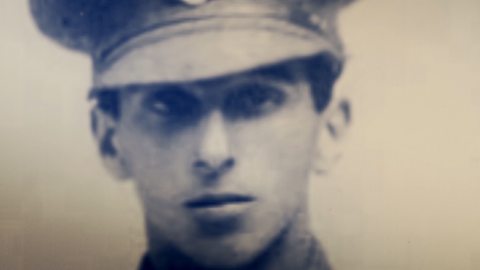
Ernest Steele. video
Ernest Steele volunteered to fight for his country in late 1914, even though he wasn't yet nineteen.
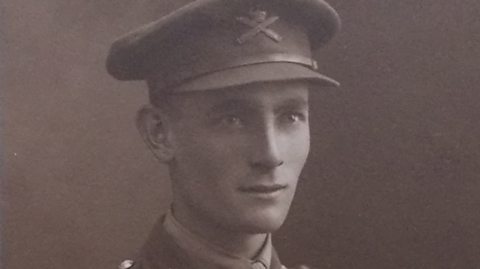
Horace Iles. video
Horace Iles was travelling on a Leeds tram when a stranger presented him with a white feather, even though he was only fourteen years old.
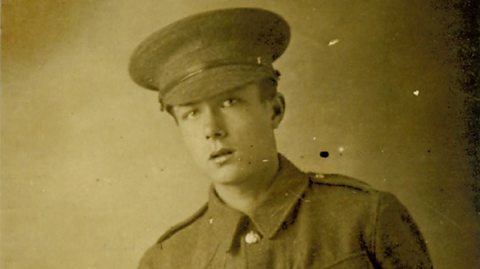
St John Battersby. video
St John Battersby, the 14-year-old son of a vicar from Blakeley in north Manchester, signed up to join the army against his father's wishes.