

16:30 - 17:30
Sean Rafferty presents a selection of music and guests from the arts world.
 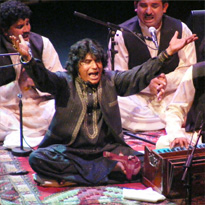  FAIZ ALI FAIZ (Pakistan) Your love makes me dance  This Pakistani singer was born in 1962 into a family steeped for seven generations in qawwali the mystical Sufi music that historically preached divine love and religious instruction to illiterate followers of Islam. Faiz Ali Faiz studied both classical and qawwali singing, and launched his professional career in 1978. Since then, he has steadily accumulated praise for his ecstatically soaring vocal style. For this, he acknowledges the influence of the late great Nusrat Fateh Ali Khan the Pavarotti of the Sufi world, who took qawwali out of the shrine onto the world stage and experimented with daring fusions. It's appropriate then that Faiz Ali Faiz should break new ground of his own. His international solo releases The New Qawwali Voice (2002) and Your Love Makes Me Dance (2004) have included interpretations of pieces popularised by Nusrat, and the lavish double CD and DVD Qawwali Flamenco (Accords Croises, 2006) does the same, with the added twist of a tentative but frequently inspired fusion of qawwali and flamenco. This new project with Spanish flamenco singers Duquende and Miguel Poveda plus guitarist Chicuelo has led to his third nomination for these awards. Bringing the two genres together was a challenge. The monodic qawwali tradition uses only notes and scales, contrasting with flamenco's harmonic, chord-based system. And while qawwali texts are concerned exclusively with the sacred, flamenco has a more earthy, 'profane' lyrical tradition. Yet in both, the singers rely on the power of poetry to access deep emotions, achieving a kind of spiritual disappearing act to become an ego-free vehicle for the message of love. Qawwali and flamenco also share a surprisingly similar wailing, sobbed vocal delivery which suggests an ancient common link in the call of a muezzin or perhaps the melismas of the Gypsy tribes who migrated out of West Asia across Europe a millennia ago. It's no surprise that the rhythmic palmas of flamenco find their echo in the clapped accompaniment of a qawwali party. Qawwali Flamenco seems to suggest that the elusive flamenco concept of duende has a counterpart in the qawwali state of haal (pure ecstasy). Jon Lusk. www.accords-croises.com Read other people's comments then  Tell us what you think: Tell us what you think:David Alexander Nav Awan Ali, Manchester Sajad, Rochdale Ash, Glasgow | | |
| | |
 Listen to 'Lal Shahbaz Qalandar'


BBC iD
BBC iDBBC navigation
BBC links

BBC © 2014The BBC is not responsible for the content of external sites. Read more.
This page is best viewed in an up-to-date web browser with style sheets (CSS) enabled. While you will be able to view the content of this page in your current browser, you will not be able to get the full visual experience. Please consider upgrading your browser software or enabling style sheets (CSS) if you are able to do so.
