

16:30 - 17:30
Sean Rafferty presents a selection of music and guests from the arts world.
Tchaikovsky and Stravinsky Listeners' Diary - 16 February 2007Two Radio 3 listeners are keeping an online diary throughout The Tchaikovsky Experience. Rosalind Porter  The sound of Russia. I've taken a bit of time to listen to some of the truly Russian orchestras featured in the Tchaikovsky/Stravinsky Experience and it certainly rewards the efforts. Ever since I started playing the violin at age 12, it has always been the microcosm of the orchestra that appealed to me far more than solo or chamber opportunities. There's something about being part of the whole which is simply too exciting to describe in words. Even if you are a non-player, do grab hold of any opportunity to sit very near or even in a top orchestra and experience up close the adrenaline burst of music-making. Listening to Russian orchestras is a bit like biting into a jaffa orange without peeling it. You've got the sour peel of the occasional dodgy intonation, the astringent bitterness of the pith from the often raw and rather rustic sounding woodwind, but then last of all the sweet interior of orange flesh with juicy, big string tone. Another feature to listen out for in Russian orchestras (more often in older recordings,) is the often wide vibrato used by Russian brass players. I've heard french horns that almost sound like saxophones, a sensual and admittedly rather gorgeous sound when heard in a Tchaikovsky symphony slow movement. Russian bands also frequently play well after the beat, which admittedly happens a lot in central Europe, but I'd personally say that they also have a delayed sense of attack on notes, nothing like the spot on precision of the best UK or American bands. I think it works very well stylistically for Tchaikovsky - as we've seen this week, but in scores such as Rite of Spring, you would be struggling - you are never going to get the tightness in ensemble of the New York Phil for example. I did enjoy listening to the Russian timbre of the USSR Symphony Orchestra this morning in Francesca da Rimini. - I have to confess that I can happily take the occasional imperfections when one has this inimitable orchestral colouring - there is nothing more boring or frightening than the thought of a world of orchestras all sounding the same, with nothing to differentiate between Newcastle and Novosibirsk. Do try and listen to the Leningrad Philharmonic Orchestra under Yevgeny Mravinsky today in the Pathétique, Symphony No. 6. Oh, another of my 'unique moments' came up yesterday morning - this time reaching back into the murky mists of one of my first forays into an adult orchestra after 3 years of violin study. One of the pieces we did was the Firebird Suite and it was inevitably a goose-bump moment each time the French horn played his big theme before the final 7/4 section as we 2nd violin quietly played tremelo a few feet in front of him. These memories definitely stick with you as a musician! I am afraid that the trailer for Mr Hazlewood's '1812 Overture' concert is seriously getting on my nerves now. There is a multitude of far finer music still to be heard before then and why does this single event have to be singled out for so much unworthy promotion. He's not even doing a truly authentic version by using a chorus, so in an enterprise that has exhibited musical integrity up to now, this is a dubious route to take, to say the least. BBC Radio 3 should be taking the higher road rather the lower one. Last night I made a point of listening to the Requiem Canticles and found that to be another piece I would like to spend a bit more time getting to know. Very powerful, concise choral and orchestral writing - especially in the Tuba mirum and it was a fine recording. Being honest I have found it hard to grasp the wide range of compositional styles used by Stravinsky and I believe that switching around such a lot between early, late, neo-classical, 12-tone periods makes it incredibly hard to gain some kind of general focus on Stravinsky's works. Early rise this morning for Heifetz and the Tchaikovsky violin concerto - can anyone else think of a better way to start the musical day? But it is a sad day too, the last in our Tchaikovsky/Stravinsky odyssey... Rosalind Porter By nature I am not an early riser, 10am is a perfect wake-up call time for me. So it was with slightly bleary eyes and befuddled brain that I switched on Radio 3 at 0628 this morning to listen to Heifetz play the Tchaikovsky Concerto as part of the 'Experience'. But within the first bars of his playing I was wide awake and gasping at the immediacy and energy of the interpretation, what an amazing performance, and so full of emotional intensity. Harriet, what where you feeling when you heard this recording again? It obviously played a pivotal part in your own musical development. Like you I can't believe people who say that Heifetz was an unemotional player, as a violinist I can only imagine this is because his vibrato is fast and only used when needed for expressive purposes. It isn't the constant angry wasp buzz of many virtuosi string players. One has to remember that many major European orchestras such as the Vienna Philharmonic didn't use vibrato unless specifically required for effect until well into the 1930s. But when one considers Heifetz's amazing variation in tone colour, bowing articulation, dynamics - well, for me this is total violinistic bliss! I hope that if there are any young string players reading who don't know his playing and who were sensibly still in bed at this hour, that they might be inquisitive enough to take a listen again. Having heard quite a substantial amount of vocal music by Tchaikovsky and Stravinsky over the past week and discovered pieces which certainly deserve wider popularity in the choral repertoire, I decided to ask The Sage Gateshead's Principal Conductor, Choral Programme Simon Halsey what advice he would give choruses seeking to perform Russian repertoire, his response: 'Russian choral music has a particular colour. This colour, of course comes from the language. Russian is not difficult for us to pronounce but choirs attempting it for the first time need to find not only a good transliteration of the original language but a demanding and well organised language coach. It is intriguing how quickly your choir begins to sound a bit Russian once the language falls into place! Start with pieces with SHORT texts!' It would be great if more British choruses explored Tchaikovsky and Stravinsky as a result of some of the thought provoking repertoire of the past week. I've already expressed my misgivings about the supposedly super-powered 1812 this evening but will be watching for nostalgic reasons. Anyone who spends time as an orchestral player is almost sure to face the 1812 sooner rather than later. Actually it is a pretty normal and moderately satisfying 'play' until the pyrotechnics start… But there are some handy tips to observe: One has to be sure that the 'bangs' are clearly marked in the music, violins are expensive to repair if you drop them in sheer fright due to 9 cannon going off totally unexpectedly 10 feet behind you. Some people think it is clever to rub these cues out before the next orchestra gets the music. It is not permitted to stop playing and cower in terror behind the music stand with your hands over your ears at this point, this is show business and image is everything - even if the audience won't hear you anyway. Ear plugs are advisable to avoid hearing the comments from the brass section about 'these over sensitive string players' who jump 6 ft in the air during the quiet music when a French horn player drops a mute accidentally. If you are playing out of doors, make sure you know which way the wind is blowing, with careful adjustment fireworks and cannon smoke may obscure the conductor, however if you are unlucky, vision may remain clear, with the unfortunate disadvantage that the lack of smoke will mean there is nothing to deter the inevitable large bugs that enjoy crawling into your instrument's f-holes at the most inopportune moments. Should the artillery be let off a few bars earlier 'to keep everyone on their toes' - vow revenge. I'm sure everyone will have a fun time at the Imperial War Museum and deep down inside, I'll be wishing I was on that back stand of the 2nd violins.
 Tchaikovsky's works on Radio 3 Stravinsky's works on Radio 3 Full Radio 3 schedule Tchaikovsky's works on Radio 3 Stravinsky's works on Radio 3 Full Radio 3 schedule |  |
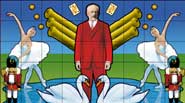
Listeners' DiaryOn Radio 3 Tchaikovsky and StravinskyFind out more about them and their music
Related LinksOn the BBC
The BBC is not responsible for the content of external websites | |||

BBC iD
BBC iDBBC navigation
BBC links

BBC © 2014The BBC is not responsible for the content of external sites. Read more.
This page is best viewed in an up-to-date web browser with style sheets (CSS) enabled. While you will be able to view the content of this page in your current browser, you will not be able to get the full visual experience. Please consider upgrading your browser software or enabling style sheets (CSS) if you are able to do so.
