

16:30 - 17:30
Sean Rafferty presents a selection of music and guests from the arts world.
Tchaikovsky and Stravinsky Listeners' Diary - 10 February 2007Two Radio 3 listeners are keeping an online diary throughout The Tchaikovsky Experience. Rosalind Porter  So we're off! I am enjoying everything tremendously so far. It is also revealing to note how well the format works. Wall-to-wall Tchaikovsky would have been just a little too much, but combining his music with Stravinsky's provides all sorts of contrasts and similarities. However, what always makes these kind of BBC events so unique are the various speech inserts: As I write I have just been listening to a fascinating interview about the Moscow Underground, and the unexpected architectural gems to be found there. Little titbits like these provide the background details to allow us to build a deeper understanding of the culture from which both these composers originated and to place their artistic heritage in context. Oh dear, one of my little pet peeves has just occurred - what a pity - I get very annoyed when one piece runs into the next without a proper back announcement, most particularly when it is NOT a well-known piece. I was listening to Stravinsky's concertino for string quartet (1920) and didn't catch how many movements there were and was suddenly somewhat confused to hear wind instruments start to play as well, not realising his Concertino for 12 instruments had already started. Come on R3 Presentation, we are your passengers on a voyage of discovery here, please don't let us get lost up the River Volga on the first day! Having said that I am glad that we are having the chance to hear some of the composer's own recordings, even if the sound quality and perhaps even playing cannot match modern standards, these archival gems provide striking insight into Stravinsky's approach to his music. I loved the rhythmic drive he produced in this very compactly written Concertino, do listen again if you missed it the first time. I have always been a fan of Stravinsky's neo-classical pieces - the inimitable way in which he captures the vital essence of the original musical style yet stamped with an originality which makes the music absolutely his own. So I'm pleased to have discovered a violin piece I didn't previously know: His 'Suite d'après Thèmes, Fragments et Pièces de GB Pergolesi', some cool harmonics, double stopping and other virtuosic technical effects but also some atmospheric lyrical sections too, it sounds a really fun and demanding piece to play! However, Saturday's highlight for me is undoubtedly going to be the performance of Tchaikovsky's 'Manfred Symphony' by the BBC Philharmonic under the direction of their Principal Conductor Gianandrea Noseda. This is still an unfairly neglected work when one considers the over exposure of Tchaikovsky's last 3 symphonies and it certainly deserves to be better known. I still remember my shock as a student on discovering it was not even mentioned in the BBC Guide to Tchaikovsky's Symphonies and Concertos! Manfred has always had a strong emotional place in my heart, as it was one of the pieces in my first orchestral concert at the Royal Festival Hall as a back desk 2nd violinist. It is hard to describe adequately and coherently the adrenaline-laden thrill of being in the middle of a piece that you are discovering as a musician for the first time. The 'moment' for me was suddenly being enveloped in this big, glorious passionate melody for tutti strings which is played only on the G-string on the violin and accompanied by one of Tchaikovsky's signature ominous tutti brass syncopated figures. For non-string players the G string is the lowest violin string and when one plays in the higher register on just this one string - far up the fingerboard - this makes the sound very intense, especially when you've got a whole section doing the same. It is SUCH an exciting experience! Listen out for this moment at the coda of the first movement of Manfred, I think it is about 14 or so minutes into the movement. Tell me if it doesn't have just as much or even more emotional impact as anything in his 5th or 6th symphonies. I still play that tune from memory sometimes when I am warming up before practising, it's still embedded so deep in my musical psyche. Sometimes music has that emotional impact and Tchaikovsky certainly seems to achieve this more often than many composers. One of the main criticisms levelled at Manfred is the unwieldy length and what could be described as a looseness of structure, which can make the music's forward momentum flag at times. However, I'd passionately argue that one needs a conductor who knows how to pace music perfectly and I'm positive Maestro Noseda will be providing that impetus tonight. I've been reliably informed that he is not making cuts in the symphony, which is great news for Tchaikovsky lovers. Anyway, in my view there is a great deal of fine music in this symphony and I could spend a lot of time picking out more examples and will try to write more a bit later. I do hope for some impressions and feedback on the concert from other listeners on what you enjoyed (or otherwise) in tonight's performance. Don't forget you can listen again too!
 Tchaikovsky's works on Radio 3 Stravinsky's works on Radio 3 Full Radio 3 schedule Tchaikovsky's works on Radio 3 Stravinsky's works on Radio 3 Full Radio 3 schedule |  |
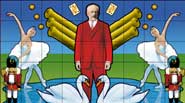
Listeners' DiaryOn Radio 3 Tchaikovsky and StravinskyFind out more about them and their music
Related LinksOn the BBC
The BBC is not responsible for the content of external websites | |||

BBC iD
BBC iDBBC navigation
BBC links

BBC © 2014The BBC is not responsible for the content of external sites. Read more.
This page is best viewed in an up-to-date web browser with style sheets (CSS) enabled. While you will be able to view the content of this page in your current browser, you will not be able to get the full visual experience. Please consider upgrading your browser software or enabling style sheets (CSS) if you are able to do so.
