8 weird facts that should be true… but aren’t
28 April 2018
The natural world is a treasure trove of mind-altering facts and strange information. The very fact that British cows have regional accents or that diamonds can be made from peanut butter should be enough, but somehow some persuasive myths have snuck in to spoil the wonderparty.
So, as Niki & Sammy's Peachy Podcast recently explored the strange and wonderful world of weird facts (and in the rigorous spirit of Greg James's Shouldn't Be News with Professor Brian Cox), here are eight facts that are verifiably untrue, no matter how many people insist otherwise:
White spots on your fingernails are a sign of calcium deficiency
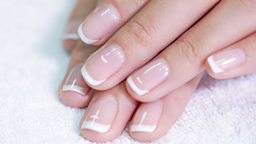
If you spot little white clouds on your fingernails, someone will inevitably tell you it's because you don't get enough calcium in your diet and point you towards the nearest yoghurt. Actually it's a very common condition called leukonychia, it's completely harmless and is most likely to be the result of an injury to the nail bed.
Reasons for the injuries can include frequent manicures, or the use of gel/acrylic nails. But it's just as likely to be a result of banging your hand on a kitchen drawer, and they will soon heal.
![]()
Niki and Sammy's Peachy Podcast
Niki and Sammy explore the world of weird facts with Oli White and look at some of their favourite Guinness World Records

Sugar makes you hyper

Sugar is not tremendously good for you, it's bad for your teeth and your weight, and excessive amounts can have an affect on your blood pressure and the health of your heart. However, scientific studies (including this 1994 double-blind report for the New England Journal of Medicine) have found no direct link between sugar intake and behaviour.
The original link seems to have come from research into people with hyperkinesis, a form of hyperactivity, which suggested they have low blood sugar, a result of excess sugar intake. However their blood sugar levels were later evaluated as roughly normal, and further studies found that in cases where parents believed their children had eaten sugar (but had been given a sugar-free placebo instead) they would still claim their children were hyperactive.
If you drop a penny from the top of the Eiffel Tower, you could kill someone

First of all, don't drop a penny off the Eiffel Tower. It's a really bad idea. Just don't. But if you did (and you really shouldn't) it would accelerate to a terminal velocity of around 30-50 miles per hour (slower if it's a windy day), and it won't get any faster, no matter how tall the building is.
By contrast, the average bullet travels at around 1,700 miles per hour. So while a penny falling from a great height could hurt someone (and that's the reason you shouldn't throw one), it won't kill them.
Wrap up warm or you'll catch a cold

There are lots of really good reasons to wear nice warm clothing when it's cold outside, but they're all very much associated with comfort and the prevention of shivering, chattering teeth and hypothermia. The idea that a scarf is going to protect you against all of the 250 million viruses that infect people under the banner of the common cold is a false one.
If you come into contact with one of these viruses, and you're susceptible, you'll be infected, that's how it works. People with asthma may find their condition is aggravated by cold air, and that may weaken their defences, but otherwise the reason you want a bobble-hat is to keep snuggly.
Humans only use 10% of their brain power
Science fiction loves the idea that there is untapped potential in the human brain, and that if we could just unlock it, we'd all make Einstein look like Joey Essex, intellectually speaking. Sadly this isn't the case, and while the brain is a hugely complex organ that can be trained to perform astonishing feats of data processing, it's actually exceptionally busy running the parts of the body we don't have to think about, so there's no secret door that will suddenly make you smarter.
Water goes down the plughole the other way in Australia
This one sort of makes sense, in that very few people think about whether the water in their sink goes down the plughole clockwise or anti-clockwise, and if someone says it's the other way in the Southern Hemisphere that sounds utterly feasible. But the truth is, water flows in either direction in either hemisphere.
There is something called the Coriolis Effect, in which the direction of water flow is affected by the Earth's rotation, but that only applies to huge bodies of water, like the Atlantic Ocean. Actually, the direction in which water spirals down a pipe is largely dictated by the design of the receptacle it is flowing out of, and the plumbing it is flowing into.
Sharks don't get cancer

This is a distortion of the truth, in that shark blood contains a compound that reduces the ability for tumours to process waste, which inhibits tumour growth. It's a very promising field of enquiry for cancer scientists, but before you invest in a bottle of shark's blood, it's worth bearing two facts in mind:
Firstly, no practical application has yet been developed for humans, and secondly, sharks do get cancer. It's relatively rare, but not impossible.
Glass is an extremely slow-moving liquid

This comes from the fact that glass is set when it's hot and in liquid form, and can still look a bit runny after it has cooled, but glass is a solid. The panes of glass in old buildings may look as if they're thicker at the bottom, but this is for a far simpler reason than you'd think. Glaziers would make a pane of glass as flat and even as possible, but inevitably one end would be slightly thicker than the other. They'd put the thick end at the bottom of the window frame so it was structurally stronger, not because the glass was on the move.
Like us on Facebook, on Instagram at bbcradio1, or follow us on Twitter @BBCR1