The bigger picture
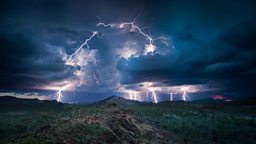
For the bigger picture we wanted to actually see the monsoon storms form on a continental scale. This is something only possible from space. Luckily the US government organization, NOAA (National Oceanic and Atmospheric Administration) has been taking pictures of the world’s clouds, one every hour, for the last few years.
we needed to capture what was happening in the soil and in the water – to the smaller beasties.Paul Bradshaw, series producer
Even more helpful they captured it in infra red so you can see the clouds at night too. Animating their data and superimposing it on a beautifully realised planet Earth, our graphics team were able to show what real monsoon clouds would look like from space.
On the other end of the scale we needed to capture what was happening in the soil and in the water – to the smaller beasties. This requires a highly specialised area of wildlife filming and would be impossible without a few leaps of both technology and lateral thinking by the team.
A good example of this was in episode 4. On Borneo the monsoon rains have made them nutrient poor, profoundly affecting evolution, and producing a world of exotic recyclers on the forest floor. Notably the spectacular iridescent Bornean giant blue earthworm (up to 70 cm long) which emerges from its burrows after the rains.The lack of available nutrients in the forest has also created a dearth of mammals and consequently some leeches have defied their stereotype and evolved not to suck blood, but to hunt!
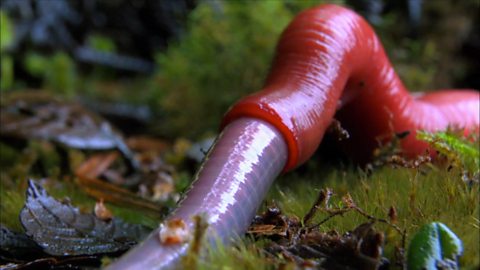
Monster leech swallows giant worm
A giant red leech hunts down a 70cm long blue worm and sucks it down like spaghetti.
The biggest of these, the giant red leech had been reported preying on the giant blue earthworm itself. This we had to see, but the red leech is little understood. It hasn’t even been properly classified by science, and it had certainly never been filmed hunting a giant worm.
...(the red leech) hasn't even been properly classified by sciencePaul Bradshaw, series producer
If true, the story would reveal a lot about the nature of the monsoon in the tropics. It sounded like the perfect Monsoon story. But with so little to go on, it also felt like a shot in the dark. The key to success was one of the few scientists who knew about this predation, Alim Buin. We launched a search party into the rainforests around Borneo’s highest peak, Mt. Kinabalu.
Alim and his team first collected some specimens so they could then be placed in an area of open forest to study and to film. This allowed us to get close enough to capture the behaviour that then unfolded. What then happened was really like nothing any of us had seen before!
On seeing the clip, it was heartening to hear Leech expert Dr. Mark Siddall of the American Museum of Natural History remark:
“I think the BBC footage is terrific and I am eagerly looking forward to the Monsoon series. I have often wanted to see this in action for myself. [the BBC] team have made an important contribution to my field. It will be interesting to see if this is indeed a new species."