King George IV attracts star Shakespearean actors
The Prince of Wales - later King George IV - had a long-standing relationship with Brighton. Indeed, he was seen by some as largely responsible for Brighton's popularity as a resort town with the fashionable London set, as well as championing high profile performances of Shakespeare in the town.
Between 1804 and 1809, the Prince acted as patron of the Theatre Royal Brighton, and took a personal interest in cultivating the theatre.
![]()
Much ado near me
Hear more Shakespeare stories on BBC Local Radio.
![]()
Shakespeare Festival 2016
The BBC celebrates the genius of the bard.

In 1806 he granted the owner, Mr Hewitt Cobb, Royal Assent to relocate the theatre from Duke Street to a new building on New Road. Constructed over ten months at a cost of £12,000 and with a capacity of 1,200, the venue was designed to the highest standards and even engaged the same painters to decorate the interior that the Prince had hired for his iconic Royal Pavilion.
The New Road Theatre Royal opened on the 27 June 1807 with a production of Hamlet starring famous actor Charles Kemble and his wife, Maria Theresa De Camp, both of whom were employed by the Theatre Royal Covent Garden.
The late 18th and early 19th century, the era of great acting stars and to be a star on the stage became synonymous with being a great Shakespearean actor
Although earlier in his career Charles had been overshadowed by his older and more successful siblings Sarah Siddons and John Philip Kemble, by 1807 he had established himself as a popular actor in his own right, and Hamlet was one of his favourite roles. His daughter, Fanny Kemble, wrote in her autobiography of being moved to tears by her father's performance, when 'every shadow of expression and intonation was so full of the mingled anguish that the human heart is capable of enduring'.
Throughout the era of the Prince's patronage, Shakespeare was performed frequently: there are records of performances of The Merchant of Venice, Romeo and Juliet, Othello, Henry IV, Hamlet, Macbeth, Much Ado About Nothing, Catherine and Petruchio (a popular version of The Taming of the Shrew), King Lear, Richard III, and The Merry Wives of Windsor.
The late 18th and early 19th century was an era of great acting stars and to be a star on the stage became synonymous with being a great Shakespearean actor.
Among those stars were Sarah Siddons, John Philip Kemble, Henry Irving and Ellen Terry. For men, the role that would make their career was Hamlet. For women, it was Lady Macbeth.
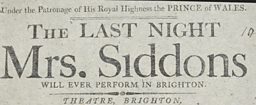
This playbill records a visit by the major star, Sarah Siddons, to the Theatre Royal in Brighton where she played Lady Macbeth. Siddons was born in Wales and became the best-known tragedienne of the 18th century. She was John Philip Kemble’s older sister. She became famous for her portrayal of Lady Macbeth.
Theatres - and the scenery used to decorate them - became more and more elaborate in the 1800s. Editions of Shakespeare’s plays were progressively cut and restructured to emphasis the soliloquies for the actors, giving the star actors even more profile on stage.
Child Stars perform Shakespeare
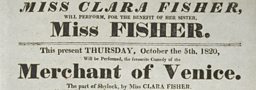
In the 1820s and 30s there was a craze for child stars.
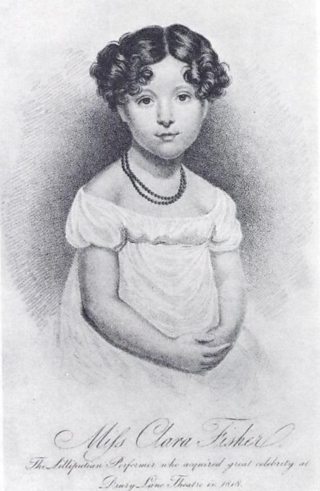
Although it was not uncommon for women to play male roles, Clara was no ordinary actress - she was just nine years old.
Theatre managers and parents alike were not shy in coming forward to push youngsters into the limelight in the hope of finding fame and fortune.
On the 10th October, 1820, Miss Clara Fisher joined the company at the Theatre Royal Brighton to play the role of Shylock in a production of The Merchant of Venice. Although it was not uncommon for women to play male roles, Clara was no ordinary actress - she was just nine years old.
After witnessing her first play at the age of four, at the Theatre Royal Covent Garden in London, Clara had become enamoured of the stage and set her heart on acting. Within two years she had made her debut at Covent Garden and quickly became one of the most highly regarded child stars of the nineteenth century, excelling in the Shakespearean roles of Shylock and Richard III. For ten years she toured provincial theatres across the UK to great acclaim, often appearing alongside her older sisters, Amelia and Caroline.
Their talent and stage presence captured the British public's imagination, and even inspired poems devoted to their talents. In 1820 an anonymous admirer penned a Valentine’s ode to each sister. He praised Amelia's 'voice and figure', addressed 'dear-loved' Caroline, and to Clara expressed his hope that 'Shakespeare's bright genius inspire you forever'.
In 1827 the Fisher sisters and their parents moved to New York. Clara, now sixteen, graduated to Shakespeare's female roles, including Ophelia and Viola, and her performances took America by storm. She became a theatrical celebrity and starred with some of the greatest American and British actors of the age, ultimately enjoying a career that spanned seven decades.
Child actor Master Mangeon 'bombs'
Sadly, another child ‘star’ was somewhat less successful than acting prodigy Clara Fisher.
Master Mangeon was one of the many who survived just a year or so on the theatrical circuit before crashing and burning.
Eight-year-old ‘Master Mangeon’ similarly appeared at the Theatre Royal in Brighton. In late October 1833, the Sussex Advertiser reported that the theatre had engaged Master Mangeon to perform 'on our boards in several favourite tragic characters'. He played a four-night engagement the following month, taking on the roles of Richard III, Shylock and Othello, and was billed as 'the celebrated Master Mangeon, The American Roscius, whose representations in the United States have created the most powerful sensation.'
At such a delicate age, a large part of Mangeon's draw for Brighton audiences was indeed his youth.
Unfortunately, he was not destined to follow the same trajectory as Clara Fisher and her sisters.
Master Mangeon was one of the many who survived just a year or so on the theatrical circuit before crashing and burning.
In February 1834, following a series of dates at provincial theatres which were relatively easy to obtain for novelty acts, Mangeon secured a trial performance at London's Victoria Theatre. This was the ultimate aim of all theatre performers in this period, as a permanent appointment in the capital came with respect from the industry and, perhaps more importantly, a sizable income.
Regrettably, poor Master Mangeon failed to impress the metropolitan audience. The Morning Chronicle featured a lengthy and scathing review of his act, which included a healthy dose of anti-American sentiment.
"Mr Mangeon, like most boy-actors, has been too much taught; natural talent he certainly has, but it has been overlaid with so much art that we fear it will, ere long, be entirely smothered by it… We advise his parents to get him taught to read and pronounce English by some competent person, for at present his orthoepy is defective… He has recently, we understand, performed in the United States, which will account for a few of his peculiarities. On the whole, we are inclined to recommend that he be taken from the stage and sent to some school."
After this, there are no further mentions of Master Mangeon in the theatrical records: it would appear that his appearance at the Victoria Theatre was his last.
About Shakespeare on Tour
From the moment they were written through to the present day, Shakespeare’s plays have continued to enthral and inspire audiences. They’ve been performed in venues big and small – including inns, private houses and emerging provincial theatres.

BBC English Regions is building a digital picture which tracks some of the many iconic moments across the country as we follow the ‘explosion’ in the performance of The Bard’s plays, from his own lifetime to recent times.
Drawing on fascinating new research from Records of Early English Drama (REED), plus the British Library's extensive collection of playbills, as well as expertise from De Montfort University and the Arts and Humanities Research Council, Shakespeare on Tour is a unique timeline of iconic moments of those performances, starting with his own troupe of actors, to highlights from more recent times. Listen out for stories on Shakespeare’s legacy on your BBC Local Radio station from Monday 21 March, 2016.
You never know - you might find evidence of Shakespeare’s footsteps close to home…
Craig Henderson, BBC English Regions
Amateurs try their hand at Shakespeare
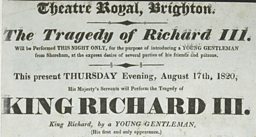
Hannah Manktelow, University of Nottingham doctoral student, working with the British Library writes:

Amateurs usually chose to appear anonymously or under a pseudonym in order to avoid embarrassment if their performance was criticised.
Throughout the 1820s and 30s, as well as children emerging as potential Shakespearean star actors, a number of amateurs took to the stage to perform Shakespeare at the Theatre Royal Brighton.
They generally fell into two categories: individuals hoping to become professional actors, and groups who hired the theatre for a fundraiser or entertainment.
This playbill, now housed in the British Library illustrates the former category. Here we have someone trying to make a name for himself, and prepared to pay for the opportunity…
The traditional path into the theatre industry began with a young man or woman joining a travelling troupe of players. They would work with them for several years on a kind of apprenticeship, gradually expanding their repertoire and learning from the examples of their more experienced colleagues. If they showed talent, they could be scouted to join a resident stock company at a smaller provincial theatre, and from there they would work their way up the ladder to larger theatres such as Brighton's Theatre Royal, aiming to ultimately find a place at London's Drury Lane or Covent Garden, the most prestigious theatres of the day.
Alternatively, wealthy young men with an eye for fame were often reluctant to pay their dues and spend years toiling on makeshift country stages, and so they would take a shortcut, paying a considerable sum to the theatre manager in return for a shot at a lead role in a respected production.
Shakespeare was a popular choice, especially the roles of Richard III and Hamlet, which were considered two of the finest creations in English drama. Just like the young man above, amateurs usually chose to appear anonymously or under a pseudonym in order to avoid embarrassment if their performance was criticised.
![]()
Shakespeare Lives
The nation’s greatest performing arts institutions mark 400 years since the Bard's death

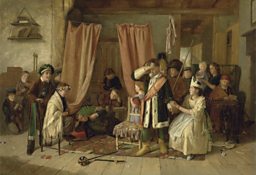
Children Acting the 'Play Scene' from "Hamlet," Act II, Scene ii
Related Links
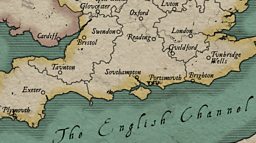
Shakespeare on Tour: Around Sussex and Surrey
![]()
'New Beginnings' in Guildford
The Guildford Shakespeare Company are celebrating their tenth anniversary
![]()
Escaping the London theatre ban
Shakespeare's Players perform in Rye
![]()
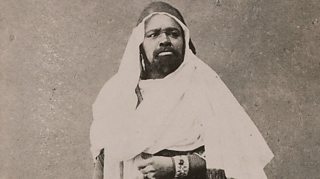
Ira Aldridge
The first black Shakespearean actor
Shakespeare on Tour: Around the country
![]()
The 'Young Roscius' storms Manchester
Boy actor William Betty treads boards at ten
![]()
Will Kemp dances to Norwich
The journey of Shakespeare's former clown
![]()
Domestic Calamity postpones performance
Did the 'curse of Macbeth' strike?
![]()
Jonathan Miller and the Cambridge Footlights
Much ado about Jonathan Miller's Shakespeare