The 18th century impersonator who was 'the Jon Culshaw of his day'
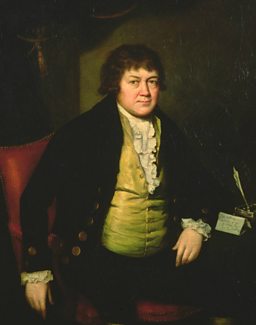
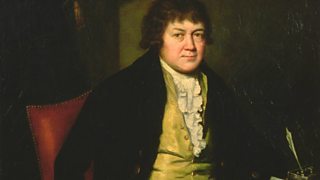
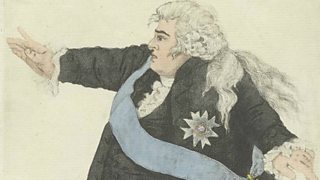
Larger than life Tate Wilkinson (1739 –1803) was a Madeira-swilling actor-manager whose talent for mimicry made him the Jon Culshaw of his day.
He worked in the great London theatres where he’d honed this talent, impersonating some of the best Shakespearean actors and actresses, sometimes even giving speeches with each line delivered in the style of a different actor.
![]()
Much ado near me
Hear more Shakespeare stories on BBC Radio York
![]()
Shakespeare Festival 2016
The BBC celebrates the genius of the bard
His productions - which included many of Shakespeare’s classics - helped develop the York circuit of theatres so it became second only to London, and Bristol and Bath. This group included The Theatre, Leeds, which was built in 1771.
Just as important, he was a passionate Shakespeare advocate with his own ideas about how the dramatist should be performed.
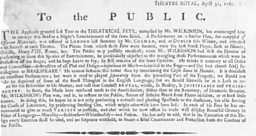
As you can see from this notice on a playbill dated April 31st 1782.
Tate wants to stage a medley of scenes from popular drama. But he assures the public that it won’t be like the ones organised previously – and by other people - which were 'sacrilegious' in their treatment of Shakespeare!
These 'mangled' performances were based on extracts from the company stock plays, those Shakespeare classics that were in the repertoire – Hamlet, Othello, Henry the Fifth, Romeo and so on.
Take for an example, the Closet scene in Hamlet. Were this to be read or played separately from the preceding part of the tragedy we should be deprived of some of the finest thoughts in the English Language, he says.
We would also be baffled by Hamlet’s behaviour towards his mother, unless we know the story leading up to this scene.
So the fete that Tate is planning will be very different – and he lays out his exciting plans in great detail. Scenes will be selected on merit – they won’t be obscure. And he won’t just be staging popular entertainment, he’s paying homage to great literature.
No expense or exertion will be spared to delight spectators with this production which will have everything - beautiful oratory, morality, boldness, whimsicality and pathos.
It’s a good sales pitch for his productions as well as an interesting insight into how this actor-manager ran his theatre.
The advanced booking pioneer
Wilkinson took over the York theatre in 1767 which got its Royal Patent in 1769 for the cost of £500, a huge sum of money for 18th Century England.
It was the third patent to be granted, after theatres in Bath and Norwich. The venue could now call itself “Theatre Royal” and members of the company “his Majesty’s Servants”. He ran a tight ship - one account from this year recounts that the fruit woman paid him a shilling a night for the privilege of plying her wares.
But he probably had a large cast to support. An earlier production has a cast of 23 actors and the prompter, 13 actresses and three children. To encourage people to attend, actors would deliver benefit bills from door to door, begging for support.
This was a practice Tate Wilkinson deplored, “Mr Frodsham, bred as a gentleman with fine natural talents and esteemed in York as a Garrick, the Hamlet of the age, running after or stopping a gentleman on horseback to deliver his benefit bill and beg half a crown…".
He had firm ideas about how to run his theatre. He banned servants from attending without their masters and mistresses because they had been too rowdy. He got rid of the young 'gallants' who would sit on the stage and patrons attending behind the scenes. He disliked late hours so there were no intervals between acts and he introduced advanced booking.
An actor-manager to the bottom of his boots, just before he died his last thought was of his actors and he asked that the theatre should not be closed that night.
He passed away at 4 o’clock and although general gloom pervaded amongst the cast they agreed to his wishes. He was buried at All Saints Church, where there is a mural tablet in the North Aisle.
About Shakespeare on Tour
From the moment they were written through to the present day, Shakespeare’s plays have continued to enthral and inspire audiences. They’ve been performed in venues big and small – including inns, private houses and emerging provincial theatres.
BBC English Regions is building a digital picture which tracks some of the many iconic moments across the country as we follow the ‘explosion’ in the performance of The Bard’s plays, from his own lifetime to recent times.
Drawing on fascinating new research from Records of Early English Drama (REED), plus the British Library's extensive collection of playbills, as well as expertise from De Montfort University and the Arts and Humanities Research Council, Shakespeare on Tour is a unique timeline of iconic moments of those performances, starting with his own troupe of actors, to highlights from more recent times. Listen out for stories on Shakespeare’s legacy on your BBC Local Radio station from Monday 21 March, 2016.
You never know - you might find evidence of Shakespeare’s footsteps close to home…
Craig Henderson, BBC English Regions
Tate takes pity on pregnant actress
Wilkinson refreshed his productions with London based actors, and he also had an eye for new talent.
In 1782 Dorothea Jordan joined the company from Dublin. She was fleeing an abusive relationship with a theatre manager in Dublin that left her pregnant.
Tate hired her but as the name of “Miss Francis” could not apply to a woman in her condition he came up with the name of Mrs Jordan (her escape across the Irish sea was compared to the Israelites crossing to the Promised Land).
At a later point he was less charitable calling her “Mrs Wilful”, when she refused to play one of the parts advertised for her. Jordan went on to become famous as “The Comic Muse” known for her mastery of roles such as Rosalind in “As You Like It”.
But she was just as famous for her role as the mistress of the Duke of Clarence - later William the Fourth with whom she had 10 children.
In many ways her life was a contrast to her contemporary the other great actress, Sarah Siddons, aka the Tragic Muse. While the married Siddons lived a life beyond moral reproach, Jordan’s scandalous relationship characterised the popular Regency idea of the actress.
Related Links
Shakespeare on Tour: Around York
![]()
The 18th century impersonator who was 'the Jon Culshaw of his day'
The city gets its prestigious Theatre Royal
![]()
Interval show lands pair in jail
'Seditious' performance led to court case
![]()
Famous theatre impresario bows out in Scarborough
Stephen Kemble says goodbye to the theatre
![]()
Clamoring crowds wreak havoc at Guildhall
The King's Men return to the popular performance destination
Shakespeare on Tour: Around the country
![]()
Ipswich: a magnet for Shakespeare?
Why did Shakespeare's company visit Ipswich ten times?
![]()
Sarah Siddons visits Norwich
Putting the Theatre Royal, Norwich, on the map
![]()
Madame Tussaud's exhibiton in Nottingham
Including a model of William Shakespeare
![]()
Touring Kent to avoid the plague
In 1592, the plague forced touring theatre companies out of London