
The Golden Age of SteamYou are in: Birmingham > History > The Golden Age of Steam > Beeching & Birmingham 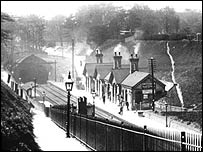 Moseley Station in 1910 Beeching & BirminghamAndy Doherty takes a look at the development, the demise and the Beeching effect on the railways of Birmingham. Many cuts had already been made before Dr Beeching - but one of his legacies was to put more freight and lorries on our roads. Forty five years on from the swinging of the legendary "Beeching Axe", when many stations and track disappeared from the national rail network, the railway scene in Birmingham has undergone something of a renaissance. But lets first take a step back and find out about Birmingham's railway history - as a lot of development and change took place well before Dr Richard Beeching came along. 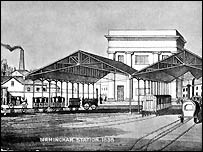 Curzon Street Station in 1838 First railway arrives in BirminghamThe first railway to arrive in Birmingham was the short-lived Grand Junction Railway (GJR) in 1837 whose line from Warrington passed through Bescot and Perry Barr to a temporary terminus at Vauxhall (now Duddeston). The following year saw the London and Birmingham Railway (L&B) arrive in the city centre with their line from London Euston, terminating at a new station at Curzon Street. GJR then extended their Vauxhall line into Curzon Street, setting up their terminus adjacent to that of rivals L&B’s in 1839. Such was the competition to establish transport links with the industrialising city of Birmingham, that in 1839 the third company to reach the city was Birmingham and Derby Junction Railway (BDJR) and a fourth company in 1841 the Birmingham and Gloucester Railway (B&GR). 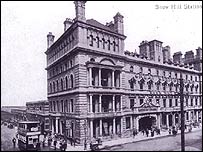 Snow Hill in the early 20th century The major playersIn subsequent years a flurry of mergers and acquisitions left three major players in the Birmingham railway scene: the London and North Western Railway (LNWR), the Midland Railway (MR) and the Great Western Railway (GWR). The latter operated out of Snow Hill station, with the others operating from a joint station at New Street. All three companies set about expanding their network of lines and stations across the city. Whilst there were some early station closures, these were largely due to the expansion of the network - such as the Granville Street terminus of the Midland Railway's Birmingham West Suburban Line which closed in 1885 and Curzon Street and Lawley Street which lost their passenger services in 1854 and 1851, respectively. 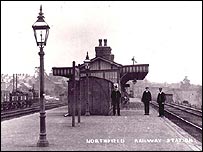 Northfield Railway Station An alternative to railIn the early 1900s the tram and embryonic bus and motor industries began to provide viable alternatives to rail travel leading to the beginning of a series of station and route closures - with the Halesowen Railway from Longbridge through Rubery closing to passengers in 1919 being an early casualty. By this time the region's railway companies had been reduced to just the Great Western Railway and the newly formed London, Midland and Scottish Railway (LMSR), after the 1921 Railways Act which had amalgamated the myriad of rail operators nationwide into four large companies: a process known as 'Grouping'. LMSR set about a program of rationalisation and economies which led to the Camp Hill line from Kings Norton through Moseley and Kings Heath closing to passengers in 1931, Somerset Road and Church Road closing on their other southern approach to New Street on what is now the Cross City Line in 1930 and 1925 respectively, Soho Road and Handsworth Wood closing in 1940 and the axing of passenger services along the Harborne Railway in 1934. The arrival of BeechingBy the time Dr Richard Beeching was appointed as Chair of the British Rail Board in 1961 with a brief to stem the considerable losses of the then-nationalised British Rail network (around £30 million a year), the Birmingham railway scene had already changed out of all recognition from its halcyon period in the late nineteenth century.  Curzon Street station being demolished Freight takes to the roadsIt could be argued that the biggest impact the "Reshaping of British Railways" had on Birmingham stemmed from the radical shakeup of freight handling with an emphasis on identifying major trunk routes for goods and their loading and unloading to be handled in vast freight concentration depots. This move rang the death knell for all goods yards and sidings, with which most passenger stations were equipped, and the closure of lines that had been retained for goods-only purposes beyond the cessation of their passenger services. However, a number of passenger routes were also identified for closure to passenger services in the Report: Derby Midland – Tamworth - Birmingham New Street (Local) 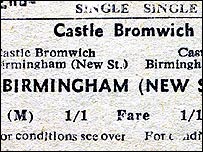 Rail ticket - Castle Brom to New Street This pruning of passenger routes did lead to some station closures within the city such as the closure of Castle Bromwich, Bromford Bridge and Saltley - although these stations were not directly named in the Report itself. Within the County Borough of Birmingham boundary (as at Nationalisation of the railways in 1948) 73 passenger stations had existed - today there are only 38 (four of which were new stations built since the 1960s and occupying sites not previously housing a station: University and Longbridge on the Cross City Line along with Jewellery Quarter and Smethwick Galton Bridge on the Jubilee Line). Re-defining rather than axe wieldingWith hindsight, the Beeching era did more to redefine the operation of the city's railways than it did wield an 'axe' over its stations and, certainly when compared to its close neighbour the Black Country, Birmingham was able to retain the majority of its stations, as much of the pruning had already been achieved by the pre-nationalised railway companies themselves. 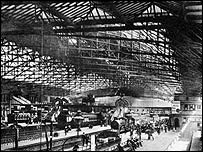 New Street Station in 1903 After BeechingThe erosion of services continued after Beeching's departure in 1965 until the mid-1970s - then rail travel was identified as a viable means of travel once more and investment was made in the redevelopment of the Cross City Line which opened to local services in 1978 and has gone from strength to strength, going some way to disprove Beeching's hypothesis that increased car ownership directly relates to decreased use of the railways, at least in the long-term! Beeching in the Black CountryThe Beeching influence was far more devastating on passenger routes in the Black Country. Take a look at the impact there. last updated: 29/10/2008 at 18:43 SEE ALSOYou are in: Birmingham > History > The Golden Age of Steam > Beeching & Birmingham    Nature in Birmingham |
 About the BBC | Help | Terms of Use | Privacy & Cookies Policy |
