A favourite programme from BBC archives on the popular topic of rocks, this programme covers
- How rocks are formed, including the 3 main rock groups.
- How to recognise different types of rocks.
- The uses of rocks in everyday life.
The programme aims to develop geographical ideas around the topic of rocks. It will help young people to study rocks as materials and also make informed judgements about how we use resources from our natural environment.
It is important to note that since the production of this programme, the Northern Ireland Curriculum for geography has been reviewed. This means that there is now no necessity for children to have in-depth knowledge about the formation of rocks. Teachers are advised to treat rocks as 'materials' and so classify them by their characteristics. This programme helps children to do this by suggesting ways in which they can test rocks and so help them to describe a rock even if they can’t name it.
The programme is divided into 5 main sections, each of which could be used separately:
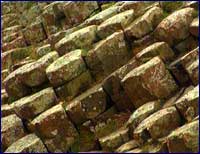
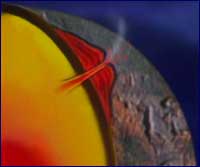
Section 1 – The myth of Finn McCool and how he made the Giant’s Causeway and facts about the structure of the earth.
Section 2 – ‘Fire-made Rocks’ or igneous rocks. These are rocks made from molten lava which has erupted from the earth’s mantle. Maurice, the presenter, uses a pot of porridge to explain how these rocks were formed. We find out that when we look at fire-made rocks closely they always have sparkly crystals. Basalt from County Antrim and granite from County Down are examples of these rocks.
 Section 3
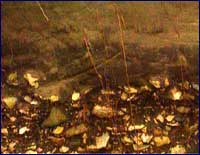
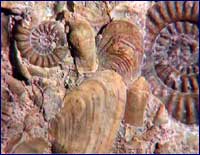
 – ‘Layered Rocks’ or sedimentary rocks. These are rocks made up of tiny parts of sand, plants or animals that have been gradually laid down and squeezed together at the bottom of a sea or lake. Maurice demonstrates how this might have happened by pouring layers of sand into a sweet jar filled with water. When we look at these rocks closely we can see tiny particles within the layers. Limestone, sandstone and shale are all layered rocks.
Section 4 – ‘Changed Rocks’ or metamorphic rocks. These rocks used to be layered but have been squeezed and changed by heat and pressure. They include schist, marble and slate.
Section 5 – This final section looks at how rocks are used in our everyday lives. It reminds us how many metals come from ores which are extracted from rocks and looks briefly at the issue of quarrying rocks from the landscape around us.







 Display the rocks with their descriptions but this time sorted by their characteristics. There is no need to ever identify a rock by name or type, simply by its characteristics.