This programme will introduce and explore the issue of "sustainability". It will help people understand what the term "sustainability" means and will show them that there is a connection between our lifestyles and our environment.
It will also create opportunities for further development in the classroom and help to stimulate lively discussion on the subject. There is a particular emphasis on the problem of waste.
The programme starts by looking at the way we live today. We learn that our current lifestyle in the developed world is based on a huge consumption of goods.
We visit the P7 class at Forge Primary School in Belfast where the teacher, Anne-Marie, and the pupils are working on a project. We learn that all products are made from natural resources. The pupils discuss what natural resources are used to make the different products we use (iron ore for cars, trees for furniture, oil for plastic and minerals in computers etc.) And we learn that many natural resources are limited.
The pupils discuss what happens to the products we buy. We use a lot but we also throw a lot away. We are introduced to the issue of waste. In the old days people did not waste as much as we do today. They did not have rubbish bins.
We then discover what happens to the waste that is produced in Belfast. We learn that an average family in Belfast produces a lot of waste each year - the weight of a medium sized elephant! Ninety per cent of this waste ends up in the landfill site. Much of the rubbish also produces pollution.
Later, back at the school, the pupils discuss the amount of waste that they create. We learn that one pupil produces ten times their weight in rubbish each year - when the landfills fill up what will happen to the rubbish then?
The class then visit the ECOS environmental centre in Ballymena. The director of the centre, Billy Reid, explains that we need to think about how people will live in the future. We must live in a sustainable way today - and that means thinking about how we use natural resources and what pollution we cause.
The pupils have learnt that human actions are causing problems to the environment. At the centre they see that human actions can help to solve these problems. They learn that we can reduce what we consume, we can reuse some products and we can recycle.
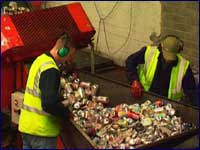
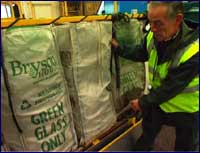
Back at the school they explore the idea of recycling. This happens in nature as e.g. vegetable matter and fruit decay but we can also help to recycle. The class visits a local recycling project run by the charity Bryson House.
The pupils learn that some natural resources are non-renewable, like oil and iron ore, and that some are renewable. One of the best natural resources are trees which give us a variety of products from wood chips and floorboards to furniture and bowls.
Finally, we see the pupils planting trees in the school grounds. The tree represents a natural resource that gives us many benefits and that can be endlessly recycled with our help. All the actions we take have an effect on our environment. They will also affect people in the future. We can help to look after our environment, and live in a more sustainable way, by taking positive actions:
- We can reduce the amount of products we use.
- We can reuse products whenever possible.
- We can recycle products such as glass, paper, some kinds of plastic and metal and tin objects.