Summary

  1. Lebanon says 203 killed in Israeli strikes yesterdaypublished at 09:54 BST

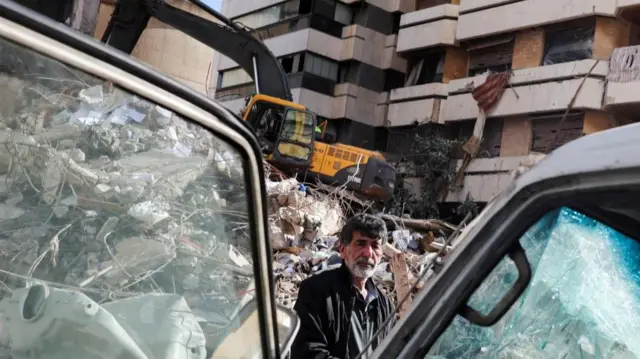
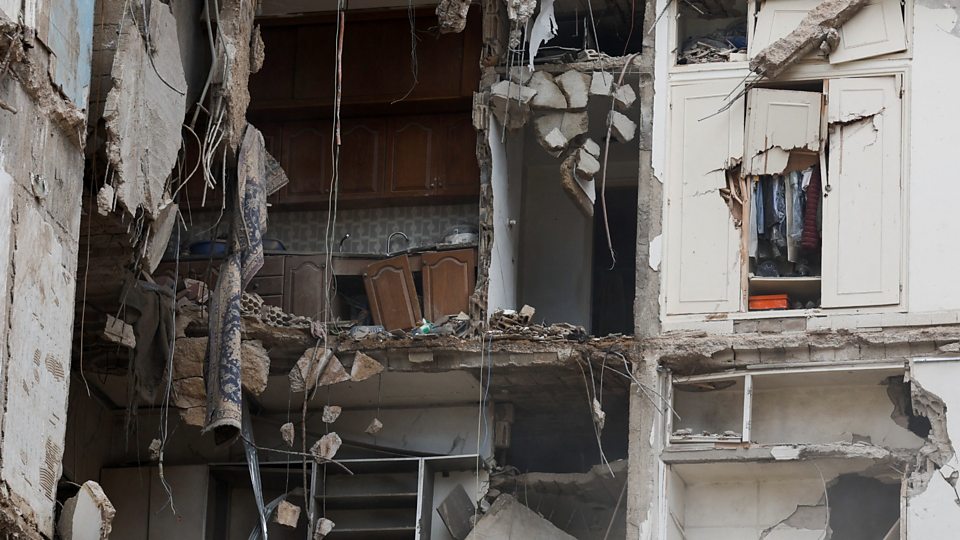
    Lebanon’s health ministry says 203 people have been killed and more than 1,000 wounded in the last 24 hours across the country.

    It comes as Iran says ongoing Israeli strikes across the nation are a "grave violation" of the US-Iran ceasefire agreement.
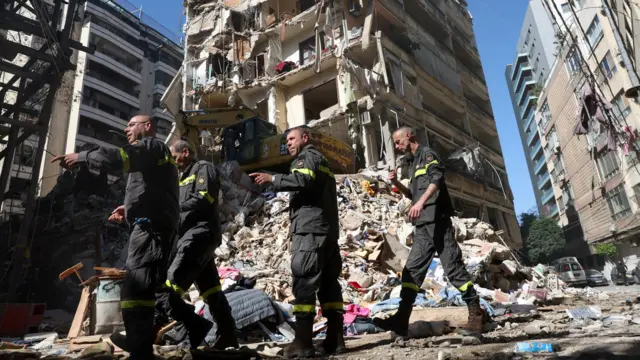
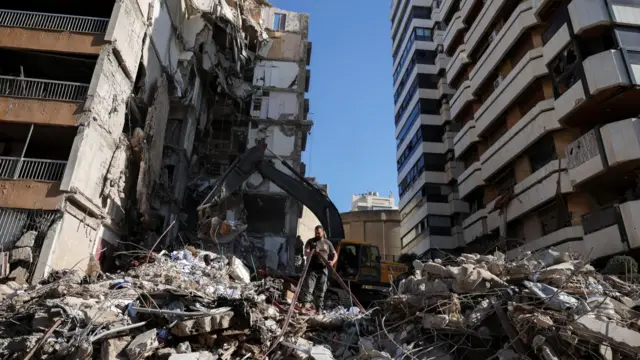
    Rescuers work at the site of an Israeli strike carried out on Wednesday, in Ain Al Mraiseh in Beirut, Lebanon on ThursdayImage source, Reuters
  2. 'Impossible' to tell when ships can pass through Strait of Hormuz, says shipping firm directorpublished at 09:40 BST

    Safety remains uncertain for ships passing through the Strait of Hormuz, according to the senior director of a global shipping company.

    Speaking to the Today programme, Nils Haupt from Hapag-Lloyd says the shipping company still has six vessels stuck in the Gulf.

    He adds that one of the company's ships was struck by bomb fragments in the strait two weeks ago, despite not being targeted in an attack.

    "The ship burned, the engine room burned and the crew had to extinguish the fire for two hours so that was kind of traumatising for the crew", he says.

    Asked when he thinks the firm will be able to get their ships out of the Gulf, he says that question is "impossible to answer".

    This Flourish post cannot be displayed in your browser. Please enable Javascript or try a different browser.

  3. Oil prices creep up amid ceasefire concernspublished at 09:22 BST

    Nick Edser
    Business reporter

    Oil prices have crept up and financial markets remain edgy as concerns grow over whether the US-Iran ceasefire will hold and whether the crucial Strait of Hormuz shipping route will open.

    After plunging on Wednesday in the immediate aftermath of the ceasefire being announced, the price of Brent crude oil was up 2.7% on Thursday at $97.23 a barrel.

    Stock markets in Asia fell back, reversing some of the big increases they had seen yesterday. Japan’s Nikkei closed down 0.7% while South Korea’s Kopsi index fell 1.6%.

    In Europe, the UK’s FTSE 100 index was down 0.1% shortly after opening and markets in Germany and France were also lower.

    "I think there's a little bit of nervousness in global markets," Victoria Scholar, head of investment at Interactive Investor, told the BBC's Today programme.

    "Markets are giving back some gains… and I think that reflects a lot of uncertainty over whether the Strait of Hormuz is actually open."

    This Flourish post cannot be displayed in your browser. Please enable Javascript or try a different browser.

  4. France condemns 'unacceptable' Israeli strikes on Lebanonpublished at 09:08 BST

    A man stands near a damaged vehicle and rubble at the site of an Israeli strike in Tallet El Khayat in BeirutImage source, Reuters
    Image caption,

    A man stands near a damaged vehicle and rubble at the site of an Israeli strike in Tallet El Khayat in Beirut

    As we reported earlier, UK Foreign Secretary Yvette Cooper called Israel's strikes on Lebanon "completely wrong". There has also been reaction from across Europe:

    • Israel's strikes on Lebanon were "unacceptable", Foreign Minister Jean-Noel Barrot says - while adding Iran must give up the means to obtain nuclear weapons, and its support for proxies like Hezbollah and Hamas
    • The Israeli strikes were "all the more unacceptable as they undermine the temporary ceasefire reached yesterday between the United States and Iran", he says
    • Italian PM Giorgia Meloni says: "We have come within a step of the point of no return, but we now face a fragile prospect of peace that must be pursued with determination"
    • Meanwhile, Spain is reopening its embassy in Tehran, its foreign minister says. Jose Manuel Albares also accused Israel of "flouting the ceasefire" and being "in violation of international law"

  5. Strikes on Lebanon overnight targeted Hezbollah infrastructure, says Israelpublished at 08:56 BST

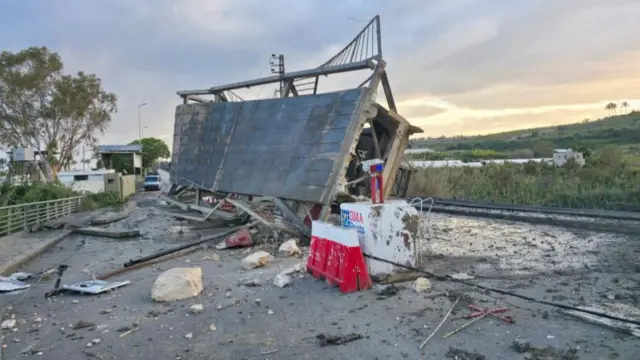
    A damaged bridge in Qasmiyeh, southern Lebanon, seen on Thursday morningImage source, Reuters
    Image caption,

    A damaged bridge in Qasmiyeh, southern Lebanon, seen on Thursday morning

    Overnight, Israel struck several Hezbollah facilities and infrastructure in Lebanon, the Israel Defense Forces (IDF) says.

    The IDF says it struck two bridges over the Litani river, which has been heavily targeted in recent weeks, isolating southern Lebanon.

    At the end of March, Israel said it was setting up a buffer zone within southern Lebanon, and the area to be occupied would go up to the Litani river - about 30km (18.6 miles) from the border with Israel.

    The IDF adds that it killed Ali Yusuf Harshi, the secretary and nephew of the Hezbollah secretary-general. Hezbollah has not commented.

    The overnight strikes come after heavy attacks on Lebanon on Wednesday afternoon, in which the Israel says it 100 targets in the space of 10 minutes. The Lebanon health ministry says at least 182 people were killed.

    Media caption,

    Israel says it hit Lebanon 100 times in just 10 minutes

  6. Israeli strikes against Lebanon on Wednesday 'completely wrong' - UK foreign secretarypublished at 08:35 BST

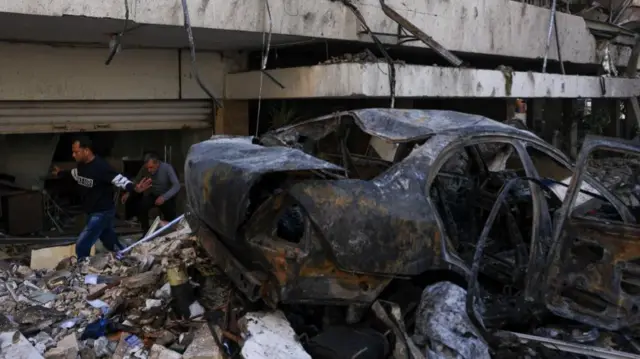
    A burnt car at the site of an Israeli strike in Al-Mazraa in Beirut. The Lebanese health ministry says Israeli attacks killed at least 182 people on WednesdayImage source, Reuters
    Image caption,

    A burnt car at the site of an Israeli strike in Al-Mazraa in Beirut. The Lebanese health ministry says Israeli attacks killed at least 182 people on Wednesday

    With Keir Starmer in the UAE, we've just heard more from UK Foreign Secretary Yvette Cooper, who was speaking to Radio 4's Today programme.

    She repeats her call for Lebanon to be "urgently included" in the US-Iran ceasefire agreement, describing Israel's strikes against Lebanon on Wednesday as "completely wrong".

    "We’ve seen the mass displacement of civilians in Lebanon with significant humanitarian consequences.

    "This escalation in damaging, it's wrong… we want the ceasefire extended to cover Lebanon."

    Cooper is then asked about the Iranian deputy foreign minister's comments that the Strait of Hormuz is not in international waters and that safe passage depends on the "the goodwill of Iran and Oman".

    She disputes this, stating freedom of navigation applies to international transit routes under maritime law, adding that "countries cannot simply hijack those kinds of international transit routes and unilaterally apply tolls".

  7. Keir Starmer arrives in UAE for talks on Iran warpublished at 08:25 BST
    Breaking

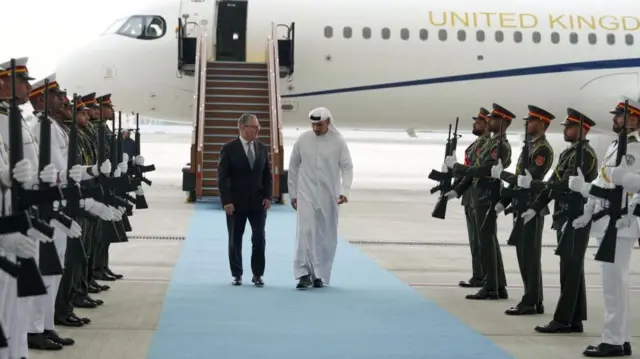
    Keir Starmer welcomed by Khaldoon Khalifa Al Mubarak, chairman of the Executive Affairs Authority, as he arrives at the airport in Abu Dhabi in the UAE earlier todayImage source, PA Media
    Image caption,

    Keir Starmer welcomed by Khaldoon Khalifa Al Mubarak, chairman of the Executive Affairs Authority, as he arrives at the airport in Abu Dhabi in the UAE earlier today

    UK Prime Minister Keir Starmer has arrived in the United Arab Emirates for further talks on the Iran war.

    His arrival comes with the US-Iran ceasefire under strain - with Iran saying that ongoing Israeli strikes against Lebanon are a "grave violation" of the deal.

    Starmer has already met Saudi Crown Prince Mohammed Bin Salman in Jeddah, and is expected to meet UAE President Sheikh Mohamed bin Zayed Al Nahyan.

  8. Recap: What Iran's deputy foreign minister told the BBCpublished at 08:12 BST

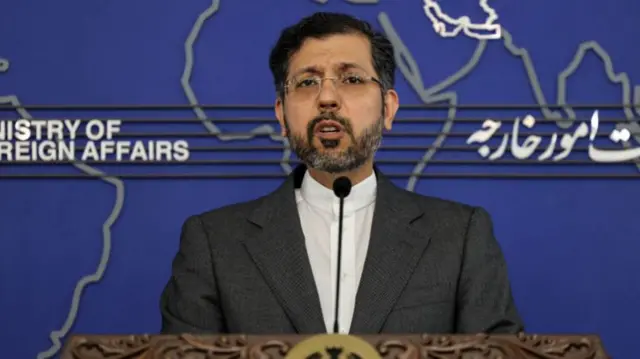
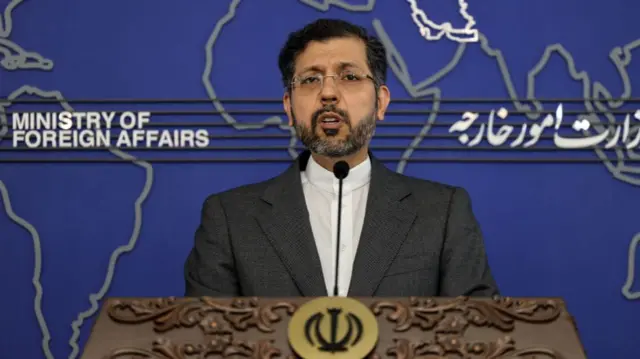
    Saeed Khatibzadeh speaks behind an ornate wooden lectern in front of a large map of the world.Image source, Getty Images

    BBC's Today programme earlier had an exclusive 15-minute interview with Iran's deputy foreign minister, Saeed Khatibzadeh. Here's a recap of what he said:

    • After Israeli attacks on Lebanon continued on Wednesday - despite a US-Iran ceasefire - the minister says Iran sent a message to the Oval Office last night, which he sums up as: "You cannot have a cake and eat it at the same time"
    • He adds: "You cannot ask for a ceasefire and then accept terms and conditions, accept all the areas that a ceasefire is applied to, and name Lebanon, exactly Lebanon in that, and then your ally [Israel] just starts a massacre"
    • He says the US "must choose" whether it wants war or peace. "They cannot have it both at the same time. They are mutually exclusive, it is quite clear"
    • When questioned on whether Iran will pull out of negotiations if the Israeli strikes continue, he says: "We are very much focusing on the wellbeing of the whole Middle East"
    • Nick Robinson asked if Iran will ask its militant proxy, Hezbollah, to stop firing rockets into Israel from Lebanon. Khatibzadeh says the deal includes Lebanon, and Iran and its allies were willing to "accept ceasefire"
    • The minister says Iran will "provide security for safe passage" through the Strait of Hormuz - but reopening will only happen "after the United States actually withdraw this aggression", seemingly referring to Israel's attacks on Lebanon
  9. Lebanon should be 'urgently included' in ceasefire, says UK foreign secretarypublished at 08:03 BST
    Breaking

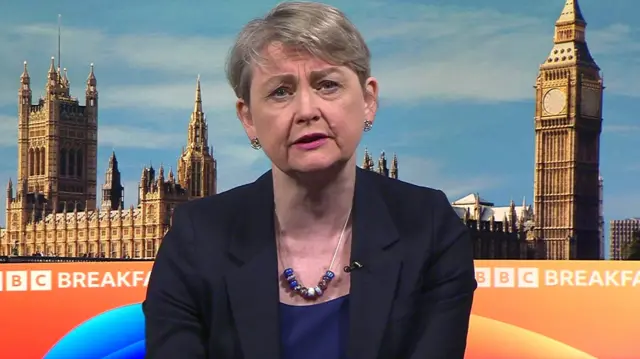
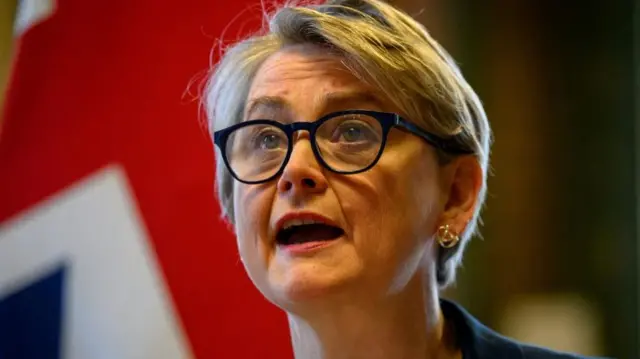
    Yvette Cooper on BBC Breakfast

    While the Iranian deputy foreign minister was speaking to the Today programme, the UK foreign secretary was talking to BBC Breakfast TV.

    She says Lebanon should be "urgently included" in the conditional two-week ceasefire agreement between the Untied States and Iran.

    Cooper says she is "extremely concerned" by the "escalation of Israeli strikes" seen in the country on Wednesday,.

    She says she believes this is the "right thing to do" for Israel's security as well as the "wider security of the region".

  10. Iran minister says Strait of Hormuz will reopen when the US stops 'aggression'published at 08:01 BST

    Khatibzadeh tells the Today programme that Iran will "provide security for safe passage" through the Strait of Hormuz - which he says was "open for millenia" until the US war with Iran began.

    However, he says the reopening will only happen "after the United States actually withdraw this aggression", seemingly referring to Israel's attacks on Lebanon.

    Khatibzadeh says Iran will abide by "international norms and international law" - however, he says the strait is not in international waters, and safe passage depends on "the goodwill of Iran and Oman".

    Nick Robinson asks if safe passage means Iran will not be "charging a fee for every ship that goes through, or threatening to blow it up".

    In response, the minister says Iran wants the strait be be "peaceful", but safe passage is two-sided and it will not accept the Gulf being "misused by warships".

    This Flourish post cannot be displayed in your browser. Please enable Javascript or try a different browser.

  11. Minister pressed on whether Iran will stop Hezbollah attacking Israelpublished at 07:55 BST

    Khatibzadeh says "we ask everyone in the Middle East to be abiding by this ceasefire that we reached with Americans".

    Nick Robinson asks if this means Iran will ask its militant proxy, Hezbollah, to stop firing rockets into Israel from Lebanon.

    Khatibzadeh says that "it's quite clear Hezbollah is pure Lebanese freedom movement".

    He is pressed on whether he is denying that Iranian officers are advising, training and arming Hezbollah.

    "I'm not denying that," he says, adding that he is "not shy to say" that Iran provides "support to this freedom and resistance movement", but it is "not true that they are acting on behalf of us".

    He adds that, on the US-Iran deal, it was included that Iran and its allies and the US and its allies were "going to accept ceasefire from that moment".

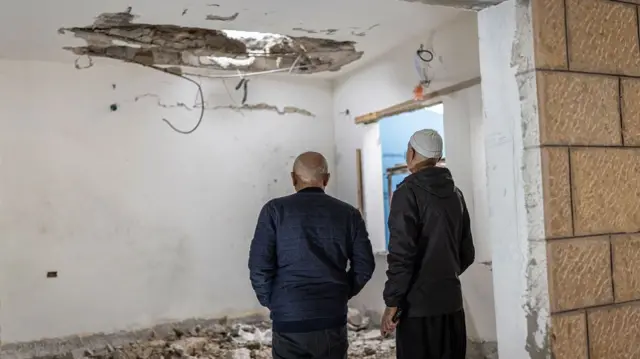
    This picture, taken on 2 April, shows people in the Israeli city of Shefa-Amr inspecting damage from a rocket fired from LebanonImage source, Getty Images
    Image caption,

    This picture, taken on 2 April, shows people in the Israeli city of Shefa-Amr inspecting damage from a rocket fired from Lebanon

  12. Back and forth messages between US and Iran last night - ministerpublished at 07:46 BST

    On this weekend's talks between the US and Iran in Pakistan, Khatibzadeh says that "back and forth messages" between both sides continued through Pakistan last night.

    He adds that Iran is "very much focused on getting this done" as it's "within our national interests".

    He says he understands that US Vice President JD Vance is going to lead the talks for the US, and the speaker of Iran's parliament Mohammad Bagher Ghalibaf is going to lead the talks for Iran.

  13. US 'must choose' between war and ceasefire, minister sayspublished at 07:35 BST

    In his inteview with the Today programme, Iran's deputy foreign minister says the US "must choose" whether it wants war or peace.

    "They cannot have it both at the same time. They are mutually exclusive, it is quite clear."

    As we already reported, Saeed Khatibzadeh says Israel's ongoing strikes in Lebanon are a "grave violation" of the US-Iran ceasefire.

    Iran, he says, asks "everybody in the Middle East to abide by this agreement...and we expect the Americans to do the same with its allies."

    When questioned by Nick Robinson on whether Iran will pull out of negotiations if the Israeli strikes continue, he says: "We are very much focusing on the wellbeing of the whole Middle East."

  14. Listen to Iran's deputy foreign minister livepublished at 07:32 BST
    Breaking

    We have already brought you some key lines from our interview with Iran's deputy foreign minister, Saeed Khatibzadeh.

    He says the Israeli attacks on Lebanon on Wednesday were a "grave violation" of the US-Iran ceasefire.

    You can listen to the full interview now - either click here, or press "listen live" at the top of the page.

  15. After a day of horror in Beirut, it's hard to know what Israel's long-term strategy ispublished at 07:23 BST

    Hugo Bachega
    Middle East correspondent, reporting from Beirut

    The aftermath of an Israeli strike on Beirut, seen on ThursdayImage source, Reuters
    Image caption,

    The aftermath of an Israeli strike on Beirut, seen on Thursday

    The morning after Israel’s bombs brought horror and destruction to this city, Beirut is quiet.

    President Joseph Aoun described it as a “massacre”, and the government announced that today would be a public holiday, to mourn those who were killed.

    For 10 minutes, at around 14:00 here, the whole country came under attack.

    The Israeli military said more than 100 air strikes were carried out on what it described as Hezbollah targets. Busy, densely populated residential areas were hit, and Israel knew that this would inevitably lead to a high number of casualties.

    According to the Lebanese health ministry, at least 182 people were killed, a number that is likely to be higher, and 890 wounded.

    It is difficult to see what the long-term Israeli strategy is.

    Even Israeli military officials acknowledge what has been known in Lebanon for a long time: that Hezbollah will not be disarmed by force.

    The attacks may give Israel some military gain, but this is likely to be limited.

    Meanwhile, opponents and supporters of the group are coming together in their anger and criticism of Israel, united in their view that what happened here was unacceptable and unjustifiable.

  16. You cannot have a cake and eat it at the same time, Iranian minister tells USpublished at 07:18 BST
    Breaking

    Saeed Khatibzadeh speaks behind a wooden lectern in front of a large map of the world.Image source, Getty Images

    We can bring you some more lines now from the Today programme's interview with Iran's deputy foreign minister.

    Saeed Khatibzadeh says Iran sent a message to the Oval Office last night: "You cannot have a cake and eat it at the same time."

    He adds: "You cannot ask for a ceasefire and then accept terms and conditions, accept all the areas that a ceasefire is applied to, and name Lebanon, exactly Lebanon in that, and then your ally just starts a massacre."

    Khatibzadeh says the strikes by Israel amount to a "sort of genocide". Israel insists it is hitting the militant group Hezbollah, which is itself firing rockets into Israel.

    You can hear the full interview on BBC Radio 4 from 07:30 BST - listen live at the top of the page.

  17. Israeli attacks on Lebanon were 'grave violation' of ceasefire, Iranian minister tells BBCpublished at 07:07 BST
    Breaking

    The Israeli attacks on Lebanon on Wednesday were a "grave violation" of the US-Iran ceasefire, Iran's Deputy Foreign Minister Saeed Khatibzadeh tells the BBC's Today programme in an exclusive interview.

    We'll have more lines from that interview very soon - and you can hear the full thing on BBC Radio 4 from 07:30 BST.

  18. Iranian negotiators head to Pakistan - despite scepticism over 'repeated ceasefire violations'published at 06:53 BST
    Breaking

    An Iranian delegation is heading to Pakistan today to begin negotiations with the US on ending the war, Iran's ambassador to Pakistan has confirmed.

    They are set to meet US Vice-President JD Vance in Islamabad on Saturday.

    Reza Amiri Moghadam, the Iranian ambassador to Pakistan, posts on X that the talks will be "based on 10 points proposed by Iran". As we've reported, there is some confusion about exactly what those points are.

    Moghadam says the talks will take place "despite skepticism of Iranian public opinion due to repeated ceasefire violations by Israeli regime to sabotage the diplomatic initiative".

  19. UK to urge Strait of Hormuz reopening - and for Lebanon to be included in ceasefirepublished at 06:18 BST

    Yvette CooperImage source, Reuters

    UK Foreign Secretary Yvette Cooper will call for the Strait of Hormuz to be fully reopened later today.

    In her annual speech on UK foreign policy priorities, Yvette Cooper will also call for Lebanon to be included in the US and Israel's ceasefire agreement with Iran.

    Pakistan - which mediated the US-Iran ceasefire - initially said Lebanon was included in the deal. But Israel said it was not and carried on with air strikes, killing 182 people yesterday, according to Lebanon's health ministry.

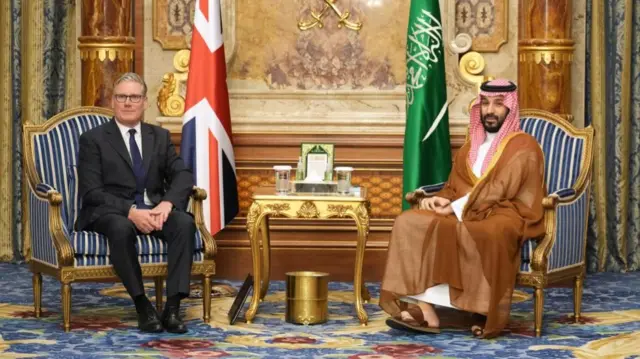
    Prime Minister Sir Keir Starmer is visiting allies in the Gulf, last night meeting Saudi Crown Prince Mohammed bin Salman, who agreed on the need for a lasting peace.

    Prime Minister Sir Keir Starmer met Saudi Arabia's Crown Prince Mohammed bin Salman in Jeddah, Saudi Arabia, on WednesdayImage source, PA Media
    Image caption,

    Prime Minister Sir Keir Starmer met Saudi Arabia's Crown Prince Mohammed bin Salman in Jeddah, Saudi Arabia, on Wednesday

  20. Oil prices rise on Thursday as ceasefire remains uncertainpublished at 05:55 BST

    A picture of petrol pumps at a gas stationImage source, Getty Images

    Oil prices nudged higher on Thursday morning trading in Asia after plunging when the US agreed to stop striking Iran for two weeks.

    Global benchmark Brent crude was up 2.2% at $96.70 (£72.18) a barrel, while US-traded West Texas Intermediate was 2.8% higher at $96.90.

    Cracks in the conditional ceasefire have started to show after Israel continued to launch strikes at Lebanon.

    Brent initially sank 15% to just under $92 a barrel on Wednesday after US President Donald Trump's announcement, though prices edged upwards slightly later in the day.

    Oil prices are still far higher than they were before the war started on 28 February.

    Read more here.