Summary

  1. Analysis

    Potential Houthi threat to Red Sea shipping could further damage global economypublished at 20:04 GMT

    Sebastian Usher
    Middle East analyst
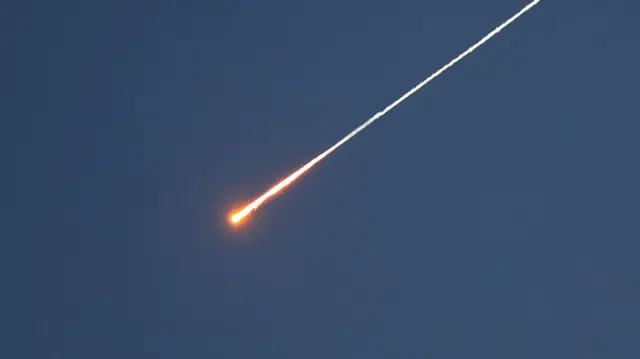
    A missile fired at Israel from YemenImage source, Getty Images
    Image caption,

    The Houthis have fired a missile at Israel for the first time since the recent conflict in the Middle East began

    The Houthis held their fire for the first four weeks of the war, despite their affiliation with and backing from Iran.

    Now, the movement that still holds the Yemeni capital, Sanaa, and the north and other areas of the country, has made its first move, firing missiles towards Israel.

    It is true that the threat the Houthis pose to Israel through its missile fire is far less than that of Iran, but the group poses a threat off the coast of Yemen.

    As part of their support for Hamas in Gaza, the group targeted shipping coming through the Bab al-Mandab strait at the southern end of the Red Sea, between Yemen and the Horn of Africa.

    Their action then endangered that key commercial maritime route.

    Were they to do so again, it would be another big blow to the global economy.

    Coupled with Iran's near-closure of the Strait of Hormuz, two of the main strategic waterways in the world for trade and energy supplies could potentially be cut off.

  2. Pakistan given greater access to Strait of Hormuz, deputy prime minister sayspublished at 19:48 GMT

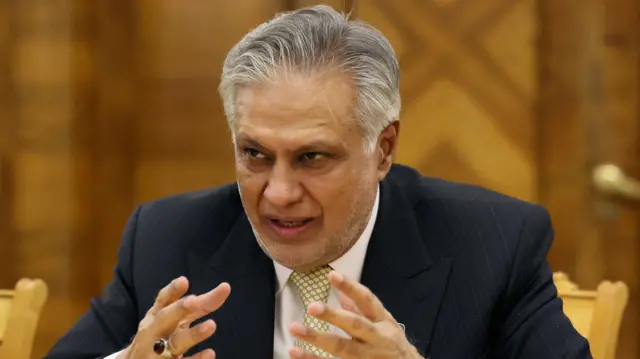
    Ishaq DarImage source, Reuters
    Image caption,

    Ishaq Dar says two ships under the Pakistani flag will now cross through the Strait of Hormuz each day

    Pakistan has been given greater access to the Strait of Hormuz, according to Deputy Prime Minister Ishaq Dar.

    Dar, who is also foreign minister, says Iran "has agreed to allow 20 more ships under the Pakistani flag to pass through the Strait of Hormuz".

    He says this means "two ships will cross the Strait daily". Iran is yet to confirm this.

    Since the start of the recent conflict, Iran has effectively closed the Strait of Hormuz, one of the world's busiest oil shipping channels.

    About 20% of the world's oil and liquefied natural gas (LNG) usually passes through the strait, but BBC Verify analysis has shown daily traffic has been down by about 95%.

    Dar says the agreement with Iran is a "harbinger of peace" which "will help usher stability in the region".

    Pakistan's Prime Minister Shehbaz Sharif has volunteered his country as a venue for possible talks between Iran and the US.

  3. US-Israeli strikes hit Iranian water facility, official sayspublished at 19:38 GMT

    A large water facility in Iran has been hit by US-Israeli strikes, according to Iran's Fars news agency.

    Citing the deputy for security and law enforcement of the Khuzestan Governorate, Fars says a "10,000 cubic metre" water source in Haftkel, western Iran, was targeted.

    The news agency, which is affiliated with Iran's Islamic Revolutionary Guards Corps, says there were no reported casualties and adds that water sources are still functioning in Haftkel.

  4. Centcom says it has struck more than 11,000 targets in war with Iranpublished at 19:17 GMT

    We've just seen an update from the US Central Command (Centcom) detailing key figures regarding Operation Epic Fury - their ongoing military action in Iran.

    Centcom says they have:

    • Struck more than 11,000 targets
    • Carried out more than 11,000 combat flights
    • Either damaged or destroyed over 150 Iranian vessels

    In the update, Centcom also says its forces are "striking targets to dismantle the Iranian regime's security apparatus, prioritizing locations that pose an imminent threat".

  5. Iran Foreign Ministry spokesman condemns attacks on universitiespublished at 19:10 GMT

    Ghoncheh Habibiazad
    Senior reporter, BBC Persian

    Iranian Foreign Ministry spokesman Esmail Baghaei, in a post on X, has condemned attacks on two universities in Iran; Isfahan University of Technology in central Iran and the University of Science and Technology in Tehran.

    Baghaei accuses the US and Israel of attempting to cripple the “country’s scientific foundation and cultural heritage by systematically targeting universities, research centers, historical monuments, and prominent scientists”.

    He has also says that US and Israel claims of countering Iran’s nuclear programme and threats by Tehran were “nothing but vicious pretexts” and “mere fabrications designed to conceal their real intention”.

  6. BBC Verify

    Footage shows damage at Tehran university after overnight strikespublished at 18:59 GMT

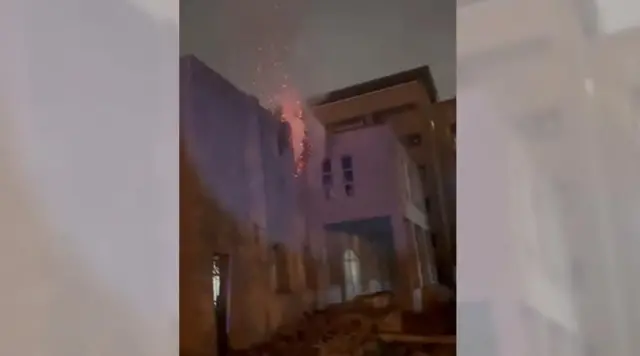
    A video clip shows a fire burning in the location of the language faculty of Iran University of Science and Technology (IUST)Image source, X

    Mobile phone footage, geolocated by BBC Verify, shows the aftermath of overnight strikes on the Iran University of Science and Technology (IUST) in eastern Tehran’s Narmak neighbourhood.

    Multiple locations across the Iranian capital were struck, including the IUST, which appears to have been hit in the early hours of Saturday.

    The video clip shows a fire burning in the location of the language faculty. As the camera pans round it shows sparks and smoke emerging from the teaching faculty. Large amounts of rubble can be seen on the ground.

    We verified the video by matching the buildings seen in the footage with satellite imagery of the campus. Reverse-image searches showed the footage had not been uploaded before today.

    Getting video and pictures from inside Iran has been made more difficult since the war began as the authorities are severely restricting internet access for most Iranians.

  7. WHO director says 51 Lebanese health workers killed this month, including nine todaypublished at 18:46 GMT

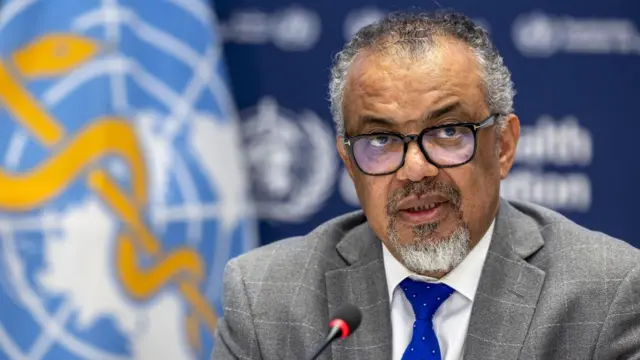
    Ghebreyesus speaks to media during a press conferenceImage source, SALVATORE DI NOLFI/EPA-EFE/REX/Shutterstock

    Nine paramedics have been killed in southern Lebanon today, according to the director-general of the World Health Organization (WHO).

    In an X post, Tedros Adhanom Ghebreyesus adds that this takes the number of health personnel killed in Lebanon this month to 51 - making it the second most deadly month for the country's health workers since the WHO began monitoring them in October 2023.

    "The repeated attacks on health care are severely disrupting the delivery of services in southern Lebanon," says Ghebreyesus.

    "Health workers are protected under international humanitarian law and should never be targeted."

    According to news agency Agence France-Presse, Lebanese Health Minister Rakan Nassereddine says that 46 of the 51 health workers killed are paramedics.

  8. More than 250 targets hit across Iran and Lebanon this weekend, says IDFpublished at 18:27 GMT

    The Israeli military says it has hit more than 250 Iranian and Hezbollah targets this weekend.

    In an update, the IDF says that it has completed "dozens of wide-scale waves of strikes" across Lebanon and Iran.

    In Iran, it says it struck over 100 targets, including "ballistic missile production sites, ready-to-launch missiles" and "missile storage facilities".

    In Lebanon, it says that "more than 170 Hezbollah targets were struck".

    The military adds that "four IDF divisions are operating in southern Lebanon to deepen the targeted ground activity and eliminate terrorists".

  9. Second Houthi missile fired at Israel - reportspublished at 18:08 GMT
    Breaking

    The Houthi rebel group in Yemen has fired a second missile towards Israel, CNN and the Times of Israel are both reporting.

    The Iran-backed group has launched a cruise missile at Israel which was shot down, hours after it shot a ballistic missile into its airspace, the outlets say.

    Separately, Israeli media Channel 12 and Times of Israel are also reporting a drone attack on Eilat in southern Israel, which they say was sent from Yemen.

    Earlier, the Houthis said they had fired a barrage of ballistic missiles "targeting sensitive Israeli military sites" in response to Israel's targeting of Iran, Lebanon, Iraq and Palestinian territories. Israel said it had intercepted a missile from Yemen.

  10. Sources report heavy strikes in Tehranpublished at 17:53 GMT
    Breaking

    Ghoncheh Habibiazad
    Senior reporter, BBC Persian

    Two sources have reported heavy strikes on east and west Tehran.

    Iranian outlets are reporting that air defences have been activated.

  11. Israel strikes Iran's headquarters for naval weapons, IDF sayspublished at 17:27 GMT

    The Israel Defense Forces (IDF) says it has struck the headquarters of the Iranian regime's Marine Industries Organization (MIO) in Tehran.

    "This headquarters is responsible for the research, development, and production of a wide range of naval weaponry," Israel's military says in a statement.

    The MIO headquarters was hit as part of "a wide-scale wave of strikes" targeting infrastructure across Iran's capital overnight, the statement adds.

  12. Burned-out car and press vest: Photo from scene of strike which killed journalistspublished at 17:14 GMT

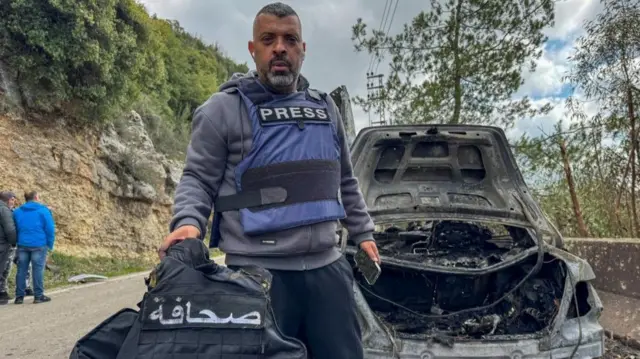
    Al Mayadin journalist Jamal Al-Gharabi holds a press vest next to a car destroyed by an Israeli strike that killed Lebanese journalists Al Mayadeen reporter Fatima Ftouni and cameraman Mohammed Ftouni, and Al Manar reporter Ali Shaib, amid escalating hostilities between Israel and HezbollahImage source, Reuters
    Image caption,

    Al Mayadin journalist Jamal Al-Gharabi

    We have now seen images of a journalist holding a press vest at the site of a strike in Lebanon, where three journalists were killed.

    A burned-out car is visible in the background.

    The man in the photo, Jamal Al-Gharabi, works for Al Mayadin, a TV channel based in Beirut.

    As we reported earlier, two of the journalists killed in the strike were his colleagues: reporter Fatima Fetoni and cameraman Mohamed Fetoni.

    A reporter from Hezbollah’s Al Manar TV channel, Ali Shoeib, was also killed.

    Confirming Shoeib's death in a post on Telegram, the Israel Defense Forces (IDF) accused him of being a Hezbollah operative "under the guise of a journalist".

    But responding to the attack, the Committee to Protect Journalists (CPJ), a leading body which promotes press freedom, says: "Journalists are not legitimate targets, regardless of the outlet they work for."

    Sara Qudah, regional director at the CPJ, says there is a "disturbing pattern" both "in this war and in the decades prior" of "Israel accusing journalists of being active combatants and terrorists without providing credible evidence".

    During the course of the war in Gaza, Israel has repeatedly denied deliberately targeting civilians.

  13. Yemen's internationally-recognised government accuses Iran of dragging country into conflictpublished at 16:48 GMT

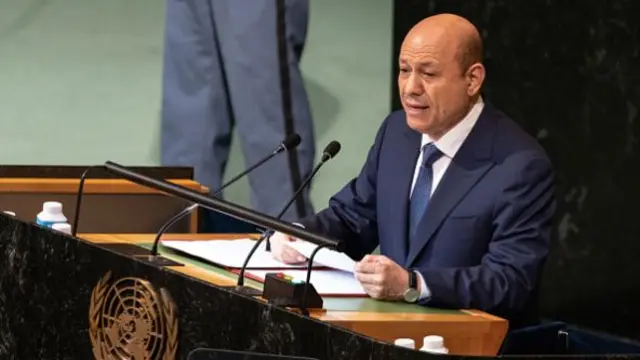
    Rashad al-Alimi, president of Yemen's Presidential Leadership CouncilImage source, Bloomberg via Getty Images
    Image caption,

    Rashad al-Alimi, who heads Yemen's Presidential Leadership Council

    Yemen's internationally-recognised government has condemned what it describes as Iran's "frequent attempts to drag Yemen" and other countries in the Middle East into the conflict "through its terrorist militias".

    For context, Yemen has been engulfed in a civil war that escalated in 2015 when the Iran-backed Houthi rebel group seized control of the country's north-west from the internationally-recognised government, leading to intervention from a Saudi-led coalition supported by the US.

    In a statement, the Presidential Leadership Council, which governs from the southern port city of Aden but frequently conducts operations from Riyadh in Saudi Arabia, says "the involvement of the Houthi militias in defending the Iranian regime" shows that Iran is "pushing its agents to open other fronts" in order to reduce political pressure on itself.

    It warns that this would exacerbate poor "humanitarian and living conditions... in a country already suffering from one of the worst humanitarian crises in the world".

    The Houthi rebels consider themselves part of the Iranian-led "axis of resistance" against Israel, the US and the wider West - along with armed groups such as Hamas and Lebanon's Hezbollah movement.

  14. US warship arrives in 'area of responsibility' - US Central Commandpublished at 16:23 GMT

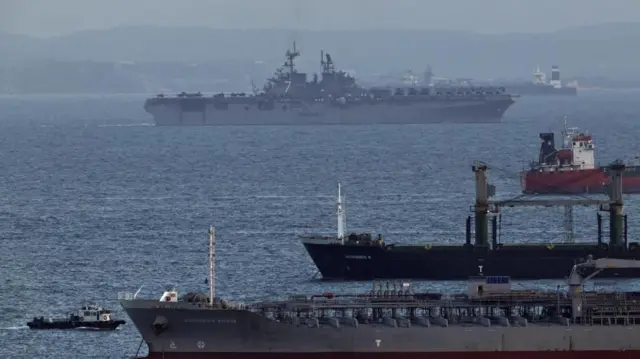
    The USS Tripoli amphibious assault ship enters the Singapore Strait, amid the US-Israeli conflict with Iran, as seen from Singapore, 17 March 2026.Image source, Reuters
    Image caption,

    The USS Tripoli was seen entering the Singapore Strait earlier this month

    The warship USS Tripoli has arrived in US Central Command's "area of responsibility", it writes on X.

    A more specific location is not disclosed, but the so-called area of responsibility spans across north-east Africa, the Middle East and central and south Asia.

    US media previously reported that the ship would lead an amphibious ready group being deployed to the Middle East. The unit headed by the USS Tripoli typically consists of around 5,000 sailors and Marines distributed across several warships.

    The warship was previously based in Japan.

    In recent weeks, the US administration has faced increasing questions about whether it will deploy boots on the ground in the region.

    Speaking to reporters after a G7 meeting on Friday, US Secretary of State Marco Rubio said the US could achieve its goals in Iran "without any ground troops".

  15. Israeli military and Gulf nations report drone attackspublished at 15:59 GMT

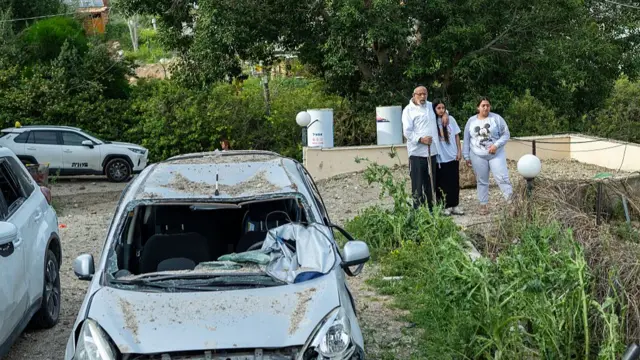
    Civilians in Beit Shemesh view a damaged car near a crater left by a missileImage source, Getty Images
    Image caption,

    Civilians gather around a damaged car in Beit Shemesh, central Israel, which was hit by missiles earlier today

    The Israel Defence Forces (IDF) says it's working to intercept Iranian missiles which have been launched towards Israeli territory. As we reported in our last post, emergency services have been inspecting the site of a missile strike in central Israel.

    Qatar's defence ministry, meanwhile, says the country has been "targeted by an attack" involving "a number of drones launched from Iran" today, all of which have been intercepted.

    Kuwait International Airport has seen "significant damage" to its radar system after being targeted by 15 drones, says Kuwait's defence ministry. No casualties have been reported.

    Earlier, five people were reportedly injured in Abu Dhabi - in the United Arab Emirates - after a ballistic missile was intercepted.

    Saudi Arabia's Ministry of Defence also earlier shared an update, saying it intercepted three drones and a ballistic missile launched towards Riyadh.

  16. Missiles hit central Israelpublished at 15:55 GMT

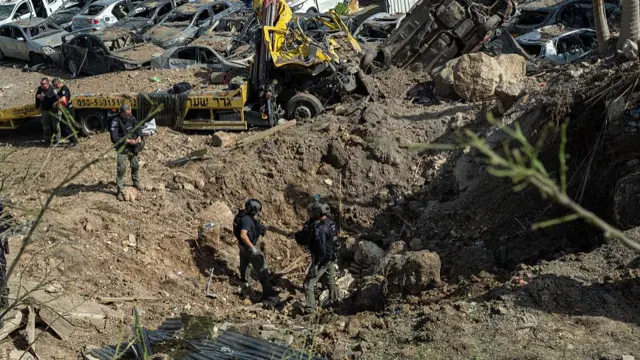
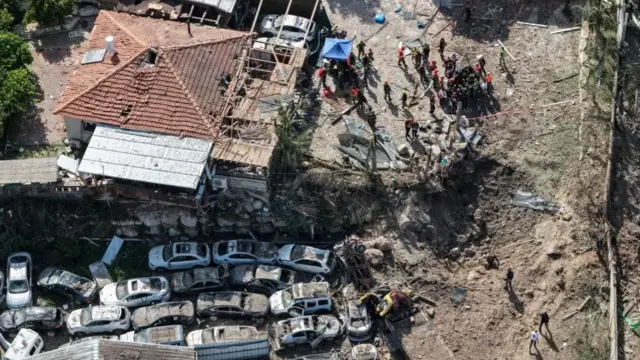
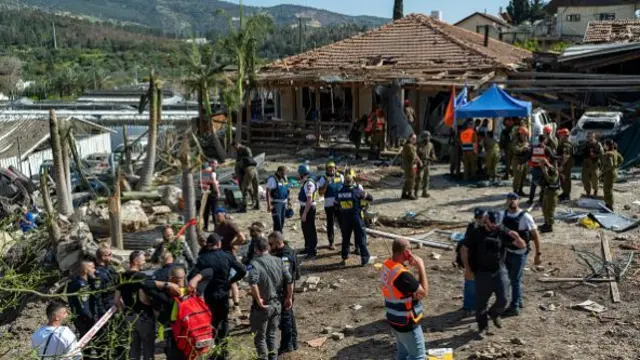
    These are some of the latest pictures from the Beit Shemesh area in central Israel, which has been hit by several missiles.

    A large crater has been formed at the impact site, with the strike damaging buildings and cars and emergency services at the scene.

    Israeli Police say the fall of ammunition in the Judean Hills area near Jerusalem has injured 12 people. Officials and volunteers continue to operate at the scene, they write on X.

    The Times of Israel reports that the country's air force will investigate the failure to shoot down the ballistic missile that made impact.

    First responders gather near a crater left by an Iranian missile on March 28, 2026 in Beit Shemesh, Israel.Image source, Getty Images
    An aerial view of the site of the crater surrounded by cars and a buildingImage source, Reuters
    Emergency responders stand around on the ground at the site of a missile strikeImage source, Getty Images
  17. The strike on a school that killed 168 people on first day of war - a reminderpublished at 15:25 GMT

    Local people and rescue workers looking for survivors in the rubble of the schoolImage source, Mehr News/WANA via Reuters
    Image caption,

    Local people and rescue workers looking for survivors in the rubble of the school

    As we've just reported, Iran says the US and Israel have attacked a clinic near the site of a fatal school strike on the first day of the war.

    What happened?

    On the first day of the US-Israeli war with Iran, a strike hit Shajareh Tayyebeh school, located in Minab, southern Iran.

    It killed at least 168 people, including about 110 children, according to Iranian officials. Funerals were held for the victims on Iranian state TV.

    The girls school was located near an Islamic Revolutionary Guard Corps (IRGC) base which has previously been a target.

    What's been said since?

    Following the attack, Iran's President Masoud Pezeshkian called the incident a "barbaric act", adding to the "countless crimes committed by the aggressors".

    The Israel Defense Forces (IDF) said it was "not aware" of any Israeli military operations in the area.

    Weeks later, US Defence Secretary Pete Hegseth said the US did not target civilians, and the issue was being investigated.

    US media have reported that US military investigators believe American forces were likely responsible for hitting the school unintentionally - but that they have not reached a final conclusion.

    Since then, UN Commissioner for Human Rights Volker Türk has urged the US to conclude its investigation and publish its findings on the deadly attack.

  18. Iran says US and Israel have attacked clinic nearby site of fatal school strikepublished at 14:53 GMT

    Ghoncheh Habibiazad
    Senior reporter, BBC Persian

    A clinic located close to the Shajareh Tayyebeh Primary School in Minab county - which was hit on the first day of the war - has been attacked, an Iranian official has said.

    The Political, Security, and Social Deputy Governor Ahmad Nafisi, of the southern Hormozgan province, says the attack caused "damage to the storage facilities" at the Martyr Absalan Clinic.

    Iran's Fars News Agency, which is affiliated to the Islamic Revolutionary Guard Corps (IRGC), cites Nafisi as saying the US and Israel used "several drones" in the attack on the medical complex.

    "Fortunately, this attack did not lead to any casualties," he says, adding an investigation into the extent of the attack is under way.

    The area had been evacuated following the fatal strike on the primary school on 28 February - when the US and Israel launched their offensive against Iran. Iranian officials say the attack on the school involved two missile strikes in quick succession, killing at least 168 people, including about 110 children.

    US media have reported that American military investigators believe its own forces were likely responsible for hitting the school unintentionally, while US Defence Secretary Pete Hegseth has said the matter is being investigated.

    Nafisi adds: "Today the whole world knows that the area targeted by the enemy is by no means military, yet we are once again witnessing an attack on this area, which clearly proves the deliberate nature of the attack on Shajareh Tayebeh School in Minab and the killing of 168 pupils and teachers."

    People and rescue forces work following an Israel strike on a school in Minab, Iran,.Image source, Reuters
    Image caption,

    The strike on the Minab school took place on the first day of the US-Israeli war with Iran

  19. Israeli strike kills three journalists in Lebanonpublished at 14:44 GMT

    Lina Sinjab
    Middle East correspondent, reporting from Beirut

    Three Lebanese journalists have been killed in a targeted Israeli strike on their media car in southern Lebanon, local media is reporting.

    Ali Shoeib, reporter for Al Manar TV - a network operated by militant group Hezbollah - and Al Mayadin reporters Fatima and Mohamed Fetoni were killed in an air strike in the town of Jezzine.

    Lebanese President Joseph Aoun condemned the attack as a "blatant crime" that violates international law under which journalists should be protected during war.

    Israel's military has confirmed it killed Ali Shoeib in a strike, but accuses him of being a Hezbollah-operative posing as a journalist.

    This is the second time Israel has been accused of targeting journalists in Lebanon since the war broke out.

    Last week, Mohammad Sherri - a prominent presenter at Al Manar TV - and his wife were killed in a targeted strike.

    So far, more than 1100 civilians, including 120 Children and 42 paramedics, have been killed in Israeli airstrikes in Lebanon.

    Many in Lebanon are worried that Israel is using similar tactics which it has been accused of deploying in Gaza - including the deliberate targeting of civilians, journalists and paramedics, which Israel has denied.

  20. Zelensky says Russia is supplying intelligence to Iran on US and UK basespublished at 14:17 GMT

    Vitaly Shevchenko
    Chief analyst, BBC Monitoring

    President Volodymyr Zelensky has accused Russia of helping Iran attack US and UK military bases in the Gulf as well as a joint US-UK base on Diego Garcia, part of the Chagos Islands - officially known as the British Indian Ocean Territory.

    Speaking to journalists, Zelensky read off his phone what he said was an intelligence report saying that Russian satellites had been spying on US military bases in the Middle East, the Diego Garcia base and oil wells across the Gulf.

    Zelensky suggested that this intelligence had been passed on to Iran to assist with its attacks.

    Commenting on the war in Ukraine, he said he was working to ensure that his country's ability to fight Russia was unaffected by the global energy crisis which erupted because of the war in Iran.

    Answering a question from the BBC, President Zelensky said the Ukrainian army had enough fuel - for now.