Summary

  1. Yemen's internationally-recognised government accuses Iran of dragging country into conflictpublished at 16:48 GMT
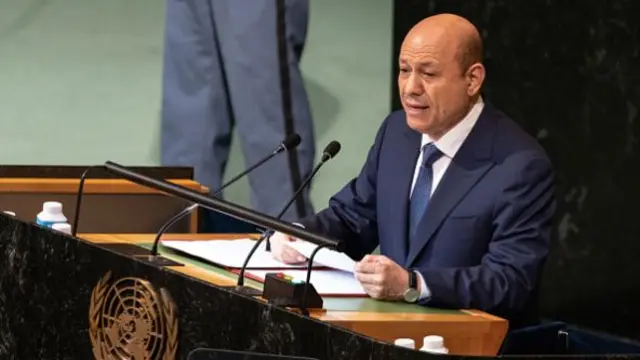
    Rashad al-Alimi, president of Yemen's Presidential Leadership CouncilImage source, Bloomberg via Getty Images
    Image caption,

    Rashad al-Alimi, who heads Yemen's Presidential Leadership Council

    Yemen's internationally-recognised government has condemned what it describes as Iran's "frequent attempts to drag Yemen" and other countries in the Middle East into the conflict "through its terrorist militias".

    For context, Yemen has been engulfed in a civil war that escalated in 2015 when the Iran-backed Houthi rebel group seized control of the country's north-west from the internationally-recognised government, leading to intervention from a Saudi-led coalition supported by the US.

    In a statement, the Presidential Leadership Council, which governs from the southern port city of Aden but frequently conducts operations from Riyadh in Saudi Arabia, says "the involvement of the Houthi militias in defending the Iranian regime" shows that Iran is "pushing its agents to open other fronts" in order to reduce political pressure on itself.

    It warns that this would exacerbate poor "humanitarian and living conditions... in a country already suffering from one of the worst humanitarian crises in the world".

    The Houthi rebels consider themselves part of the Iranian-led "axis of resistance" against Israel, the US and the wider West - along with armed groups such as Hamas and Lebanon's Hezbollah movement.
  2. US warship arrives in 'area of responsibility' - US Central Commandpublished at 16:23 GMT

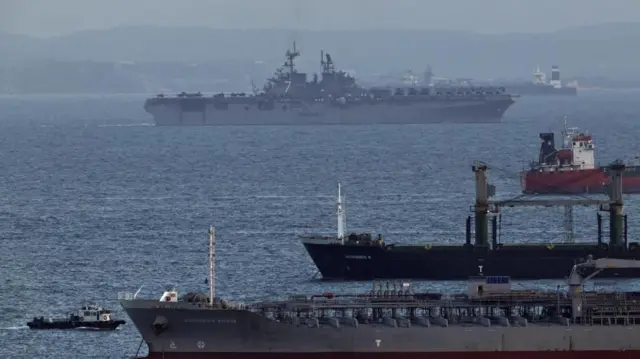
    The USS Tripoli amphibious assault ship enters the Singapore Strait, amid the US-Israeli conflict with Iran, as seen from Singapore, 17 March 2026.Image source, Reuters
    Image caption,

    The USS Tripoli was seen entering the Singapore Strait earlier this month

    The warship USS Tripoli has arrived in US Central Command's "area of responsibility", it writes on X.

    A more specific location is not disclosed, but the so-called area of responsibility spans across north-east Africa, the Middle East and central and south Asia.

    US media previously reported that the ship would lead an amphibious ready group being deployed to the Middle East. The unit headed by the USS Tripoli typically consists of around 5,000 sailors and Marines distributed across several warships.

    The warship was previously based in Japan.

    In recent weeks, the US administration has faced increasing questions about whether it will deploy boots on the ground in the region.

    Speaking to reporters after a G7 meeting on Friday, US Secretary of State Marco Rubio said the US could achieve its goals in Iran "without any ground troops".

  3. Israeli military and Gulf nations report drone attackspublished at 15:59 GMT

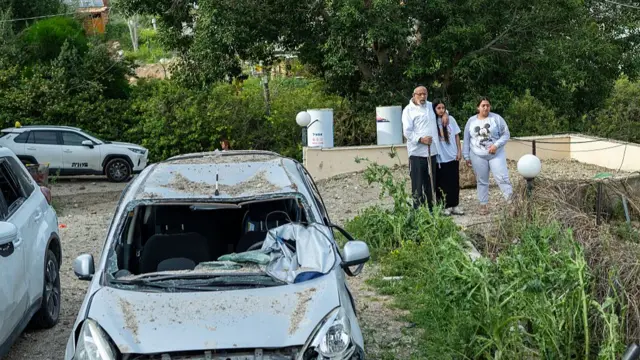
    Civilians in Beit Shemesh view a damaged car near a crater left by a missileImage source, Getty Images
    Image caption,

    Civilians gather around a damaged car in Beit Shemesh, central Israel, which was hit by missiles earlier today

    The Israel Defence Forces (IDF) says it's working to intercept Iranian missiles which have been launched towards Israeli territory. As we reported in our last post, emergency services have been inspecting the site of a missile strike in central Israel.

    Qatar's defence ministry, meanwhile, says the country has been "targeted by an attack" involving "a number of drones launched from Iran" today, all of which have been intercepted.

    Kuwait International Airport has seen "significant damage" to its radar system after being targeted by 15 drones, says Kuwait's defence ministry. No casualties have been reported.

    Earlier, five people were reportedly injured in Abu Dhabi - in the United Arab Emirates - after a ballistic missile was intercepted.

    Saudi Arabia's Ministry of Defence also earlier shared an update, saying it intercepted three drones and a ballistic missile launched towards Riyadh.

  4. Missiles hit central Israelpublished at 15:55 GMT

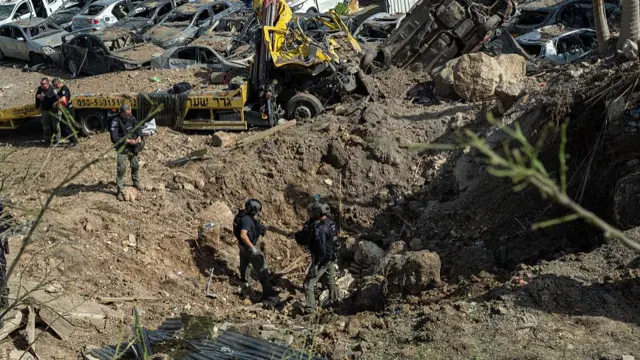
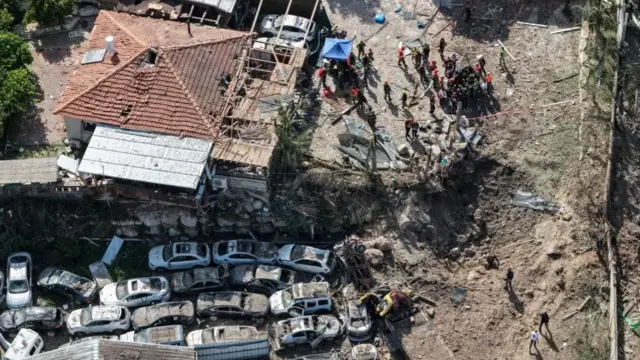
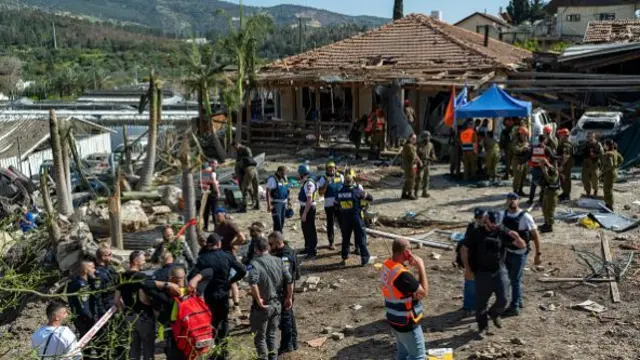
    These are some of the latest pictures from the Beit Shemesh area in central Israel, which has been hit by several missiles.

    A large crater has been formed at the impact site, with the strike damaging buildings and cars and emergency services at the scene.

    Israeli Police say the fall of ammunition in the Judean Hills area near Jerusalem has injured 12 people. Officials and volunteers continue to operate at the scene, they write on X.

    The Times of Israel reports that the country's air force will investigate the failure to shoot down the ballistic missile that made impact.

    First responders gather near a crater left by an Iranian missile on March 28, 2026 in Beit Shemesh, Israel.Image source, Getty Images
    An aerial view of the site of the crater surrounded by cars and a buildingImage source, Reuters
    Emergency responders stand around on the ground at the site of a missile strikeImage source, Getty Images
  5. The strike on a school that killed 168 people on first day of war - a reminderpublished at 15:25 GMT

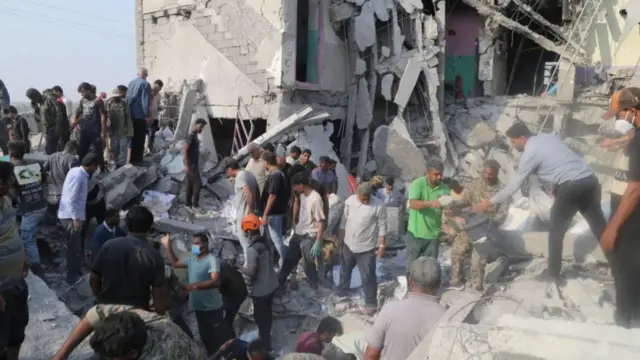
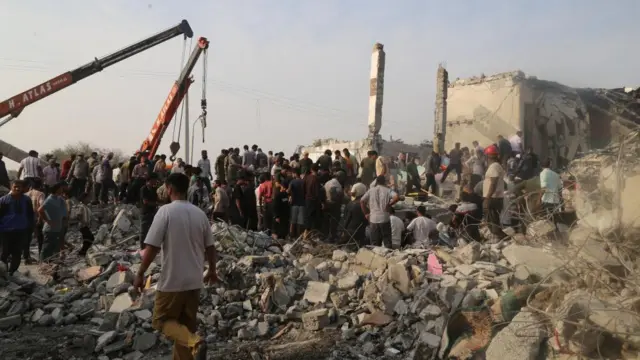
    Local people and rescue workers looking for survivors in the rubble of the schoolImage source, Mehr News/WANA via Reuters
    Image caption,

    Local people and rescue workers looking for survivors in the rubble of the school

    As we've just reported, Iran says the US and Israel have attacked a clinic near the site of a fatal school strike on the first day of the war.

    What happened?

    On the first day of the US-Israeli war with Iran, a strike hit Shajareh Tayyebeh school, located in Minab, southern Iran.

    It killed at least 168 people, including about 110 children, according to Iranian officials. Funerals were held for the victims on Iranian state TV.

    The girls school was located near an Islamic Revolutionary Guard Corps (IRGC) base which has previously been a target.

    What's been said since?

    Following the attack, Iran's President Masoud Pezeshkian called the incident a "barbaric act", adding to the "countless crimes committed by the aggressors".

    The Israel Defense Forces (IDF) said it was "not aware" of any Israeli military operations in the area.

    Weeks later, US Defence Secretary Pete Hegseth said the US did not target civilians, and the issue was being investigated.

    US media have reported that US military investigators believe American forces were likely responsible for hitting the school unintentionally - but that they have not reached a final conclusion.

    Since then, UN Commissioner for Human Rights Volker Türk has urged the US to conclude its investigation and publish its findings on the deadly attack.

  6. Iran says US and Israel have attacked clinic nearby site of fatal school strikepublished at 14:53 GMT

    Ghoncheh Habibiazad
    Senior reporter, BBC Persian

    A clinic located close to the Shajareh Tayyebeh Primary School in Minab county - which was hit on the first day of the war - has been attacked, an Iranian official has said.

    The Political, Security, and Social Deputy Governor Ahmad Nafisi, of the southern Hormozgan province, says the attack caused "damage to the storage facilities" at the Martyr Absalan Clinic.

    Iran's Fars News Agency, which is affiliated to the Islamic Revolutionary Guard Corps (IRGC), cites Nafisi as saying the US and Israel used "several drones" in the attack on the medical complex.

    "Fortunately, this attack did not lead to any casualties," he says, adding an investigation into the extent of the attack is under way.

    The area had been evacuated following the fatal strike on the primary school on 28 February - when the US and Israel launched their offensive against Iran. Iranian officials say the attack on the school involved two missile strikes in quick succession, killing at least 168 people, including about 110 children.

    US media have reported that American military investigators believe its own forces were likely responsible for hitting the school unintentionally, while US Defence Secretary Pete Hegseth has said the matter is being investigated.

    Nafisi adds: "Today the whole world knows that the area targeted by the enemy is by no means military, yet we are once again witnessing an attack on this area, which clearly proves the deliberate nature of the attack on Shajareh Tayebeh School in Minab and the killing of 168 pupils and teachers."

    People and rescue forces work following an Israel strike on a school in Minab, Iran,.Image source, Reuters
    Image caption,

    The strike on the Minab school took place on the first day of the US-Israeli war with Iran

  7. Israeli strike kills three journalists in Lebanonpublished at 14:44 GMT

    Lina Sinjab
    Middle East correspondent, reporting from Beirut

    Three Lebanese journalists have been killed in a targeted Israeli strike on their media car in southern Lebanon, local media is reporting.

    Ali Shoeib, reporter for Al Manar TV - a network operated by militant group Hezbollah - and Al Mayadin reporters Fatima and Mohamed Fetoni were killed in an air strike in the town of Jezzine.

    Lebanese President Joseph Aoun condemned the attack as a "blatant crime" that violates international law under which journalists should be protected during war.

    Israel's military has confirmed it killed Ali Shoeib in a strike, but accuses him of being a Hezbollah-operative posing as a journalist.

    This is the second time Israel has been accused of targeting journalists in Lebanon since the war broke out.

    Last week, Mohammad Sherri - a prominent presenter at Al Manar TV - and his wife were killed in a targeted strike.

    So far, more than 1100 civilians, including 120 Children and 42 paramedics, have been killed in Israeli airstrikes in Lebanon.

    Many in Lebanon are worried that Israel is using similar tactics which it has been accused of deploying in Gaza - including the deliberate targeting of civilians, journalists and paramedics, which Israel has denied.

  8. Zelensky says Russia is supplying intelligence to Iran on US and UK basespublished at 14:17 GMT

    Vitaly Shevchenko
    Chief analyst, BBC Monitoring

    President Volodymyr Zelensky has accused Russia of helping Iran attack US and UK military bases in the Gulf as well as a joint US-UK base on Diego Garcia, part of the Chagos Islands - officially known as the British Indian Ocean Territory.

    Speaking to journalists, Zelensky read off his phone what he said was an intelligence report saying that Russian satellites had been spying on US military bases in the Middle East, the Diego Garcia base and oil wells across the Gulf.

    Zelensky suggested that this intelligence had been passed on to Iran to assist with its attacks.

    Commenting on the war in Ukraine, he said he was working to ensure that his country's ability to fight Russia was unaffected by the global energy crisis which erupted because of the war in Iran.

    Answering a question from the BBC, President Zelensky said the Ukrainian army had enough fuel - for now.

  9. Qatar and Ukraine sign defence dealpublished at 13:53 GMT

    Katy Watson
    Reporting from Doha

    The Emir of Qatar, Sheikh Tamim bin Hamad Al Thani, meets President of Ukraine, Volodymyr Zelenskiy, in Doha, QatarImage source, Reuters

    Qatar and Ukraine have signed a defence agreement which will enable the two countries to share expertise in countering threats from both missiles and drones.

    It’s the latest in a round of deals and discussions that Ukrainian President Volodymyr Zelensky has had on his whistlestop tour of the Gulf this week.

    According to a statement from Qatar’s Ministry of Defence, the two sides discussed the security developments in the region and areas in which they could cooperate. An agreement was then signed by Ukraine’s Chief of the Armed Forces Lt Gen Andriy Hnatov and the Chief of Staff of Qatar Armed Forces Lt Gen Jassim bin Mohammed Al-Mannai.

    The agreement will enable collaboration in technology as well as defence investments.

    Ukraine wants to offer support to Gulf states that have come under attack in the past month since the war with Iran started (Ukraine prides itself on its drone expertise) but also wants more support from allies that could help support the war against Russia - allies with deep pockets and capacity to back Kyiv, especially with US attentions focused elsewhere right now.

  10. In Tehran, some are getting used to the sound of strikespublished at 13:29 GMT

    Ghoncheh Habibiazad
    Senior reporter, BBC Persian

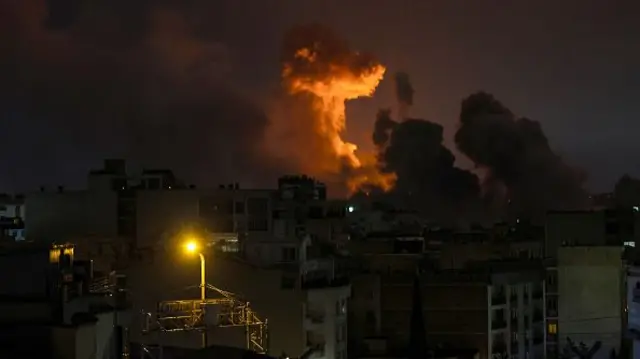
    A red glow around a smokey cloud over a city skyline at night timeImage source, Getty Images
    Image caption,

    Smoke rises over Tehran, following an overnight air strike

    Moving away from Zelensky's visit to the Middle East now, we can bring you the latest from Tehran:

    Tehran has had another night of heavy strikes on the city. There was also rain and temporary power cuts in some parts of Tehran, I've heard.

    "I saw that right beneath my window, the glass above my head was shaking hard, so I got up and went into the sitting room just in case it shattered and fell on me," a man in his twenties in Tehran tells me.

    "It didn’t end there, and the strikes got worse. My family got so scared that they all screamed and ran out of the house."

    There are still some I’m talking to who support the strikes. A man in his thirties tells me: "I still want it to keep going until the clerics are gone. I don’t have a problem with it. Might as well see it through to the end now that we’ve come this far."

    It has been a month since the war started, and some are getting used to the sound of the strikes.

    "I heard the strikes last night, but I was so tired that I went back to sleep. I went out to the park for a walk in the morning and also got a takeaway coffee," says a woman in her twenties in Tehran.

    But with the strikes ongoing, more people have decided to leave the capital. "I’ve decided to go to northern Iran. It’s very relaxed and chill here. Compared to Tehran, it’s as if there’s no war," a woman in her twenties tells me.

  11. Analysis

    Zelensky cultivating relationships in Middle East, as war takes spotlight off Ukrainepublished at 12:49 GMT

    Katy Watson
    Reporting from Doha

    As we reported a little earlier, Ukraine’s president Volodomyr Zelensky has touched down in Qatar - the latest leg in his whistlestop tour of the Gulf region.

    Ukraine’s had to become an expert in drone technology in the past few years of the war with Russia – and now, Kyiv’s looking to leverage that expertise by helping Gulf states counter Iranian drones that have attacked the region in the past month.

    Earlier this week Ukraine signed a deal with Saudi Arabia and Zelensky also had meetings in the United Arab Emirates.

    And what will Ukraine get out of these visits?

    Well, building better relationships with Gulf states that have deep pockets could help Ukraine with much-needed air defence from Russia’s ballistic missiles.

    And it couldn’t come at a more important time – with the war in the Middle East, US defence efforts are stretched and the spotlight has come off Ukraine somewhat.

    Zelensky no doubt realises he needs to build broader relationships with other allies to ensure Ukraine has the support it needs to defend itself from Russia.

  12. 'It's a lie': Kyiv denies reports Iran destroyed air defences in Dubaipublished at 12:44 GMT

    Vitaly Shevchenko
    Chief analyst, BBC Monitoring

    Earlier, Iranian media reported that a Ukrainian air defence depot in Dubai had been destroyed.

    Ukraine's foreign ministry spokesperson, Heorhii Tykhyi, denies the report in a message to journalists.

    "It's a lie. We officially deny this report. The Iranian regime often carries out such disinformation operations, and is no different from the Russians in this respect," he says.

    It comes amid Ukrainian President Zelensky's visits to several Gulf countries - our next post from the BBC's Katy Watson will explore how he is cultivating relationships.

  13. Iran says it destroyed Ukraine's anti-drone systems depot in Dubaipublished at 12:42 GMT

    Ghoncheh Habibiazad
    Senior reporter, BBC Persian

    Ebrahim Zolfaghari, a spokesperson for Iran's Khatam al-Anbiya Central Headquarters, the country's highest operational command unit co-ordinating the armed forces, has said in a statement that Iran has targeted a warehouse "stockpiling Ukrainian counter-drone systems" in Dubai.

    In a statement published by Iranian outlets, Zolfaghari claims that a "warehouse storing counter-drone systems belonging to Ukraine in Dubai to help the US military and where 21 Ukrainians were also on site, was targeted and destroyed in a combined operation by the Aerospace and Naval forces of the Islamic Revolutionary Guard Corps (IRGC)."

    In the statement, Zolfaghar says that "there is no information about the fate of the Ukrainian personnel present at that warehouse".

    Ukraine has since denied Iran's reports, we'll have more on that in our next post.

  14. As strikes continue across the Middle East, Zelensky offers drone expertisepublished at 12:33 GMT

    Matt Spivey
    Live editor

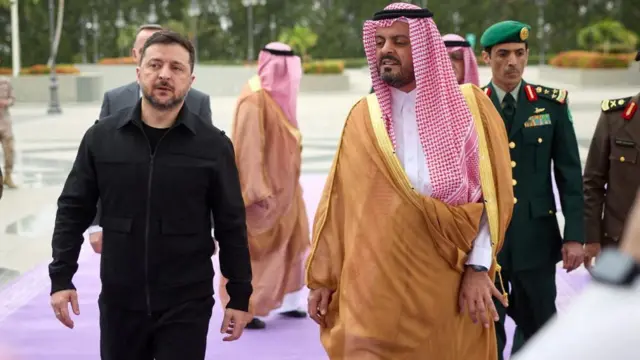
    Ukraine's President Volodymyr Zelenskiy meets Deputy Governor of Makkah Region Prince Saud bin Mishaal bin Abdulaziz during his visit to Jeddah, Saudi Arabia.Image source, Reuters
    Image caption,

    Ukrainian President Zelensky met Deputy Governor of Makkah Region Prince Saud bin Mishaal bin Abdulaziz in Jeddah, Saudi Arabia on Thursday

    Missile and drone strikes continue across the Middle East as Saudi Arabia, UAE, Iran, Lebanon, Kuwait and Israel all report attacks overnight.

    In the backdrop to the conflict, Ukrainian President Volodymyr Zelensky has signed a deal with Saudi Arabia to share its drone defence expertise and technology. Ukraine's president has also met with military leaders in the UAE, before landing today in Qatar.

    He says Saudi Arabia is facing the same type of ballistic missile and drone attacks from Iran that Ukraine had been resisting for more than four years from Russia. Several Ukrainian drone companies tell the BBC they have been approached by Gulf states for help.

    "We are ready to share our expertise and systems with Saudi Arabia and to work together to strengthen the protection of lives," Zelensky says.

    We're now seeing reports that Iran has destroyed a Ukrainian air defence depot in Dubai, Kyiv denies this. In our next few posts we'll shift our attention to this development - stay with us.

  15. UAE intercepts 20 missiles and 37 drones - defence ministrypublished at 12:29 GMT

    The United Arab Emirates (UAE) has intercepted 20 ballistic missiles and 37 drones, its defence ministry says.

    It adds the country's air defences have now intercepted 398 ballistic missiles, 15 cruise missiles and 1,872 drones since the start of "the blatant Iranian attacks".

    The defence ministry says attacks have led to 11 deaths, including two members of the armed forces as well as a Moroccan civilian contracted by the armed forces.

    As we reported earlier, five people were injured after a missile was intercepted in Abu Dhabi - the capital of the UAE.

  16. Analysis

    Houthis see themselves as pivotal player in Iran's 'axis of resistance'published at 12:07 GMT

    Lyse Doucet
    Chief international correspondent

    It was always expected that Yemen’s Houthis would join this war if it dragged on.

    Their ties to Iran don't run as deep as Lebanon's Hezbollah. But if Tehran asked for assistance, they couldn't say no to an ally which has armed and trained their forces in recent years.

    The Houthis, who hold sway in north west Yemen, have so far not wielded their most potent weapon – their ability to disrupt traffic through Bab al-Mandeb, the maritime chokepoint linking the Red Sea to global trade routes.

    Opening up this front would pose risks for the Houthis too.

    Bab al-Mandeb is now the main route for neighbouring Saudi Arabia’s oil exports and the kingdom is the main backer of the Houthis’ rivals in southern Yemen.

    But the Houthis see themselves as a pivotal player in what Iran and its allies call their "axis of resistance" against Israel and the US.

    Their attacks on Red Sea shipping from 2023 to 2025 put them on the world stage. Air strikes by the US, UK and other countries inflicted damage on their forces but also sparked even greater defiance.

  17. Turkey offers help in ending conflict ahead of talks in Pakistan - says Iranpublished at 12:01 GMT

    Turkish Foreign Minister Hakan FidanImage source, Getty Images
    Image caption,

    Turkish Foreign Minister Hakan Fidan has been speaking at the International Strategic Communication Summit in Istanbul today

    Turkey's foreign minister has reaffirmed the country's readiness to play a "constructive role" in resolving the Middle East war, the Iranian foreign ministry says.

    It says that the foreign ministers for Turkey and Iran held a phone call in which Iranian Foreign Minister Abbas Araghchi thanked his counterpart for Ankara's efforts to try and end the war so far.

    Turkey has been one of the nations pursuing diplomatic methods to end the conflict.

    Earlier, Pakistan said that Turkey - alongside Saudia Arabia and Egypt - would attend talks on de-escalation in Islamabad on Monday.

    Turkey has a delicate path to tread in this conflict - as a Nato member but also a neighbour of Iran, sharing a more than 300-mile border.

  18. Iranian military says it targeted a US support boat near Omanpublished at 11:43 GMT

    Iran's military says it has targeted a US support boat near an Oman port.

    A logistics vessel was targeted "a considerable distance" from the port of Salalah, says the Tasnim News Agency, which is linked to the IRGC (Iranian Revolutionary Guard Corps).

    It comes after two drones targeted the port in the south of Oman, injuring a foreign worker.

  19. Watch: Could the Houthis cause more Middle East shipping upheaval?published at 11:10 GMT

    Yemen's Iran-backed Houthis have launched a missile strike on Israel for first time since the war began.

    The BBC's James Waterhouse looks at whether it could lead to further shipping disruption - this time in the Red Sea.

  20. Houthis launch strike on Israel as Iran war enters second month - a recappublished at 10:44 GMT

    Freya Scott-Turner
    Live reporter

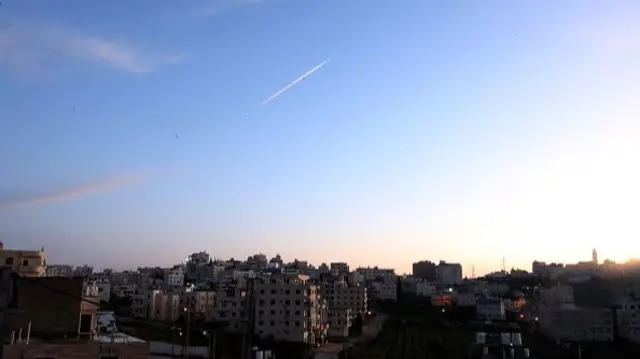
    Traces from a missile launched by Yemen seen over the sky of Hebron, in the West Bank. Photo: 28 March 2026.Image source, Anadolu via Getty Images

    Yemen's Iran-backed Houthis have launched a missile at Israel for the first time in the month-long war.

    Houthis enter conflict: The Iran-backedrebel group launched a missile strike on Israel from Yemen, a day after they warned of intervention if attacks on Iran continued. Israel said it intercepted the missile.

    Who are the Houthis? They are an armed political and religious group which champions Yemen's Shia Muslim minority, the Zaidis. They have controlled much of north west Yemen since 2014, when they ousted the internationally-recognised government from the capital, Sanaa.

    The intervention of the Houthis now raises the prospect of an expanded war, writes our Middle East bureau chief in Jerusalem.

    Across the Middle East

    • Sources in Iran told the BBC heavy strikes hit the capital Tehran overnight, as the country's internet blackout has entered its fourth week
    • Several towns across southern Lebanon were hit by Israeli strikes overnight, the BBC's Hugo Bachega spoke to displaced families there
    • Saudi Arabia said it intercepted a ballistic missile heading towards Riyadh, and Kuwait media reported the country's international airport sustained "limited damage" in a drone strike

    Economic impacts of the war continue to be felt. Shares in all three major US indexes sank again on Friday, capping the fourth week of losses since the war began, our New York business reporter writes.