Summary

  1. Analysis

    Houthis see themselves as pivotal player in Iran's 'axis of resistance'published at 12:07 GMT

    Lyse Doucet
    Chief international correspondent

    It was always expected that Yemen’s Houthis would join this war if it dragged on.

    Their ties to Iran don't run as deep as Lebanon's Hezbollah. But if Tehran asked for assistance, they couldn't say no to an ally which has armed and trained their forces in recent years.

    The Houthis, who hold sway in north west Yemen, have so far not wielded their most potent weapon – their ability to disrupt traffic through Bab al-Mandeb, the maritime chokepoint linking the Red Sea to global trade routes.

    Opening up this front would pose risks for the Houthis too.

    Bab al-Mandeb is now the main route for neighbouring Saudi Arabia’s oil exports and the kingdom is the main backer of the Houthis’ rivals in southern Yemen.

    But the Houthis see themselves as a pivotal player in what Iran and its allies call their "axis of resistance" against Israel and the US.

    Their attacks on Red Sea shipping from 2023 to 2025 put them on the world stage. Air strikes by the US, UK and other countries inflicted damage on their forces but also sparked even greater defiance.
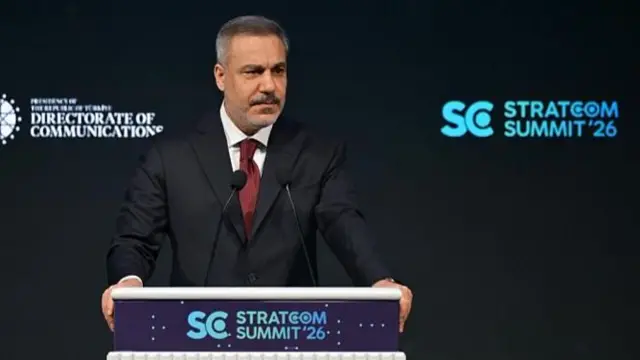

  2. Turkey offers help in ending conflict ahead of talks in Pakistan - says Iranpublished at 12:01 GMT

    Turkish Foreign Minister Hakan FidanImage source, Getty Images
    Image caption,

    Turkish Foreign Minister Hakan Fidan has been speaking at the International Strategic Communication Summit in Istanbul today

    Turkey's foreign minister has reaffirmed the country's readiness to play a "constructive role" in resolving the Middle East war, the Iranian foreign ministry says.

    It says that the foreign ministers for Turkey and Iran held a phone call in which Iranian Foreign Minister Abbas Araghchi thanked his counterpart for Ankara's efforts to try and end the war so far.

    Turkey has been one of the nations pursuing diplomatic methods to end the conflict.

    Earlier, Pakistan said that Turkey - alongside Saudia Arabia and Egypt - would attend talks on de-escalation in Islamabad on Monday.

    Turkey has a delicate path to tread in this conflict - as a Nato member but also a neighbour of Iran, sharing a more than 300-mile border.

  3. Iranian military says it targeted a US support boat near Omanpublished at 11:43 GMT

    Iran's military says it has targeted a US support boat near an Oman port.

    A logistics vessel was targeted "a considerable distance" from the port of Salalah, says the Tasnim News Agency, which is linked to the IRGC (Iranian Revolutionary Guard Corps).

    It comes after two drones targeted the port in the south of Oman, injuring a foreign worker.

  4. Watch: Could the Houthis cause more Middle East shipping upheaval?published at 11:10 GMT

    Yemen's Iran-backed Houthis have launched a missile strike on Israel for first time since the war began.

    The BBC's James Waterhouse looks at whether it could lead to further shipping disruption - this time in the Red Sea.

  5. Houthis launch strike on Israel as Iran war enters second month - a recappublished at 10:44 GMT

    Freya Scott-Turner
    Live reporter

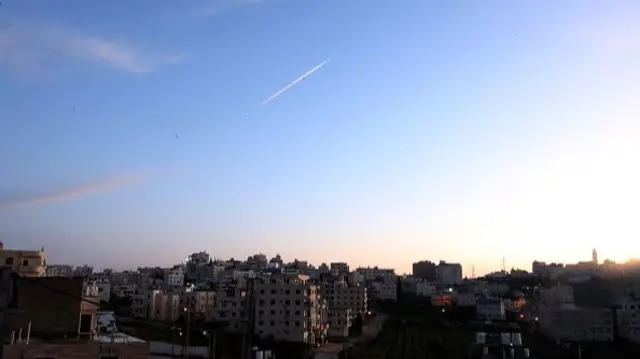
    Traces from a missile launched by Yemen seen over the sky of Hebron, in the West Bank. Photo: 28 March 2026.Image source, Anadolu via Getty Images

    Yemen's Iran-backed Houthis have launched a missile at Israel for the first time in the month-long war.

    Houthis enter conflict: The Iran-backedrebel group launched a missile strike on Israel from Yemen, a day after they warned of intervention if attacks on Iran continued. Israel said it intercepted the missile.

    Who are the Houthis? They are an armed political and religious group which champions Yemen's Shia Muslim minority, the Zaidis. They have controlled much of north west Yemen since 2014, when they ousted the internationally-recognised government from the capital, Sanaa.

    The intervention of the Houthis now raises the prospect of an expanded war, writes our Middle East bureau chief in Jerusalem.

    Across the Middle East

    • Sources in Iran told the BBC heavy strikes hit the capital Tehran overnight, as the country's internet blackout has entered its fourth week
    • Several towns across southern Lebanon were hit by Israeli strikes overnight, the BBC's Hugo Bachega spoke to displaced families there
    • Saudi Arabia said it intercepted a ballistic missile heading towards Riyadh, and Kuwait media reported the country's international airport sustained "limited damage" in a drone strike

    Economic impacts of the war continue to be felt. Shares in all three major US indexes sank again on Friday, capping the fourth week of losses since the war began, our New York business reporter writes.

  6. Analysis

    Resumption of Houthi attacks a headache for Israel, a potential disaster for shippingpublished at 10:29 GMT

    Paul Adams
    Diplomatic correspondent

    Houthi missile attacks on Israel, which began in mid-October 2023, following the outbreak of the Gaza war, did very little damage. The attacks were sporadic and most missiles were intercepted.

    However, in July 2024, an Israeli civilian was killed when a Houthi drone evaded Israeli air defences and struck a residential building in Tel Aviv.

    The resumption of attacks will be an additional headache for Israel, but is unlikely to pose a significant challenge.

    However, if the Houthis decide to start attacking Red Sea shipping, the effects could be dramatic.

    Saudi Arabia is currently diverting around 4 million barrels of oil through a pipeline to Yanbu, on the Red Sea coast, in order to avoid the Strait of Hormuz.

    Shipments bound for the Asian market then sail south, past Yemen.

    From November 2023 to early 2025, the Houthis launched almost 200 attacks on ships in the Red Sea, damaging over 30 ships and hijacking at least one.

    Traffic through the Bab al-Mandab Strait (at the southern end of the Red Sea) and Suez Canal (at the northern end) dropped by around 50% - not as great as the impact of Iran’s de facto closure of the Strait of Hormuz, but hugely damaging.

    If this happens again, the simultaneous closure of both vital waterways could be disastrous.

  7. Pakistani PM says he spoke to Iranian president for 'over one hour' on phonepublished at 10:17 GMT

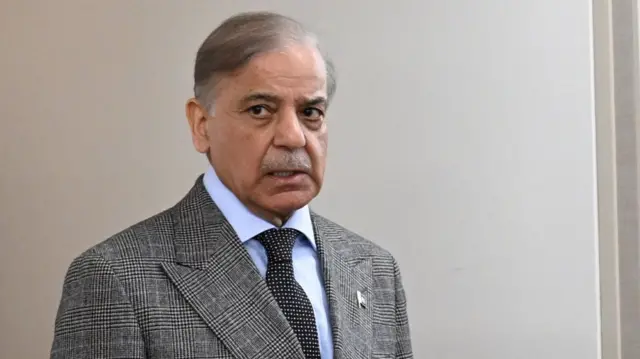
    Pakistani Prime Minister Shehbaz Sharif, pictured earlier this yearImage source, Reuters
    Image caption,

    Pakistani Prime Minister Shehbaz Sharif, pictured earlier this year

    In further diplomatic news from Pakistan, PM Shehbaz Sharif says he held a "detailed" phone call with Iranian President Masoud Pezeshkian earlier today. The call lasted over an hour, he says.

    Writing on X, Sharif says he "apprised him of Pakistan’s ongoing diplomatic outreach", engaging the US and Gulf states to "facilitate dialogue and de-escalation".

    Pakistan has previously offered to host talks between the US and Iran.

    Sharif also condemned Israeli strikes on Iran and conveyed Pakistan's "solidarity with the brave people of Iran", he says.

  8. Pakistan to host Saudi Arabia, Turkey and Egypt for talks on de-escalationpublished at 09:50 GMT

    Pakistan's Foreign Minister Ishaq Dar says the country will host the foreign ministers of Saudi Arabia, Turkey and Egypt in Islamabad from 29-30 March.

    They will hold "in-depth discussions", including on efforts to "de-escalate tensions in the region", he writes in a statement shared on X.

    Egypt's Ministry of Foreign Affairs has now put out a statement confirming its foreign minister has travelled to the Pakistani capital for the talks.

    Pakistan has been making efforts to play the role of peace facilitator in the region.

    Separately, it has offered to host talks between the US and Iran - there has not yet been any confirmation of whether these will take place. Earlier this week, Dar said "indirect talks" were taking place through "messages being relayed by Pakistan".

    Trump also shared a screenshot of an X post from Pakistan's PM Shehbaz Sharif earlier this week, posting it on Truth Social. In the post, Sharif said Pakistan "stands ready" to host talks.

  9. Iranians suffer 'digital darkness' for four full weekspublished at 09:39 GMT

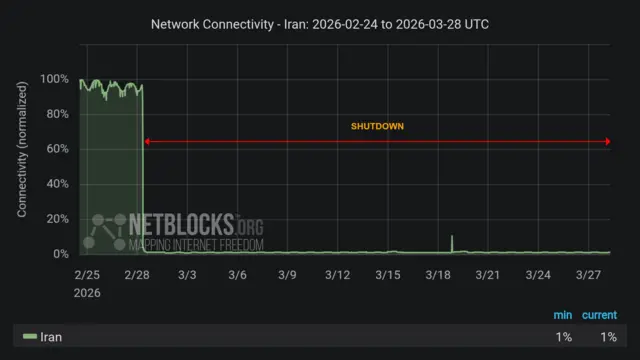
    A graph on NetBlocks shows internet connectivity plunge to just above 0% on 8 February and staying at the same level until 28 MarchImage source, NetBlocks

    Iran has been "plunged into digital darkness" for a month due to the war in the Middle East, reports internet monitoring group NetBlocks.

    NetBlocks says the internet blackout has been in effect for four full weeks "violating Iranians' right to communicate and stay informed".

    The Iranian regime also imposed a blackout in January for weeks as protests took place across the country.

    Authorities in Iran use a two-tiered system where only members of the regime are allowed online, with most citizens restricted to a domestic 'National Information Network'.

  10. 'Our home is gone': BBC speaks to displaced families in Lebanonpublished at 09:27 GMT

    More than a million people have been displaced in Lebanon as the US-Israel war with Iran continues to impact the wider region.

    It comes after Israel issued evacuation orders for large parts of the south.

    Israel intensified its campaign against the Iran-backed armed group Hezbollah in Lebanon after it fired rockets into northern Israel earlier this month. Hezbollah has continued firing rockets at Israel since then.

    With shelters overwhelmed, many families are sleeping in their cars or in open areas in makeshift tents, under extreme weather conditions. Among them children and pregnant women.

    The BBC's Middle East Correspondent, Hugo Bachega, spoke to some of the hundreds of displaced families about the reality of living in Lebanon amid the conflict:

    Media caption,

    BBC's Hugo Bachega speaks to displaced families in Lebanon

  11. IDF confirms strikes on southern Lebanon - says attacks still ongoingpublished at 09:20 GMT

    The Israeli military says attacks on Lebanon are ongoing, and confirms it struck the south of the country earlier.

    "Overnight, the IDF conducted strikes on dozens of targets from the air and sea across multiple areas in southern Lebanon," it says in a statement.

    "At this time, the IDF continues to strike Hezbollah terrorist infrastructure across Lebanon," it adds.

    The IDF's Arabic spokesperson has separately issued another evacuation warning, telling people in southern Lebanon to move north of the Zahrani River.

    Lebanon's state-run news agency was earlier reporting a series of Israeli strikes on several towns in the south of the country.

  12. Kuwait International Airport targeted by drone attack, state media sayspublished at 08:54 GMT

    Several drone attacks were launched against Kuwait International Airport, a spokesperson for the country's Civil Aviation Authority says, in comments reported by KUNA state news agency.

    They said the radar system was significantly damaged but there were no casualties.

    It's not the first attack on the site. Wednesday saw the targeting of a fuel depot at the airport by an Iranian drone.

  13. Houthis disrupted shipping during Israel-Gaza warpublished at 08:37 GMT

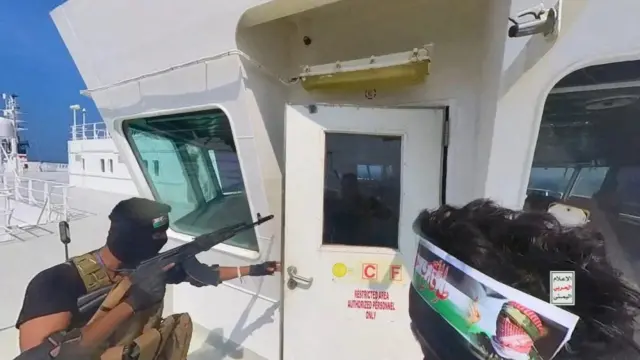
    A fighter carrying a gun while wearing a black balaclava opens the door of a cockput on a ship. A second head can be seen on the right hand sideImage source, Reuters
    Image caption,

    Houthi fighters boarded a ship in Red Sea in November 2023

    The Houthi intervention in the US-Israel war with Iran risks expanding the conflict to a new front near the Red Sea.

    The Houthis began attacking shipping in the Red Sea in November 2023 and regularly launched missiles at Israel in the aftermath of the 7 October attacks, saying they were acting in solidarity with the Palestinians.

    The Houthis targeted commercial shipping with drone and missile attacks as well as more brazen assaults by boat and helicopter, leading to companies redirecting their ships away from the Red Sea and choosing the much longer journey around Africa's Cape of Good Hope.

    The Houthis also carried out attacks against British and US warships in January 2024.

    The UK and US carried out a series of attacks against Houthi targets in Yemen in response and deployed a Royal Navy destroyerto protect shipping from attacks by the Houthi rebels.

    The Houthi intervention in the war in the Middle East could raise further concerns for shipping after the Strait of Hormuz, where a number of tankers have been attacked, was effectively closed by Iran.

    The Houthis have controlled much of north-western Yemen since 2014, when they ousted the internationally-recognised government from the capital, Sanaa, and sparked a devastating civil war.

  14. If Houthis attack Red Sea, it could make a bad situation worse - Middle East expertpublished at 08:24 GMT

    Chatham House research fellow Farea Al-Muslimi says the Houthis' new involvement in the conflict is of "huge significance" as they "sit on another important international trade route” - the Red Sea.

    The Houthis haven't yet said they will attack the Red Sea, he tells BBC Radio 4's Today programme. In his view, they could be "trying to spare themselves another American attack".

    In 2025, Donald Trump launched a bombing campaign (alongside the UK), to prevent Houthi attacks in the region.

    But asked how disruptive another effective blockade would be, in addition to existing threats in the Strait of Hormuz, Al-Muslimi says: “It’s a nightmare. We already have a nightmare, and this would make it worse of a nightmare”.

  15. Latest strikes on Lebanon in picturespublished at 08:04 GMT

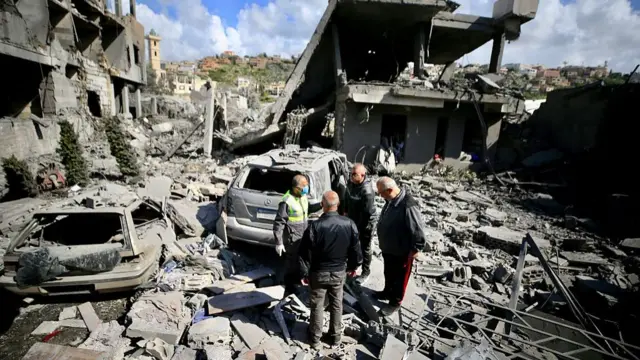
    Lebanon's state-run news agency is reporting a series of Israeli strikes on several towns in the south of the country.

    The Iran-backed Hezbollah group, which operates in Lebanon says it has been targeting Israeli military positions in the north of Israel.

    Four men standing in a pile of rubble and destroyed buildings with a green hillside and cloudy sky in backgroundImage source, AFP via Getty Images
    Image caption,

    First aid responders inspect the site of an Israeli airstrike that targeted a building in the southern Lebanese town of Saksakiyeh

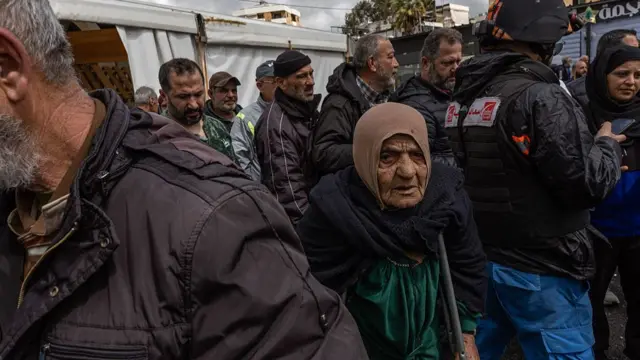
    An elderly woman in a brown headscarf is standing in line to receive food from tents.Image source, AFP via Getty Images
    Image caption,

    Members of the Nabatieh Civil Defence distribute food to residents who have remained in in Nabatieh, Lebanon amid Israeli warnings to evacuate

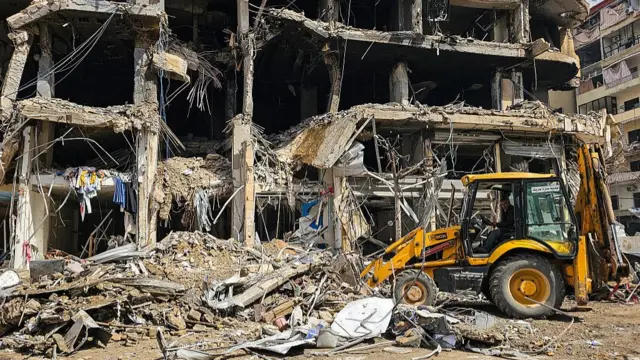
    A bulldozer in front of a largely destroyed buildingImage source, AFP via Getty Images
    Image caption,

    A bulldozer clears rubble from a street at the site of an Israeli airstrike in Beirut's southern suburbs

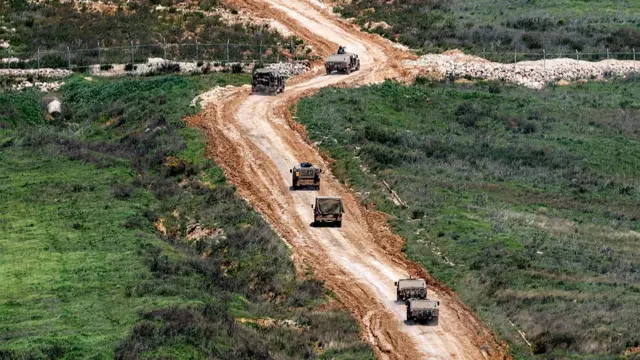
    A line of tanks driving up a dirt road surrounded by green grass.Image source, AFP via Getty Images
    Image caption,

    Israeli army vehicles move at a position in southern Lebanon by the border with northern Israel

  16. Houthis confirm they launched attack against Israelpublished at 07:36 GMT
    Breaking

    The Iranian backed Houthis in Yemen have confirmed they have attacked Israel for the first time since the start of the US-Israeli war with Iran.

    The group says it fired a barrage of ballistic missiles "targeting sensitive Israeli military sites" in response to the targeting of Iran, Lebanon, Iraq and Palestinian territories. It adds that its operations will continue until the "aggression" on all fronts ends.

    It comes after the Israel Defense Forces said it intercepted a missile from Yemen.

  17. Two Israeli soldiers seriously injured in clashes in southern Lebanonpublished at 07:23 GMT

    TheIsrael Defence Forces (IDF) says that two soldiers have been seriously injured in clashes in southern Lebanon.

    The IDF says in a post on X that a combat officer was seriously injured and six other soldiers were moderately injured in rocket fire on Friday.

    It adds that another officer was seriously injured and a second officer was moderately injured by anti-tank missile fire in another clash.

  18. Attacks continue across the Gulf as strikes hit Tehran overnightpublished at 07:12 GMT

    Missile strikes have been taking place overnight in the Iranian capital of Tehran while Iran has continued to fire at Israel and countries across the Gulf region.

    Here is a round up of the latest strikes:

    • Israeli ambulance service Magen David Adom (MDA) says a 52-year-old man has died and several others were injured after a missile was fired towards central Israel late on Friday, reports the Times of Israel.
    • The IDF also says that a missile fired from Yemen was intercepted
    • A foreign worker was injured after two drones targeted the port of Salalah in the south of Oman, the country's official news agency says
    • Air defence systems have also been activated and drones intercepted in the United Arab Emirates (UAE), Kuwait and Bahrain. As we reported earlier, five people were injured after a missile was intercepted in Abu Dhabi, the capital of the UAE.
    • Saudi Arabia's Ministry of Defence says it has intercepted three drones as well as a ballistic missile that was launched towards Riyadh, the nation's capital. Earlier, we also reported that at least 12 US soldiers were injured in an attack on the Prince Sultan airbase on Friday

  19. Houthi intervention could create new front in the Arabian peninsulapublished at 06:39 GMT

    Jo Floto
    Middle East bureau chief in Jerusalem

    For weeks now the Houthi movement in Yemen has been voicing support for Iran - its greatest provider of military, financial and political support - saying that Houthi participation in the war was only a matter of time.

    A further threat came last night in a televised address by the Houthi military spokesperson Yahya Saree.

    “We confirm that our fingers are on the trigger for direct military intervention,” he said, adding that the group would enter the war if any new alliances join Washington and Israel against Iran and its ⁠allies, or if the Red Sea is used for “hostile operations” against Iran.

    This morning the trigger appears to have been pulled - with Israel’s military saying it had identified a launch of a missile from Yemen, triggering sirens in and around the southern Israeli city of Beersheba.

    The intervention of the Houthis now raises the prospect of an expanded war, with a new front in the Arabian peninsula.

    Of most concern will be the threat to attack shipping in the Red Sea, something the Houthis did in the aftermath of the October 7th attacks.

    In 2025 Donald Trump launched a bombing campaign (alongside the UK), to prevent these attacks.

    The weeks-long mission struck thousands of targets, and killed a number of high ranking Houthi officials, but ultimately ended in a negotiated ceasefire.

  20. Five people injured after missile intercepted in Abu Dhabipublished at 06:27 GMT

    Five people have been injured after a ballistic missile was intercepted by air defences in Abu Dhabi in the United Arab Emeriates.

    The Abu Dhabi Media Office reports that five Indian nationals were injured by falling debris near the Khalifa Economic Zone Abu Dhabi (KIZAD).

    The media office had said in a post on X it was responding to two fires in the area.