Summary

  1. 'It's for President Trump to explain his language' - UK government ministerpublished at 15:43 BST
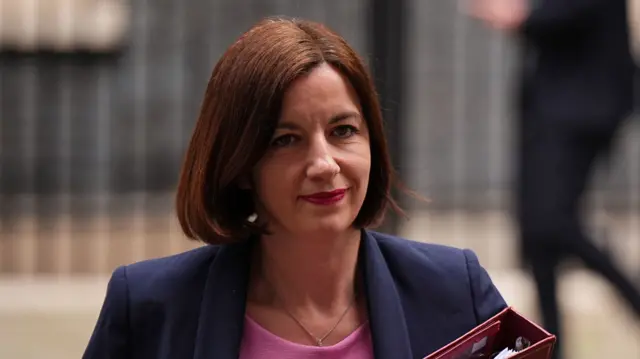
    Bridget Philipson headshotImage source, PA Media

    We've had some reaction through to Donald Trump's expletive-laden threat aimed towards Iran on social media yesterday.

    UK Education Secretary Bridget Phillipson has distanced the government from his choice of language.

    "We see this kind of language often used by President Trump. It's for President Trump to explain the language that he chooses to use. It is not language or an approach that this Government would be taking," she says as she reiterates the UK's position within the war is to participate in defensive action only.
  2. Five key points to remember about the Strait of Hormuzpublished at 15:41 BST

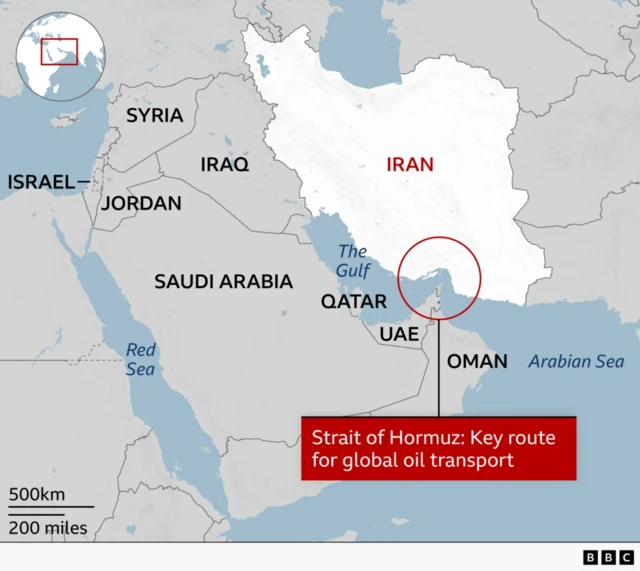
    A graphic showing a map of the Middle East, highlighting the Strait of Hormuz at its narrowest point between Iran and Oman.

    It's critical to the global economy

    The Strait of Hormuz is one of the world's busiest oil shipping channels, and about 20% of the world's oil and liquefied natural gas usually passes through it. It also carries a third of the world's fertiliser trade, and is a vital channel for food, medicines and technological supplies.

    Iran can influence traffic through the channel with attacks and threats

    The strait is narrow, and it has been easy for Iran to launch strikes at commercial ships - even after most of its navy was destroyed. The fear of being attacked means most vessels will not attempt the crossing without Iran's blessing, which gives the country significant leverage.

    It would be difficult to force open

    Trump has suggested countries that can't get fuel through the strait should “build up some delayed courage, go to the Strait, and just TAKE IT".

    But Maersk chief executive Vincent Clerc told the BBC that while naval escorts could offer a "temporary reprieve", it would take a "significant presence from the Navy to be able to provide a shield all the way through" - and even then, shipping and insurance companies would still balk at the risk.

    Economic pressure is mounting fast

    The strait's closure has dramatically pushed up global energy prices, with oil hitting $110 (£83.38) a barrel on Monday, and will also impact food, smartphones and medicines.

    Trump is furious over this political flashpoint

    Yesterday, in an expletive-filled post on Truth Social, he warned Iranians they would be "living in hell" if they did not meet his Tuesday deadline for reopening the strait. Trump has postponed his deadlines several times.

    Media caption,

    'We are at the edge of a battlefield': BBC reports near Strait of Hormuz

  3. Trump's shifting deadlines over the Strait of Hormuzpublished at 15:11 BST

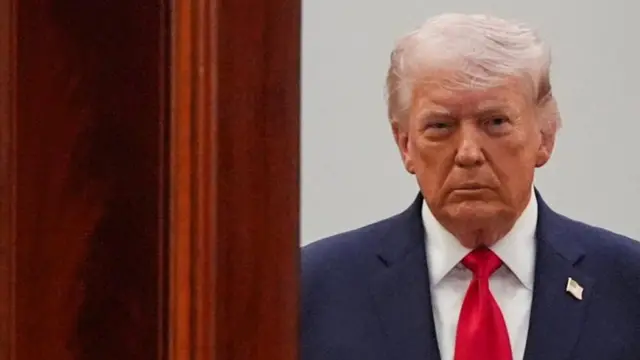
    Donald Trump stands next to a wooden doorImage source, Reuters

    We are due to hear from Donald Trump later today on the war in Iran.

    Sunday saw him issue the latest in a series of threats to attack civilian infrastructure in Iran, if the country didn't open up the Strait of Hormuz by 6 April.

    But his deadlines have chopped and changed over the course of the war - here's a recap.

    • Deadline 1: On 21 March, Trump said he would "hit and obliterate" power plants, "starting with the biggest ones first", if Iran didn't reopen the waterway within 48 hours
    • Deadline 2: Two days later, he said there had been "very good and productive conversations" between the countries and postponed strikes against energy infrastructure for five days
    • Deadline 3: On 27 March, Trump said he would postpone attacking energy plants for 10 days, "as per [an] Iranian government request", bringing the deadline to 6 April
    • 48-hour warning: On Friday, with the 6 April deadline looming, he warned that Iran had "48 hours" before he unleashed "all hell"
    • Latest threat: In a Sunday post peppered with expletives, Trump reiterated this threat, saying that "Tuesday will be Power Plant Day, and Bridge Day" - in a later post he said "Tuesday, 8:00 P.M. Eastern Time!"
  4. UAE says Iran's strategy likely to push Gulf states closer to USpublished at 15:00 BST

    Lorna Gordon
    Reporting from Dubai

    The United Arab Emirates is warning against a ceasefire that fails to address key issues in the region, including Iran’s nuclear programme and “the missiles and drones which are still raining down on us and other countries".

    Dr Anwar Gargash, a senior adviser to the UAE president, made the comments in a briefing that his country wants to see an end to the conflict but not one that creates continuous instability in the region going forward.

    Iran has had a chokehold on the Strait of Hormuz during this conflict. A handful of tankers are passing through the waterway every day, but the numbers are vastly reduced compared to normal.

    He said Iran’s strategy was likely to harden the Gulf’s security alignment with Washington - not reduce it - and lead to Israeli influence in the region becoming more prominent. He added that the UAE would “double down” on its relationship with the United States.

    He said “the Strait of Hormuz cannot be held hostage by any one country” and while the UAE was not ready to act as a maritime force, it would join "any American-led effort, international effort to secure navigation in the Strait.”

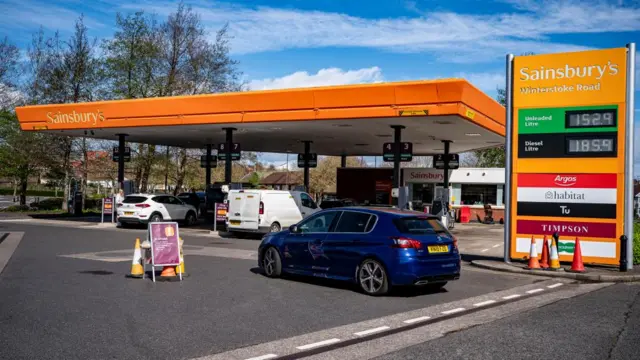
    Prices at a petrol station in Bristol on SundayImage source, PA Media
    Image caption,

    Cars at a petrol station in Bristol on Sunday

  5. 'Illegal and unacceptable': European Council president on civilian infrastructure strikespublished at 14:39 BST

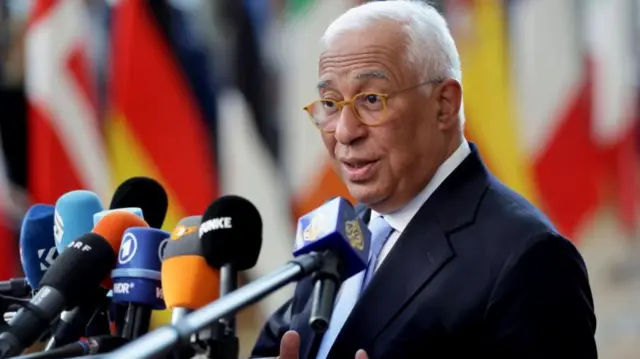
    António Costa is shown speaking behind a bank of microphones. He is wearing a dark blue suit with a white shirt and light blue tie.Image source, EPA

    Strikes on civilian targets are illegal, says the European Council's president - and "only a diplomatic solution" will end the war with Iran.

    "Any targeting of civilian infrastructure, namely energy facilities, is illegal and unacceptable," António Costa said in a post on X earlier this morning.

    His statement comes after threats by US President Donald Trump to destroy Iranian infrastructure if the Strait of Hormuz is not reopened.

    Luis Moreno Ocampo, founding chief prosecutor of the International Criminal Court, has previously told the BBC that the war on Iran amounts to a crime of aggression under international law.

    More than 100 experts on international law have also signed an open letter expressing "profound concern" about what they see as serious violations of international law by the US, Israel and Iran.

  6. Second Iranian petrochemical complex targeted - local mediapublished at 14:28 BST

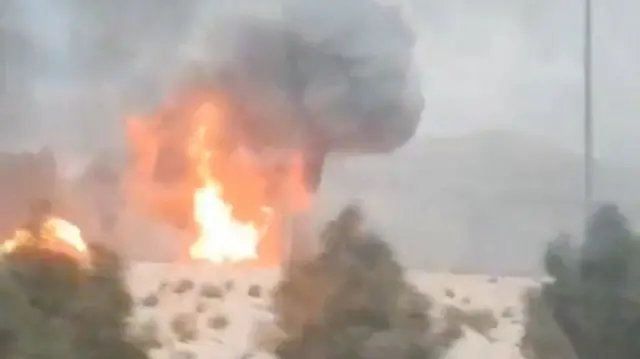
    Multiple Iranian agencies are reporting the Marvdasht Petrochemical Complex has been targeted in an "enemy attack".

    The Fars news agency says the attack resulted in a fire that was "contained within the first few minutes".

    Citing the Marvdasht County Governor's Office, the semi-official Tasnim news agency adds that "no significant damage was inflicted" on the industrial unit.

    Earlier, Israel said it had struck the South Pars petrochemical plant in Asaluyeh, in the south of Iran.

  7. What you need to know about the war in the Middle East on Mondaypublished at 14:19 BST

    Jacob Phillips
    Live reporter

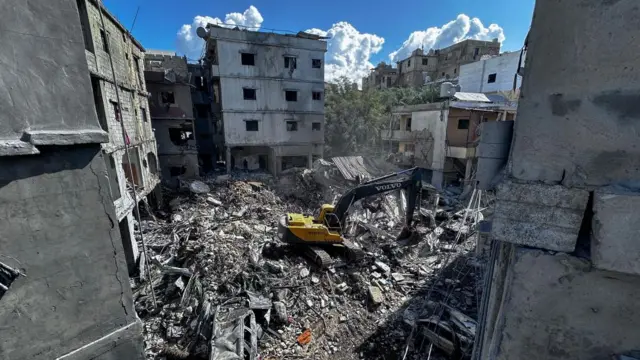
    A yellow crane sits in the middle of a square in Beirut surrounded by several damaged buildings. The floor has been completely covered in rubble from a recent airstrikeImage source, EPA/Shutterstock
    Image caption,

    The aftermath of an Israeli airstrike near Lebanon's largest public hospital in Beirut

    • The latest attack comes after US President Donald Trump warned of bigger strikes against Iranian infrastructure in an expletive-laden social media post
    • Trump said Tuesday will be "Power Plant Day and Bridge Day" if Iran does not reopen the Strait of Hormuz - a key choke point where around 20% of the world's oil passes through
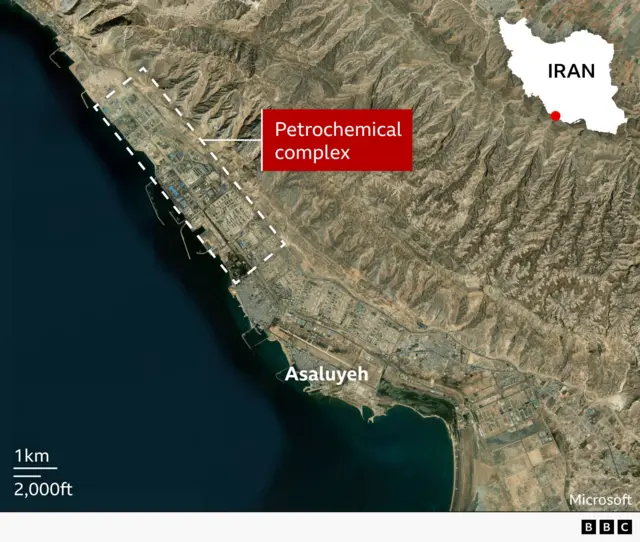
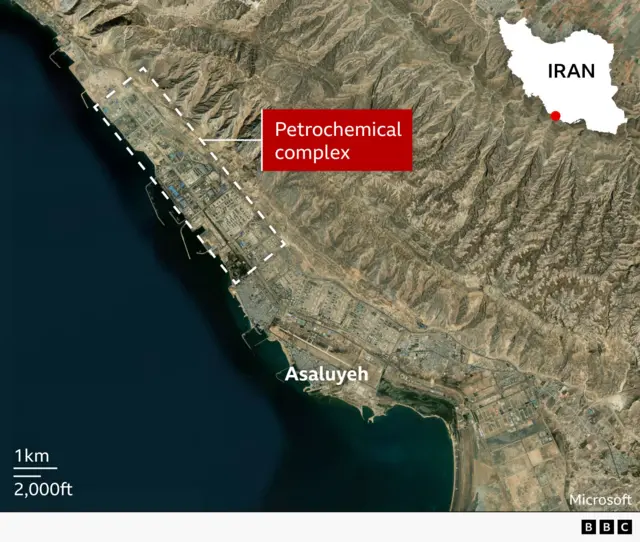
    A satellite map of the coastal city of Asaluyeh in southern Iran, showing a large petrochemical complex along the shoreline. The complex is highlighted with a red label and outlined by dashed white lines. Mountains lie to the northeast, and the coastline runs north–south along the left side of the image. A small inset map of Iran in the top-right corner marks the location of Asaluyeh with a red dot. A scale bar indicates 1 km (2,000 ft).
  8. Israeli military kills wrong people in failed assassination attemptpublished at 14:01 BST

    Daniel De Simone
    BBC News, Jerusalem

    Pierre MouawadImage source, Lebanese Forces Party

    An Israeli attempt to assassinate a Hezbollah figure in Lebanon on Sunday instead killed a senior leader from a political group that is strongly opposed to Hezbollah.

    Approached by the BBC, the Israel Defense Forces (IDF) acknowledged the strike apparently failed to kill the intended target and that it "regrets the harm" to civilians.

    The Lebanese Forces Party, a largely Christian group, say the strike on an apartment block had killed senior official Pierre Mouawad and his wife Flavia.

    The apartment block was in Ain Saadeh, a predominantly Christian town east ​of Beirut. Lebanon's health ministry said it killed a man and two women.

    The local mayor says those killed were one ​floor below the targeted apartment.

    The IDF say reports that "several uninvolved individuals were harmed as a result of the strike are being reviewed.”

    The Lebanese Forces Party say Pierre Mouawad was "not a fighter, nor a military target” and that he had celebrated Easter at home with family before the deadly attack.

    The party condemned Hezbollah and say what happened is a result of military confrontations are being brought into residential neighbourhoods.

  9. Five conditions and 15-point plans: A look at previous proposals to end the warpublished at 13:40 BST

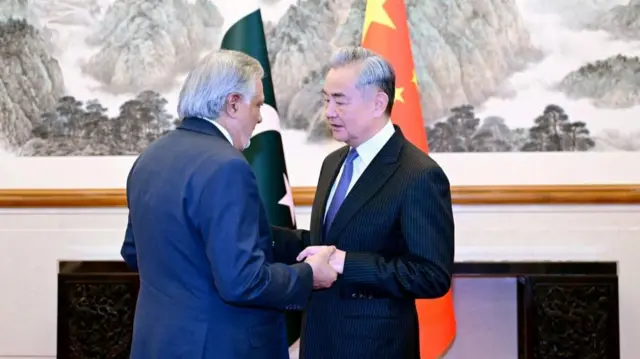
    Chinese Foreign Minister Wang Yi and Pakistani Deputy Prime Minister and Foreign Minister Mohammad Ishaq Dar shake hands in BeijingImage source, Chinese Foreign Ministry
    Image caption,

    A five-point ceasefire proposal was published by China and Pakistan, after their foreign ministers met in Beijing

    Some detail is starting to emerge about a rumoured ceasefire framework that's been passed to both the US and Iran. But this isn't the first time the idea of a peace plan has been broached.

    Previous negotiation reports have been unsuccessful, with the US and Iran either rejecting terms, or disputing that talks have even taken place.

    On 24 March, reports emerged that a 15-point plan had been sent to Iran by the US, with Pakistan acting as an intermediary.

    Israel's Channel 12 said it included demands Iran destroy key nuclear facilities, stop funding armed proxies in the region - such as Hezbollah or the Houthis - and open the Strait of Hormuz. In return, the US would remove sanctions from Iran.

    Tehran initially flatly rejected the plan - calling it "excessive" - but five conditions for ending the war were later published by Iranian state media. These included reparations and a guarantee that Iran would not be attacked again.

    Next, on 31 March, a five-point peace plan - drafted by Pakistan and China - was reported.

    The peace plan was drawn up after Pakistan's foreign minister flew to Beijing to ask for Chinese support for the country's efforts to negotiate an end to this conflict.

    It coincided with claims from Donald Trump that negotiations were going "extremely well", but Tehran stated that no talks were taking place.

    We also heard from Trump again on 2 April, when he claimed that Iran had asked the US for a ceasefire. This was swiftly described as "false and baseless" by Iran's foreign ministry.

  10. Reports of ceasefire plan 'one of many ideas and Trump has not signed off on it' - White House officialpublished at 13:35 BST

    As we reported earlier, the news agency Reuters says mediators are working on a new plan for an immediate ceasefire, citing unnamed sources.

    In response to that reporting, a White House official tells the BBC that this was "one of many ideas and [Trump] has not signed off on it. Operation Epic Fury continues."

    They add that Trump will "speak more" at a press conference at 13:00 local time (18:00 BST).

  11. Reported strikes come weeks after earlier attack on South Pars gas fieldpublished at 13:12 BST

    Monday's reports come weeks after international outcry over Israel's attack on Iran's South Pars gas field on 18 March.

    Tehran retaliated at the time by striking an energy complex in Qatar and attacking other energy targets in the Gulf.

    The attacks on energy infrastructure marked an escalation in the war launched by the US and Israel against Iran, which had already responded by restricting shipping through the Strait of Hormuz.

    They led to a spike in energy prices and US President Donald Trump later posted he had not known about the attack on South Pars in advance.

    The fallout raised questions over how united Israel and the US remain in their war aims; Israeli Prime Minister Benjamin Netanyahu subsequently stressed that Israel had "acted alone".

    Smoke and flames rise from the South Pars gas field following an Israeli strike in MarchImage source, Reuters
    Image caption,

    Smoke and flames rise from the South Pars gas field following an Israeli strike in March

  12. Extent of damage still being investigated - reportspublished at 12:55 BST

    The semi-official Tasnim news agency, citing a deputy Bushehr governor, has reported that the extent of the damage following the attack at the facilities is still being investigated.

    According to the news agency, a number of petrochemical production units have been damaged - no causalities have been reported.

  13. Katz statement follows reports of explosions in Iranian mediapublished at 12:45 BST

    Katz's statement on an Israeli attack on a petrochemical facility follows an earlier report from the Fars news agency that "several explosions" had been heard from the South Pars petrochemical plant in Asaluyeh.

    We'll bring you more updates on this as we get them.

    A satellite map of the coastal city of Asaluyeh in southern Iran, showing a large petrochemical complex along the shoreline. The complex is highlighted with a red label and outlined by dashed white lines. Mountains lie to the northeast, and the coastline runs north–south along the left side of the image. A small inset map of Iran in the top-right corner marks the location of Asaluyeh with a red dot. A scale bar indicates 1 km (2,000 ft).
  14. Israel says it has attacked key Iranian petrochemical facilitypublished at 12:30 BST
    Breaking

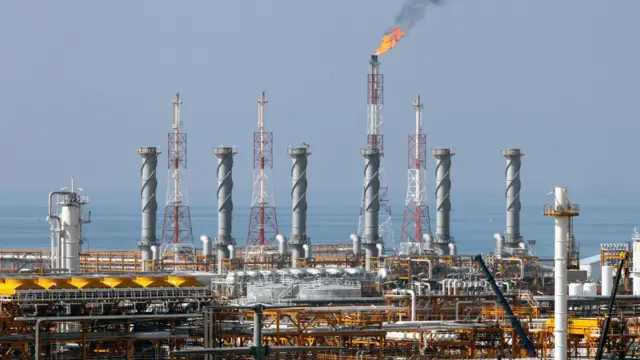
    This picture from 2014 shows the the South Pars gas field in the city of Kangan, near Asaluyeh. Israel Katz's statement did not specify the exact location of the new strikesImage source, EPA
    Image caption,

    This picture from 2014 shows the the South Pars gas field in the city of Kangan, near Asaluyeh in Iran. Israel Katz's statement did not specify the exact location of the new strikes

    Israel's defence minister Israel Katz has released a statement saying they have struck a petrochemical facility in Iran, as he says the IDF has been instructed to continue to attack Iranian infrastructure "with all force".

    "The IDF has now strongly attacked the largest petrochemical facility in Iran located in [Asaluyeh]," he says, adding the facility produced around half of the country's petrochemicals.

    The new attack follows an attack on another facility "last week", Katz says.

    "Now the two facilities, which together are responsible for about 85% of Iran's petrochemical exports - have been taken out of service and are not functioning," the statement from Katz reads.

    "This is a severe economic blow worth tens of billions of dollars to the Iranian regime. The petrochemical industry is a major engine in financing the activities of the Revolutionary Guards and in building Iran's military power."

    The semi-official Tasnim news agency has in the last few moments reported that two petrochemical companies have been attacked.

  15. Oil prices rise then fall in choppy tradingpublished at 12:14 BST

    Osmond Chia
    Business reporter

    Oil prices have dropped from this morning's $110 figure, which was reached after US President Donald Trump threatened to destroy critical infrastructure in Iran unless it allows ships to cross the Strait of Hormuz.

    In an expletive-laden social media post on Sunday, Trump said the US would attack power plants and bridges unless the crucial waterway is open by 20:00 ET (01:00 BST Wednesday).

    Brent crude rose above $110 (£83.38) a barrel on Monday morning UK-time before those gains eased after a report of US-Iran talks over a potential ceasefire.

    News website Axios reported that the US, Iran and a group of regional mediators are discussing the terms of a potential 45-day ceasefire that could lead to a permanent end to the conflict, citing US, Israeli and regional sources.

    In the hours following the Axios report, the global benchmark oil price fell from over $110 a barrel to around $107.

    Read more here.

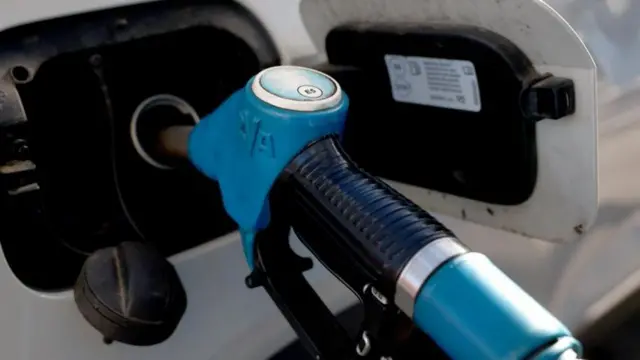
    A close-up image of a fuel nozzle inserted into a vehicle's fuel tank.Image source, Reuters
  16. In Lebanon, no respite from the constant sound of Israeli fighter jetspublished at 11:58 BST

    Hugo Bachega
    Middle East correspondent in Nabatieh, Lebanon

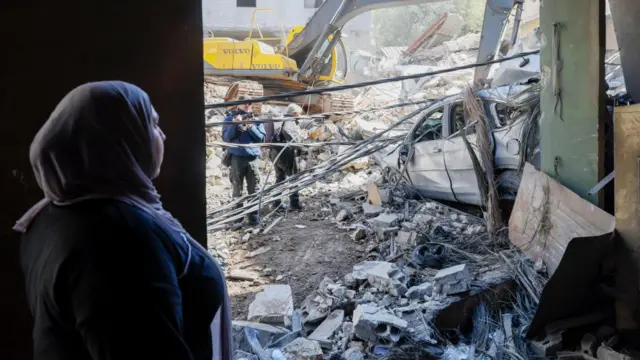
    A woman watches as a bulldozer clears the rubble of destroyed buildings following an Israeli trike near the Rafik Hariri University Hospital (RHUH), in the Jnah District of Beirut, Lebanon.Image source, EPA/Shutterstock

    From Lebanon’s south to the east and Beirut, there has been no respite from Israeli air strikes.

    Dahieh, where Hezbollah is based, was hit again in the morning, after the Israeli military repeated its evacuation order for the area.

    A dense plume of smoke billowed from the location hit, described by Israel as a Hezbollah target. The once densely populated district is deserted, as most of its residents left at the start of the war.

    In the east, the authorities say Israeli attacks this morning killed at least three people. Waves of air strikes also hit southern areas of the country, killing at least six people.

    In Nabatieh, we could hear the constant sound of Israeli fighter jets and drones in the sky.

    Not far from here, invading Israeli troops are seizing territory as Israeli authorities say their aim is to create what they call a security buffer zone along the border in southern Lebanon. The fear is that this could lead to an occupation of parts of the country.

  17. Death penalty one of many tactics used by Iranian regime to prevent further protestspublished at 11:46 BST

    Ghoncheh Habibiazad
    Senior reporter, BBC Persian

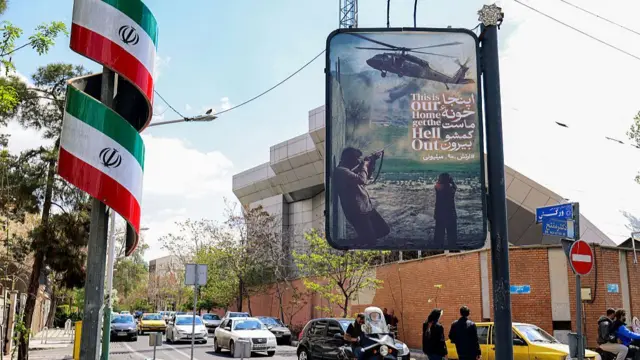
    A poster in Tehran on Monday morning, reading (in English): "This is our home, get the hell out"Image source, Getty Images
    Image caption,

    A poster in Tehran on Monday morning, reading (in English): "This is our home, get the hell out"

    Since the war began, Iranian outlets have been reporting daily on arrests in different parts of the country. Many of those detained have been accused of collaborating with opposition media and foreign intelligence services, with warnings coming from Iranian officials and outlets to those who might step out of line.

    There have been no signs of mass anti-establishment protests like those seen in January. During that wave, at least 6,508 protesters were killed and 53,000 arrested, according to the US-based Human Rights Activists News Agency.

    The scale of that crackdown, combined with current measures, may be contributing to the absence of large-scale demonstrations.

    From what people have told me from the capital, on some nights, aside from the sound of strikes and explosions, there is another noise that prevents people from sleeping.

    It is the sound of patrols moving through the streets with the Islamic Republic’s flag and loudspeakers which can reinforce a constant sense of control.

    Other tactics have also been used, including checkpoints appearing across cities, the internet blackout, and mass text warnings sent to residents.

    These measures limit communication, making it more difficult for protests to form and spread.

    Since the war started, Iranian officials and state TV have been promoting nightly pro-establishment rallies held in major squares of cities, where some anti-establishment protests also happened during January.

  18. Iran executes another man related to anti-government protests in Januarypublished at 11:37 BST

    Ghoncheh Habibiazad
    Senior reporter, BBC Persian

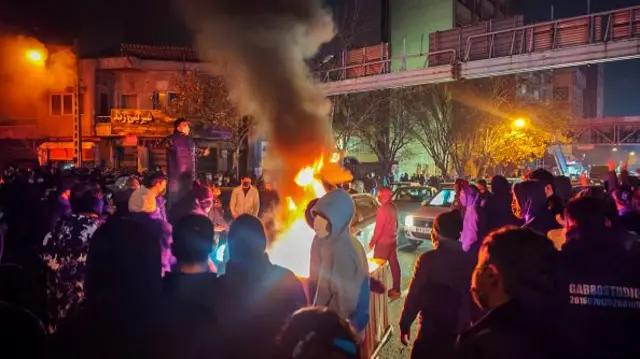
    A fire is lit and people gather round at night time in a Tehran streetImage source, Getty Images
    Image caption,

    January saw people take to the streets of Iran to protest soaring inflation and the collapse of the country's currency, the rial

    Iran says it has executed another person over accusations related to involvement in the January protests.

    Ali Fahim had been accused of entering a military-related location in Tehran and attempting to pull out motorcycles from the site, according to a report by the Islamic Revolutionary Guard Corps (IRGC) Tasnim News Agency.

    The report says that people, including Fahim, set fire to the site but that he was arrested after being trapped in the blaze.

    The BBC cannot independently verify these accusations and claims.

    In the context of the war:

    The report by Tasnim also refers to a claim by US President Donald Trump, that the US had sent "a lot of guns" to Iranian protesters through Kurdish militias. Iranian officials have also previously accused the US and Israel of backing the protests.

    So far, reports suggest that Iran has executed at least 14 political prisoners since the war began on 28 February, and there are some who are at risk of execution.

    Rights activists have warned of a rise in politically motivated executions recently.

  19. Iranian strike on Haifa kills four, targeting Israel's sense of securitypublished at 11:17 BST

    Lucy Williamson
    Middle East correspondent, reporting from Haifa

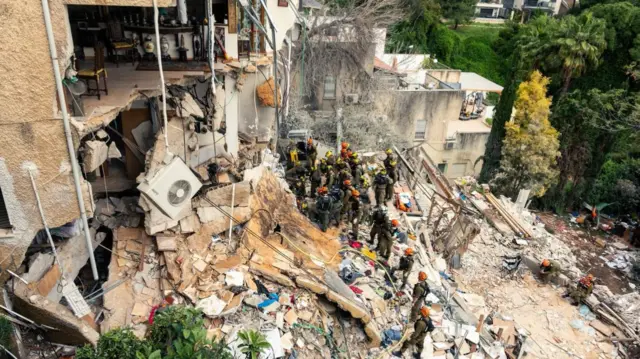
    Emergency service workers stand in the rubble of a building in Haifa, Israel, after an Iranian strike.Image source, IDF

    We’ve just seen four body bags brought out of the rubble in Haifa - residents of a building hit by an Iranian missile yesterday.

    Security officials said the bomb had failed to explode on impact, complicating the search.

    Search units reportedly had to tunnel through the concrete of a neighbouring building to reach the four people trapped inside.

    Mor Barel, who lives in a building opposite the bomb site, said even with the protection of Israel’s multilayered air defences, living with the threat of Iranian attacks felt like a daily gamble of "Russian Roulette".

    Polls suggest the overwhelming support of Jewish Israelis for this war is starting to wane, after more than five weeks of conflict.

    Israel has framed victory in terms of its success in hitting Iran’s ballistic missile sites and leadership, but Iran’s target is Israel’s sense of security, and it can hit that with a single missile strike on a single building.

  20. Reports of a peace deal presented to Iran and US - what we know so farpublished at 11:02 BST

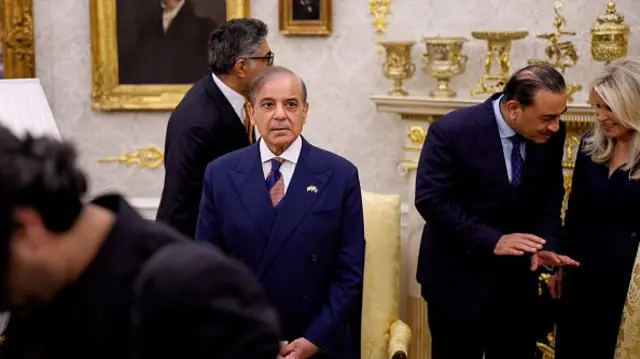
    Asim Munir stands in the Oval OfficeImage source, Getty Images
    Image caption,

    Pakistan's army chief Asim Munir - pictured here on a White House visit in September - is reported to be playing a central role in mediation

    Both Reuters news agency and Axios are reporting that a proposal to cease hostilities has been passed to the US and Iran. Some detail has emerged but there's still lots we don't know - let's take a look:

    What we know

    • A framework to end hostilities has been passed to the US and Iran, says Reuters
    • According to reports, there are "two-tiers" to the deal. It says this is an immediate ceasefire, with a more comprehensive agreement to follow later. This echoes Axios reports that mediators were discussing a 45-day ceasefire
    • Pakistan, Egypt and Turkish mediators have been involved in the negotiations, according to Axios. While Pakistan's army chief, Asim Munir, has been in contact "all night long" with US Vice-President JD Vance, adds Reuters
    • A senior Iranian official has ruled out opening the Strait of Hormuz as part of any temporary ceasefire, Reuters says
    • These reports come after Donald Trump appeared to set a new deadline for Iran to reopen the Strait of Hormuz by 20:00 ET on Tuesday (01:00 BST Wednesday)

    What we don't know

    • Any more specifics about the terms of a deal. For example, how some of the war's key sticking points so far - the Strait of Hormuz, strikes, nuclear enrichment - play a role
    • How closely the terms of this ceasefire plan mirror earlier unsuccessful proposals - such as the 15-point plan given to Iran in late March
    • How the Gulf countries in the region - that have been subject to numerous attacks throughout this conflict - feature in a peace proposal
    • If there is a timeline for either side to respond