Summary

  • Iran says the intelligence chief of the Islamic Revolutionary Guard Corps, Majid Khademi, was killed in a US-Israeli strike on Monday morning

  • Earlier, US President Donald Trump appeared to set a deadline for Iran to reopen the Strait of Hormuz of 20:00 ET on Tuesday (01:00 BST Wednesday)

  • In an expletive-laden threat on Iranian infrastructure, Trump said "Tuesday will be Power Plant Day, and Bridge Day, all wrapped up in one, in Iran. There will be nothing like it!!!"

  • In response, Iran warned of "much more devastating" retaliation. Our correspondent Lyse Doucet reports that "frantic, last ditch diplomacy is accelerating", although one insider tells us there needs to be a ceasefire first

  • The US president is due to give an update later on the operation to rescue an American airman who was in a fighter jet that was shot down over Iran

  • Meanwhile, attacks continue across the region - including in Iran, Israel, the UAE, and Saudi Arabia

  • Thousands of people have been killed in the war so far - the vast majority are in Iran and Lebanon

  1. Where strikes have already hit infrastructure and civilian targets in Iranpublished at 10:45 BST
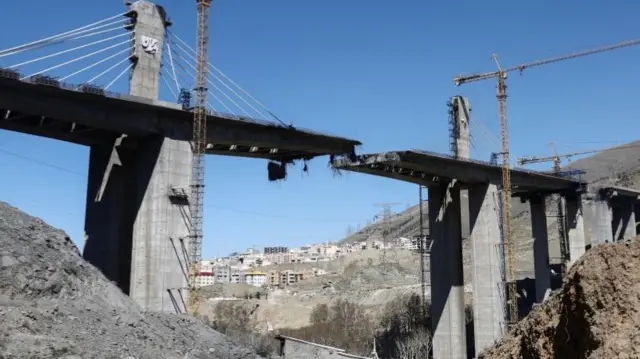
    A bombed bridge is shown spanning a dry rocky valley. There are several gaping holes in the bridge, which is surrounded by cranes.Image source, Reuters

    US President Donald Trump is threatening to blow up electricity plants, oil wells and water desaliation plants in Iran if the country does not meet his new Tuesday deadline to reopen the Strait of Hormuz.

    A number of infrastructure and civilian targets have already been hit during the war; the US and Israel say some were related to military operations, while others were accidental.

    • On 28 February, the first day of the war, two missile strikes hit Shajareh Tayyebehschool in Minab. The attack killed at least 168 people, Iranian officials said, including about 110 children. No one has officially accepted responsibility, though US media have reported that American military investigators believe its own forces were likely responsible
    • In early March, "black rain" clouded Iran's capital Tehran following attacks on oil facilities. Those targeted included the Fardis, Shahran, and Aghdasieh oil depots, and the Tehran oil refinery.
    • Iran's two largest steel plantshave been shut down due to multiple rounds of US-Israeli air strikes, the companies operating them say. Iran is a major global producer of steel.
    • Early last week, the UN's nuclear watchdog confirmed Israeli strikes had caused "severe damage" to the Khondab power plant, a heavy water complex in north-west Iran. No contamination was reported.
    • Last Thursday, 2 April, the major B1 bridge was destroyed by US strikes in Karaj, a city just west of Tehran, with Trump subsequently boasting about the bridge's destruction on social media.
    • Today, the Sharif University of Technology has been hit by a strike, which also caused a gas outage in parts of Tehran. A number of universities have been hit since the start of the war, including Tehran University of Scienceand Technology and Shahid Beheshti University.
    Media caption,

    Footage shows smoke rising from Karaj bridge
  2. Iran vows decisive and comprehensive response if US strikes civilian infrastructurepublished at 10:38 BST

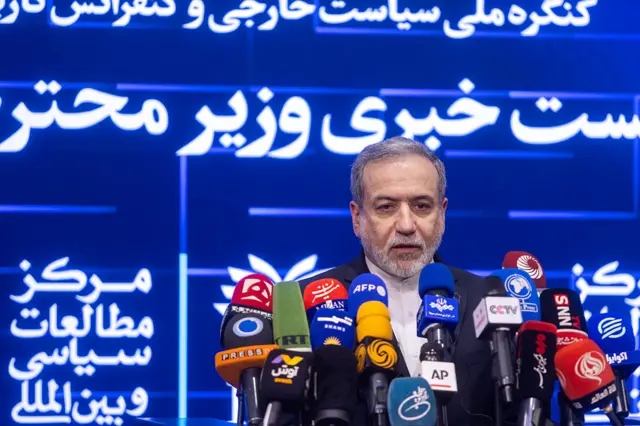
    Abbas Araghchi Iran's Foreign Ministry seen during his weekly press conference.Image source, Getty Images

    If the US carries out its threat to strike civilian infrastructure in Iran it will "undoubtedly be met with a decisive and comprehensive response from the Armed Forces of the Islamic Republic of Iran", Iran's foreign minister has said in a call with his French counterpart, Jean-Noël Barrot.

    Abbas Araghchi says the US threat "amounts to the normalisation of war crimes and genocide".

    A report of the call by Iran's foreign ministry says that Barrot described the threats of an attack on infrastructure as causing increased tension in the region, and he emphasised the need for a diplomatic solution.

  3. We're going to find out if US military is ready to say no to Trump - former Obama adviserpublished at 10:18 BST

    Ben Rhodes, former Deputy National Security Advisor of the United States under President Obama, says Trump's approach to the Iran war "increasingly feels like one man in one room making decisions".

    A little earlier he told BBC Radio 4's Today programme that Trump doesn't seem to be relying on political and military advisers, and is not following the "normal process".

    Rhodes says the US president is threatening to commit war crimes, following his latest warning to Iran's civilian infrastructure.

    "We're going to find out whether US military is ready to say no to Trump," he adds.

    Trump has to accept this war will only end over the negotiating table, Rhodes says, adding that though Iran has been weakened by strikes they have, in some ways, been strengthened by demonstrating - through the Strait of Hormuz - the strangle-hold they can have on the global economy.

  4. Frantic, last ditch diplomacy accelerates as Trump's deadline nearspublished at 10:07 BST

    Lyse Doucet
    Chief international correspondent

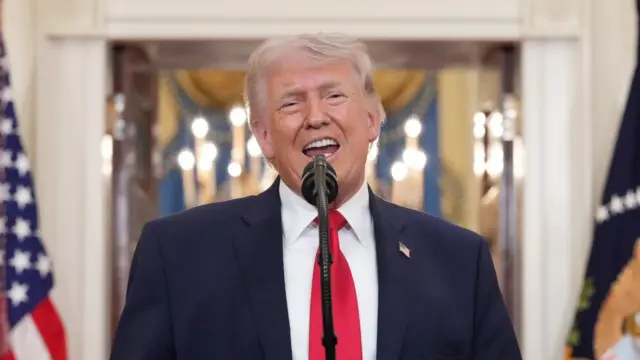
    Donald Trump in a dark suit and red tie speaking into a microphone.Image source, EPA/Shutterstock

    It's tempting to ignore President Trump’s bellicose expletive-laden rhetoric. But it’s too dangerous to be ignored.

    If Trump carries out his threats to "leave not one bridge or power plant standing," Israel will also intensify its attacks on infrastructure and Iran has threatened to retaliate against Gulf states.

    Frantic, last ditch diplomacy is accelerating as Trump’s Tuesday deadline nears.

    The Reuters news agency is reporting, based on unnamed sources, that mediators are working on a new plan - with Pakistan playing a major role - to bring the US back from this dangerous brink.

    The Axios news website also carried news of efforts to reach a ceasefire and the move to a permanent end to this war.

    Iran’s response to this reported plan isn’t clear – it’s repeatedly made it clear it won’t submit to Trump’s language of surrender and his terms for a deal which have amounted to diktats.

    But will it be enough for Trump to back down, as he did in late March, to give the plan, and the president, more time?

  5. Israel claims responsibility for killing IRGC intelligence chiefpublished at 09:47 BST

    Ghoncheh Habibiazad
    Senior reporter, BBC Persian

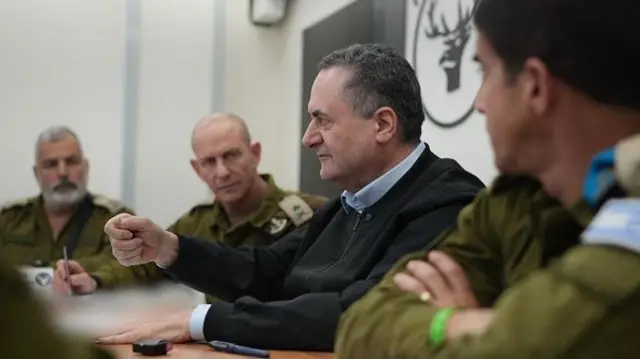
    File photo of Israeli Defence Minister Israel Katz, and members of the Israel Defense Forces (IDF)Image source, Anadolu via Getty Images
    Image caption,

    File photo of Israeli Defence Minister Israel Katz, and members of the IDF

    More now on the death of Iran's intelligence chief, with Israel's Defence Minister Israel Katz and the Israel Defense Forces (IDF) claiming responsibility for the killing of Majid Khademi.

    The IDF has written on Telegram that his killing is "another severe blow" to the Iranian Revolutionary Guard Corps (IRGC).

    When it comes to Iran acknowledging the deaths of its senior commanders in the recent war, most examples involve Iran confirming their deaths only after Israel or the US has claimed responsibility. However, this time Iran announced it earlier.

    Khademi was appointed as the commander of the IRGC intelligence organisation four days after his predecessor, Mohammad Kazemi, was killed in an Israeli attack on 15 June 2025.

    Back in August last year, Khademi urged parliament to prioritise the completion of a domestic intranet, saying it was needed to “safeguard the sovereignty” of Iran's cyberspace.

    Iran is currently still under an internet blackout since the war began on 28 February, although some domestic websites and apps remain accessible within the country.

  6. IDF issues warning to residents in southern Beirutpublished at 09:31 BST

    The Israel Defense Forces (IDF) has issued a warning to residents in the southern suburbs of the Lebanese capital Beirut.

    IDF spokesman for Arab media Avichay Adraee says Israel is continuing operations and strikes in various parts of the southern suburbs.

    It comes after at least 11 people were killed across Lebanon on Sunday.

    Lebanese authorities say 1,461 people have been killed in Israeli strikes since 2 March.

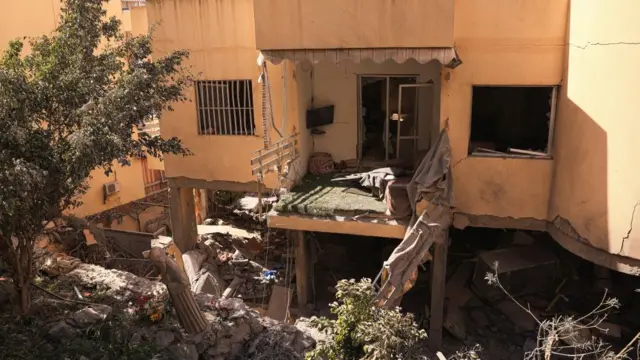
    The bottom floor of a building has been turned to rubble. A damaged balcony can be seen above itImage source, Reuters
    Image caption,

    Damage at the site of an Israeli strike on an apartment building in Lebanon

  7. IRGC says intelligence chief killed by Israel-US attackpublished at 09:03 BST
    Breaking

    Ghoncheh Habibiazad
    Senior reporter, BBC Persian

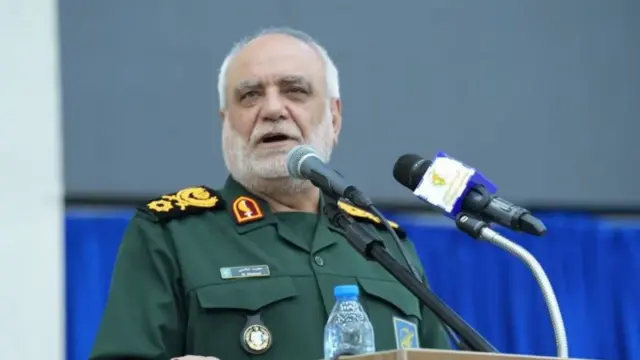
    Majid Khademi, a man with thin white hair and beard, wearing military uniformImage source, Iranian state media

    Iran’s Islamic Revolutionary Guard Corps (IRGC) has announced in a statement published by Iranian news outlets that their intelligence chief, Majid Khademi, has been killed.

    The statement says he was killed this morning and has accused Israel and the US of targeting him.

    I’ve reached out to the Israel Defense Forces (IDF) and they say they’ll “look into” the report.

    Khademi had replaced Mohammad Kazemi, who was also killed in an Israeli attack on 15 June 2025 during the 12-day Iran-Israel war.

    Back in February, following deadly anti-government protests in January, Khademi had accused US President Donald Trump of fuelling what Iranian officials have described as a "staged murder" strategy, aimed at increasing casualties to justify foreign military intervention.

    Khademi had claimed during that time that more than 10 foreign intelligence services, including Israel's cyber warfare and intelligence unit 8200, played a role in the protests that swept across Iran. According to the US-based Human Rights Activists News Agency, at least 7,000 people were killed in the January crackdown.

  8. Iran's vice-president hits out at Trump following strike on university in Tehranpublished at 08:41 BST

    Iran's first vice-president calls the strike on the Sharif University of Technology "a symbol of Trump's madness and ignorance". The US has not taken responsibility for the attack.

    The strike appears to have damaged parts of the university, including its technology centre building and the school's mosque, BBC Persian reports. The attack also has caused a gas outage in parts of Tehran.

    Dr Mohammad Reza Aref says the US president "fails to understand that Iran's knowledge is not embedded in concrete to be destroyed by bombs; the true fortress is the will of our professors and elites".

    "This fortress will not crumble," he adds.

    A number of universities in Iran have been hit since the start of the war, including Tehran University of Science and Technology and Shahid Beheshti University.

  9. More attacks across Middle East: A recappublished at 08:25 BST

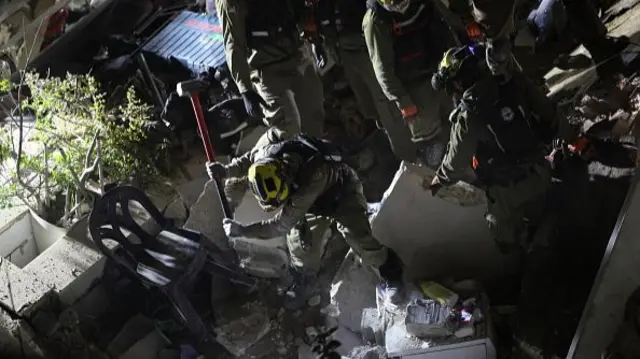
    A man with a sledge hammer digs in rubbleImage source, AFP via Getty Images
    Image caption,

    Israeli emergency services search for missing people after a strike on a residential building in Haifa

    Since our last update, alarms have sounded once again in countries across the Middle East. Here's a quick update on the attacks recorded so far on Monday.

    Iran: Thirteen people have been killed by a US-Israeli strike on a residential area in the Tehran province, says IRGC-affiliated Fars news agency. The outlet said that six of those killed overnight in the area were children.

    A strike has damaged several buildings at Sharif University in Tehran. Several Iranian media outlets now say gas supply has been restored, having been disrupted by the attack.

    Israel: Emergency services report several injuries after strikes on the country overnight. A man and woman in their forties and two girls aged five were treated for smoke inhalation in Haifa. Two were injured in central Israel, including a 34-year-old with serious shrapnel injuries.

    The Israeli military later said it was working to intercept missiles launched from Iran. Shortly after, it announced it was safe to leave protected spaces across the country.

    United Arab Emirates: Falling debris on Raneen Systems, a technology company, has injured a Ghanaian national in Abu Dhabi's industrial zone, says the Abu Dhabi media office.

    Authorities say they are dealing with an Iranian drone attack on one of the country's two main telecoms operators, Du, in the east of the UAE. No injuries have been reported from the attack, they add.

    Saudi Arabia: A Ministry of Defence spokesperson says the country has intercepted and destroyed two drones in the last few hours.

    Meanwhile in Lebanon, people have been inspecting the damage after more Israeli air strikes on Sunday (see picture below). The attacks killed at least 11 people across the country yesterday. Lebanese authorities say 1,461 people have been killed in Israeli strikes since 2 March.

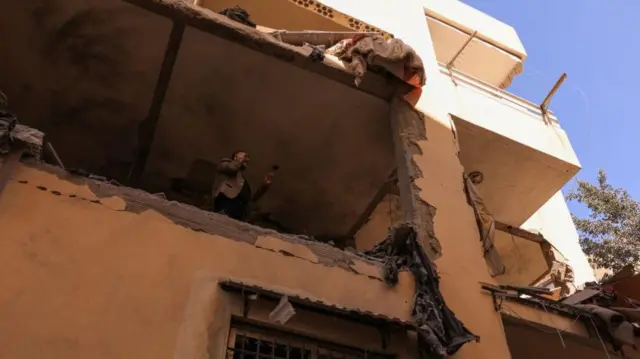
    A man talks on the phone while inspecting damage at the site of an Israeli strike on an apartment building in Ain Saadeh, Lebanon, on Monday morningImage source, Getty Images
    Image caption,

    A man talks on the phone while inspecting damage at the site of an Israeli strike on an apartment building in Ain Saadeh, Lebanon, on Monday morning

  10. Iran's deputy FM claims Trump's threats 'constitute war crimes'published at 08:08 BST

    Iran's deputy foreign minister says Trump's threats on Iranian civilian infrastructure "constitute war crimes" and a "flagrant violation of Article 2(4) of the United Nations Charter".

    The article prohibits members of the UN from using or threatening force, external against the territorial integrity of any state.

    Kazem Gharibabadi adds that Iran will deliver "a decisive, immediate, and regret-inducing response to any aggression or imminent threat".

    Our correspondent Tom Bateman spoke to Luis Moreno Ocampo, founding chief prosecutor of the International Criminal Court (ICC), last month.

    "Intentionally directing attacks at civilian objects... which are not military objectives," is a war crime, Moreno Ocampo said.

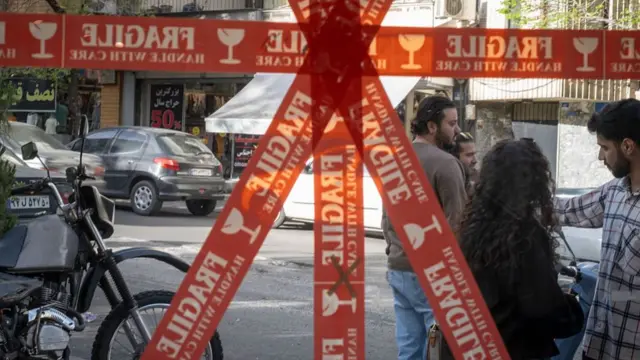
    Iranians outside a cafe in Tehran on Sunday, as tape covers the windows to protect them from shatteringImage source, Getty Images
    Image caption,

    Iranians outside a cafe in Tehran on Sunday, as tape covers the windows to protect them from shattering

  11. 'It feels like we’re sinking deeper into a swamp': Iranians speak to BBCpublished at 07:22 BST

    Ghoncheh Habibiazad
    Senior reporter, BBC Persian

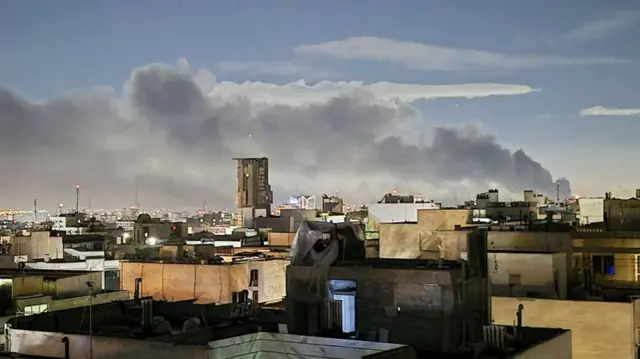
    Smoke rises from residential areas in eastern and western parts of Tehran following airstrikes carried out by the United States and Israel in Tehran, Iran, on 6 April.Image source, Getty Images
    Image caption,

    Smoke rises from a residential area in Tehran, Iran, following strikes

    I spoke yesterday with residents in Iran's capital Tehran and the nearby city of Karaj who tell me of their fears for the future after US President Donald Trump issues new threats on infrastructure.

    "It feels like we’re sinking deeper into a swamp. What can we do as ordinary people? We can’t do anything. We can’t stop him," one man in his 20s tells me.

    Trump has threatened to hit the country's civilian infrastructure and says Iranians will be "living in hell" unless the Strait of Hormuz is reopened.

    Some in Iran have been stockpiling resources. One woman in her 20s tells me her mum "is filling every bottle she can find in the house with water", while another woman whose family only has enough supplies for a few days says: "Without electricity, nothing will be possible. Nothing at all. I just hope he won’t hit Iran too hard."

    A man in Tehran whose family have also been stockpiling is concerned that, if Trump attacks Iran's infrastructure, "these efforts are pointless".

    Another Iranian man, in his 30s, tells me he doesn't see a bright future for the Iranian people. "With all these attacks, Iran won't be a place we can live in anymore. It’s going to be impossible to go back to how things were before the war."

  12. Iranian media says 15 ships passed through Strait of Hormuz in 24 hourspublished at 06:51 BST

    Ghoncheh Habibiazad
    Senior reporter, BBC Persian

    Iran's Fars news agency, which is affiliated to the country's Islamic Revolution Guards Corps (IRGC), said earlier that 15 ships passed through the Strait of Hormuz "with permission from Iran" in the previous 24-hour period.

    It added that traffic was still 90% lower than before the start of the war.

    Some Iranian officials, including Foreign Minister Abbas Araghchi, have repeatedly said that the vital shipping lane is not shut, but it is closed only to "enemy countries".

    For example, yesterday Iran announced Iraq is exempt from any restrictions it is imposing, according to the spokesman for Iran's Khatam al-Anbiya Central Headquarters.

    Meanwhile, Iranian officials and lawmakers have also raised the possibility of tolling vessels using the strait.

    Earlier an aide at Iran’s President’s Office, says the Strait of Hormuz "will be reopened" when "a portion of transit tolls is used to compensate for all the damage caused" by the war.

    Media caption,

    'We are at the edge of a battlefield': BBC reports near Strait of Hormuz

  13. Analysis

    Ceasefire needed for meaningful progress in talks, insider tells BBCpublished at 06:41 BST

    Tom Bateman
    US State Department correspondent

    Meaningful progress is unlikely to take place in negotiations between the US and Iran without a ceasefire first, a regional official familiar with the discussions tells me.

    "For any discussion, there needs to be a cessation of hostilities. It needs cessation, because it is not there as we speak... Ceasefire may be a precondition," says the official briefed on the discussions who spoke to the BBC on condition of anonymity due to the sensitivity of the talks.

    The source described mediated contact between the US and Iran, which has moved steadily for over a fortnight, much of the content of which remained secret.

    But talks have been challenging due to difficulty getting messages to and from officials in Iran amid the ongoing war and communications blackout.

    "To convey messages to Iran, getting a response in reasonable time is not possible. The average time of response has been a day or so," the official tells me.

    Trump told the news website Axios on Sunday that his envoys Steve Witkoff and Jared Kushner were holding "intense negotiations" with the Iranians but did not give further details, only saying that if a deal wasn't made to re-open the Strait of Hormuz he was "blowing up everything".

    Iran’s senior presidential aide Medhi Tabatabai said on Sunday the Strait of Hormuz would reopen only under a "new legal regime" in which Iran would use revenue from transit fees as reparations for the damage inflicted by the US-Israeli war.

    Pakistan, Turkey and Egypt have all been involved in efforts to mediate. The three countries’ foreign ministers reportedly held phone calls with both Witkoff and Iranian foreign minister Abbas Araghchi on Saturday.

  14. Don't underestimate Trump's ability to make good on Iran threatspublished at 06:34 BST

    Simi Jolaoso
    North America correspondent

    President Trump has dialled up the rhetoric in his latest social media post reminding Iran of his deadline to reopen the Strait of Hormuz.

    You can sense the frustration, and it makes for uncomfortable reading.

    Even though US media has reported that Donald Trump said on Sunday the two sides are “deep in negotiations”, it’s important to bear in mind the reality on the ground.

    More marines, paratroopers and warships have been deployed to the Middle East over the past few days.

    The last time the Trump administration said it was in talks with Iran, it struck the country - starting this war.

    This is also the second reminder Trump has given this weekend, threatening to target Iranian civilian infrastructure. It is important to not underestimate him making good on his threat.

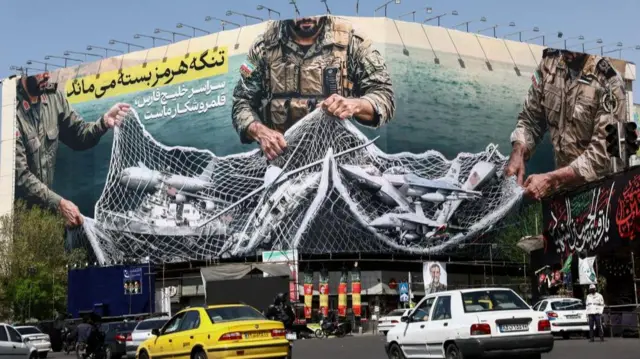
    A billboard in Tehran - apparently showing the Iranian military collecting US ships and aircraft in a net - seen in Tehran on SundayImage source, Reuters
    Image caption,

    A billboard in Tehran - apparently showing the Iranian military collecting US ships and aircraft in a net - seen in Tehran on Sunday

  15. Debris falling in Abu Dhabi as more Iranian attacks interceptedpublished at 06:16 BST

    Abu Dhabi authorities are responding to falling debris after its air defence systems made a "successful interception", says the Abu Dhabi Media Office.

    A Ghanaian national was injured as debris fell on the Raneen Systems company in the Musaffah industrial area of the city, it says.

    On Sunday, the UAE Ministry of Defence said it intercepted 50 Iranian drones, one cruise missile, and nine ballistic missiles from Iran.

    That takes the totals to 2,191 drones, 24 cruise missiles, and 507 ballistic missiles since the start of the war.

  16. Strike hits Iranian university, causing gas outage in Tehranpublished at 05:37 BST

    The Sharif University of Technology has been hit by a strike, causing a gas outage in parts of Tehran.

    BBC Persian reports that parts of the university, including its technology centre building and the school's mosque, appear to have been damaged. Images online this morning show thick smoke rising from areas in Iran's capital city.

    Elsewhere in the capital city, an airstrike on a residential building has killed 13 people.

    The mayor of the district that includes the university, said gas was being temporarily cut due to the attack.

    A number of universities in Iran have been hit since the start of the war, including Tehran University of Science and Technology and Shahid Beheshti University.

  17. Oil prices hit $110 after Trump's latest threatspublished at 05:11 BST

    Osmond Chia
    Business reporter

    Oil prices hit $110 (£83.38) a barrel after President Donald Trump's expletive-laden threat against Iran on social media.

    The price of Brent rose initially by 1.6% to $110.85, before retreating slightly during morning trade in Asia.

    US-traded crude gained slightly by 0.3% to $111.80.

    The initial jump came after Trump put more pressure on Tehran by threatening to strike Iran's bridges and power plants if Iran did not back down on its threat against ships that try to cross the critical Strait of Hormuz trade waterway.

    Major Asian stock markets also edged higher. Japan's Nikkei 225 exchange rose by 1.6% while South Korea's Kospi index gained by 0.9%.

    Read more here.

    A driver refuels a vehicle at a petrol stationImage source, Getty Images
  18. Iran warns of 'much more devastating' retaliation if civilian targets hitpublished at 04:28 BST

    Iran has warned of "much more devastating" retaliation if the US and Israel were to strike civilian targets, state media has reported.

    "If attacks on civilian targets are repeated, the next stages of our offensive and retaliatory operations will be much more devastating and widespread," reads a statement from a spokesman for the Khatam al-Anbiya Central Headquarters - Iran's highest operational military command unit. The statement was published by the Islamic Republic of Iran Broadcasting (IRIB).

    It comes after the US president threatened attacks on Iranian power plants and bridges if Iran fails to meet his Tuesday deadline to reopen the Strait of Hormuz.

  19. Attacks continue across the Middle Eastpublished at 04:19 BST

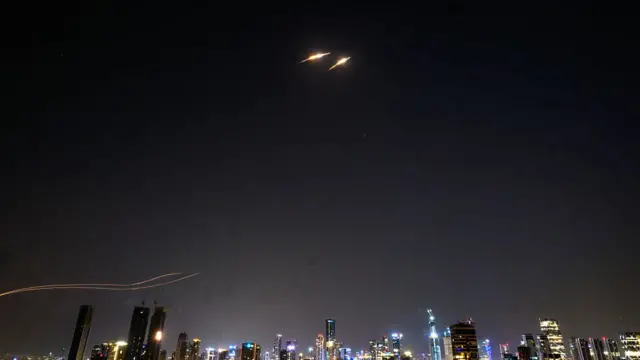
    Rockets are launched to intercept Iranian ballistic missiles fired towards Tel Aviv in the early hours on April 06, 2026 in Tel Aviv, Israel.Image source, Getty Images
    Image caption,

    Iranian missiles intercepted above Tel Aviv, Israel

    Israeli strikes on Lebanon on Sunday have killed at least 15 people and wounded 39 others, AFP reports citing the Lebanese health ministry.

    At least five people were killed in a strike on Beirut, while three were killed in an attack on an apartment building in Ain Saadeh, east of Beirut, officials said.

    A four-year-old girl was among seven people killed in a strike on the southern town of Kfar Hatta, the ministry added.

    In Israel, two bodies have been recovered from a residential building that was hit by a missile, Israeli media report.

    Israel's military says it has conducted a wave of strikes against targets in Iran's capital, Tehran.

    A US-Israeli strike on a residential building killed at least five people and left several people buried under rubble in Qom, south of Tehran, a deputy governor told the semi-official SNN news agency, Reuters reported.

    The UAE and Kuwait said their air defences had also responded to missile and drone attacks.

  20. Trump to host news conference later today on airman rescuepublished at 03:52 BST

    US President Donald Trump earlier posted a message on his Truth Social platform about yesterday's dramatic rescue of the second US airman from a downed F-15 in Iran.

    He says he will be hosting a news conference with the military on Monday at 13:00 ET (18:00 BST).

    Trump noted in his post the daring nature of the raid deep in the mountains of Iran and how this type of rescue is "seldom attempted" due to the dangers.

    The weapon systems officer was rescued nearly two days after his US fighter jet was shot down by Iran, hiding in mountains with a beacon signal and a handgun to defend himself as Iranians scoured the area looking for him.

    The jet's pilot was rescued earlier by US crews. Trump says in his post that the pilot was rescued in broad daylight after spending about 7 hours in Iranian territory.

    The White House press secretary announced shortly after Trump's post that "due to popular demand" the news conference will be held in the briefing room, rather than the smaller Oval Office where it had been scheduled.