| Slavery Trail - Liverpool's connections |
|
There were 5 main ways the city made money from slavery: - Building & repair of slave ships
- Slave trading
- Slave produced goods - cotton, sugar etc
- Production of exportable goods - pottery etc
- Insuring & Financing the above operations and industries.
|
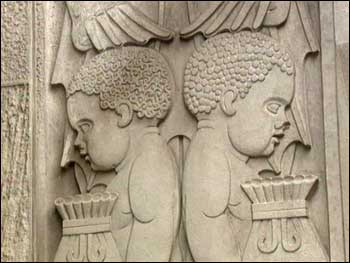 | | Much of the city's architecture takes its inspiration from the slave trade. Many buildings associated with the slave trade have African heads carved into them. |
Slavery has existed since the most primitive of human societies. Back in the 1st century, farmers in Africa used slaves as workers.  | Stow-a-way
Rachel Freeman describes how her great-great-granmother stowed away on a ship from West Africa to Liverpool. | | Real Player required: More info |
The first Europeans to expand this practice and transform it into an international and extensive trade (in terms of volume) were the Portuguese in the 16th century. This was the beginning of what is called the Atlantic slave trade.
| "I verily believe that the far greater part of wars, in Africa, would cease, if the Europeans would cease to tempt them, by offering goods for sale. I believe, the captives reserved for sale are fewer than the slain" | | JOHN NEWTON, FORMER SLAVE CAPTAIN |
Contary to popular belief few slaving voyages made a huge profit.
An average voyage would produce a profit of 8%.
Sometimes however huge profits would be made.
"In 1780 Mathew Street slave trader William Davenport sent his ship HAWKE out to Africa at a cost of £5,000.
It returned with a profit of £10,000" |
Liverpool merchants fought against the abolition of slavery, and over 64 anti-abolition petitions were submitted from Liverpool.
The Abolition of Slavery Bill was passed in 1807.
 | Did you know that? | | Bryan Blundell, tobacco merchant, privateer and slave trader, built Bluecoat Chambers in School Lane for the poor children of Liverpool. |
However much Liverpool supported the trade, slaves rarely set foot on soil here. Contary to folklore The Goree Piazzas, on the Dock Road, NEVER had slaves chained there. In fact, the Piazzas were built 11 years after courts ruled that every slave became free as soon as his feet touched English soil.
|
| |
|