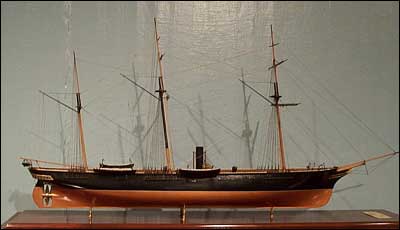
| | A model of the CSS Alabama - this originally resided in Cammel Lairds but is now on display at the Williamson Art Gallery & Wirral Museums. |
One of many local connections with America was courtesy of … a spy! The American Civil War impacted heavily on Liverpool - because cotton from the American South came through this port, to supply the mills of Lancashire.
Of course, the Union’s blockade effectively stopped that trade, mills became idle, and no work meant no pay in those days.
(The United States attempted to repair the damage caused by their blockade by sending food supplies to relieve some of the suffering..
A Southern Grand Bazaar was held in St. George’s Hall, in Liverpool’s famous Lime Street, to raise money to help the thousands of wounded in America’s southern lands. Each stall represented one of the southern states, and in just 5 days, £20,000 was raised.)  | Did you know that? | | By the end of the 18th Century trade had assumed such proportions that an American Chamber of Commerce was set up in Liverpool in 1801.
It lasted 100 years. |
At the outbreak of the War, the North had an enormous advantage over the South in terms of manufacture, men and arms, and the blockade was thrown around the southern ports to stop supplies coming in. The South needed to break that blockade, but she was short of ships. Enter the man - the so called "spy" - who arrived here on 4th June l861. James D. Bulloch, from Georgia. He had been instructed by the Government of the South to travel to Liverpool, in secret, carrying no documents that might reveal his purpose, because it was against British law to supply any foreign warring faction with armed ships; and it was important to stop the United States from finding out their plans. | Did you know that? | | In l834 Cammell Laird built the first iron paddle steamer for America - the John Randolph - which was sent over in pieces to be assembled. |
Arriving in Liverpool, Bulloch met with Charles Prioleau of Fraser Trenholm & Co, cotton merchants, with offices at 10 Rumford Place. This was a sister company to Charles Fraser of Charleston, South Carolina, the first of the Southern States to break away from the Union. Bulloch first commissioned the Liverpool shipbuilders William C. Miller & Sons to build a vessel. The rumour was put about that she was to be a merchant vessel for an Italian company, and was even given an Italian sounding name Oreto. But once out of British waters and into Caribbean waters she was turned into a fighting ship, and renamed CSS Florida.
|