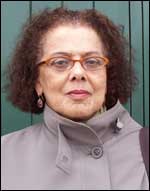
| | The capture and voyage - The Middle Passage | Dorothy Kuya talks about the capture of the slaves - and the involvement of the Europeans and Africans in the procurement of slaves.
She also describes the conditions on board ship both for the slaves and the sailors during the lengthy Middle Passage. |
Slavers wanted to transport the maximum number of slaves at the highest profit and maximum survival rate.
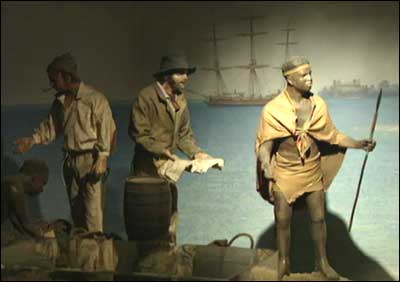
In practice this meant unbelievably cramped conditions, extraordinarily harsh discipline, and immediate death to any who showed signs of disease. As soon as slaves were taken aboard, the men were shackled two by two, the right wrist and ankle of one to left wrist and ankle of another. | Image taken in the Transatlantic Slavery Gallery at The Maritime Museum, Liverpool.
© National Museums & Galleries on Merseyside |
The men were packed together below deck and were secured by leg irons. The space was so cramped they were forced to crouch or lie down. Women and children were kept in separate quarters, sometimes on deck, allowing them limited freedom of movement, but this also exposed them to violence and sexual abuse from the crew.
"They tore off my clothes, bound me with ropes, gave me a heavy load to carry, and led me to the town of Bonduku, and from there to the town of Kumasi...
from there through Asikuma and Ajumak in the land of the Fanti.
There they sold me to the Christians" | | ABU KEKRES SIDDIK, KIDNAPPED 1804 |
It has been estimated that from 1451 to 1870 between 10 to 12 million slaves were exported from Africa. The crossing mortality rate was about 10%, (1.2 million). Some captains used a system called loose packing to deliver slaves. Under that system, captains transported fewer slaves than their ships could carry in the hope of reducing sickness and death among them. Other captains preferred tight packing. The slaves were often sold to European traders by other Africans. 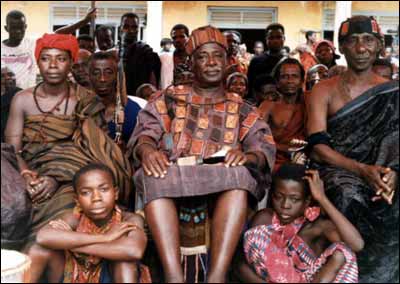 | | Chief Nana Kwame Nkyi XII (centre) |
Chief Nana Kwame Nkyi XII, Paramount Chief of the Assins, whose ancestors raided for slaves and who now presides over an annual ceremony to commemorate the souls of the slaves who passed through his town.
|