Unit 7: The Titanic
Past simple and past continuous
Select a unit
- 1Nice to meet you!
- 2What to wear
- 3Like this, like that
- 4The daily grind
- 5Christmas every day
- 6Great achievers
- 7The Titanic
- 8Travel
- 9The big wedding
- 10Sunny's job hunt
- 11The bucket list
- 12Moving and migration
- 13Welcome to BBC Broadcasting House
- 14New Year, New Project
- 15From Handel to Hendrix
- 16What's the weather like?
- 17The Digital Revolution
- 18A detective story
- 19A place to live
- 20The Cult of Celebrity
- 21Welcome to your new job
- 22Beyond the planets
- 23Great expectations!
- 24Eco-tourism
- 25Moving house
- 26It must be love
- 27Job hunting success... and failure
- 28Speeding into the future
- 29Lost arts
- 30Tales of survival
Session 1
Big events in the news can stay in our memories forever. Even if we weren't directly involved, we remember where we were and what we were doing at that time. In this session, you'll learn about one of the most well-known disasters of the 20th Century, improve your vocabulary, and test your knowledge.
Activity 1
A disaster at sea
Welcome to Unit 7. We're going to find out about a famous historical disaster and learn how to use past continuous and past simple to describe details about an event.
But to start, look at these images. What historical event do they remind you of?
Read the text and try the activity
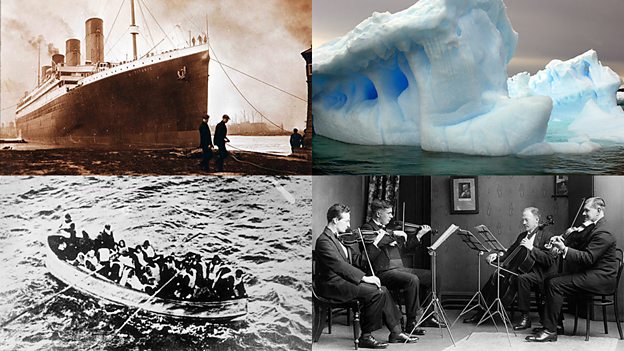
If you said 'the Titanic', then well done! You got it exactly right.
Vocabulary Test
The story of the Titanic is one that still captures people's imaginations more than a century after it sank in the North Atlantic Ocean.
It was the biggest passenger liner in the world when it was built in 1912. People said it was 'unsinkable' but they were wrong.
Tragically, the Titanic struck an iceberg while it was crossing the Atlantic Ocean and started to sink. Famously, a string quartet continued to play as the ship was going down.
Most of the people on board died but some were able to escape in lifeboats.
To do
Read the paragraph above again and look at the words in bold. Do you know what they mean? Try this quiz to find out:
Vocabulary
6 Questions
Match the word with the correct definition
Help
Activity
Match the word with the correct definition
Hint
Read the Vocabulary referenceHelp
Activity
Match the word with the correct definition
Hint
Read the Vocabulary referenceHelp
Activity
Match the word with the correct definition
Hint
Read the Vocabulary referenceHelp
Activity
Match the word with the correct definition
Hint
Read the Vocabulary referenceHelp
Activity
Match the word with the correct definition
Hint
Read the Vocabulary referenceHelp
Activity
Match the word with the correct definition
Hint
Read the Vocabulary referenceExcellent!Great job!Bad luck!You scored:
Vocabulary
6 Questions
Match the word with the correct definition
Help
Activity
Match the word with the correct definition
Hint
Read the Vocabulary referenceQuestion 1 of 6
Help
Activity
Match the word with the correct definition
Hint
Read the Vocabulary referenceQuestion 2 of 6
Help
Activity
Match the word with the correct definition
Hint
Read the Vocabulary referenceQuestion 3 of 6
Help
Activity
Match the word with the correct definition
Hint
Read the Vocabulary referenceQuestion 4 of 6
Help
Activity
Match the word with the correct definition
Hint
Read the Vocabulary referenceQuestion 5 of 6
Help
Activity
Match the word with the correct definition
Hint
Read the Vocabulary referenceQuestion 6 of 6
Excellent!Great job!Bad luck!You scored:
Next
How well did you do? In the next activity, you'll see an animated video which tells the story of a seven-year-old who survived the Titanic disaster.
