


Ecological clues
Many people assume that food in prehistory would have been a matter of survival rather than taste. However, evidence of cabbages, wild carrots, wild turnip, nettles, ramsons or wild garlic, meadowsweet, fungi, millions of hazelnuts, wild cherry and sloe stones - and more - suggest plenty of scope for creative cooking. Add to this the earliest discovery of cloudberry from a settlement site in Scotland, and we are presented with the capacity for a very palatable Iron Age feast.
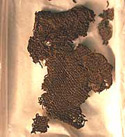
'The cloth fragment was made from drop-spun sheep’s wool woven in a 2:1 twill.'
The piece of cloth from Oakbank Crannog is of particular interest, as such finds are uncommon from early Iron Age sites in Scotland. The cloth fragment was made from drop-spun sheep’s wool woven in a 2:1 twill. This is a robust, hardwearing type of cloth, which suggests the crannog farmers had sophisticated weaving skills. There was no trace of dye remaining in the cloth but, after 2,500 years of immersion in water, this was not surprising.
Published: 2005-01-25

