


Houses on water
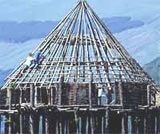
Finds of grain, a plough, animal droppings and a butter residue in a wooden vessel pointed to a farming lifestyle. The archaeologists were puzzled, though, as to why farmers should wish to live on the water. They also wondered about the building methods the ancients could have employed. How had they managed to build a roundhouse on stilts out in the water?
The team decided to try to rediscover ancient technology first, and then to recreate a life-sized crannog based on excavation results at Oakbank Crannog and on related research.
'They had to learn forestry and woodworking skills on the job ...'
The project was set up under the auspices of the Scottish Trust for Underwater Archaeology, involving Trust members, and students and staff from Edinburgh University. In 1993 the team carried out tree felling and pointing with a replica axe, and carried out pile-driving experiments, before starting work on the crannog in 1994.
They had to learn forestry and woodworking skills on the job, and harvested nearly all the materials required from the Loch Tay area. Re-discovering ancient pile-driving skills was not an easy task. The trees were heavy and difficult to raise upright from the water surface. Once the trees were upright, however, the team discovered a simple, if tiring, method to achieve the driving.
They lashed a short pole across the tree and used it to swivel the pile from side to side. The momentum was sufficient to drive the pile into the lochbed. While there is no guarantee that this is the method the ancient crannog builders used, it is simple and effective, and certainly one that they could have practised.
Published: 2005-01-25

