


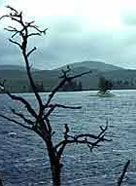
Artificial islands
Crannogs have always been steeped in a little mystery, as they are fairly inaccessible except to divers and boating enthusiasts.
They are artificial or modified natural islands, found in many of the lochs of Scotland and Ireland. They were built as defensive homesteads, and probably as symbols of status, from as early as 5,000 years ago, but people continued to build them, or re-build and occupy some of them, until at least the 17th century AD.
'Preliminary research suggests that crannogs had their heyday during the Iron Age'
Surveys in Scotland have located the remains of several hundred crannogs, which vary tremendously in size, shape, date of occupation, and methods of construction. For example, some prehistoric crannogs in densely wooded areas began as freestanding houses supported on wooden stilts or piles, while those in barren areas were stone or part-timber houses supported on partly natural or entirely man-made rocky islands.
Today, they appear as tree-covered islands or as submerged stony mounds completely hidden from view. Preliminary research suggests that crannogs had their heyday during the Iron Age (c.750 BC to AD 42), which is where this study begins.
Published: 2005-01-25

