


Reconstructing the past
Experimental archaeology is a form of 'hands-on' study based on questions about past human activity and behaviour. It is used as a tool to test theories and to help interpret archaeological sites and artefacts through an understanding of ancient technologies and the societies that created them.
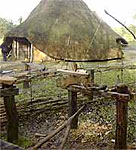
This understanding is brought about through reconstruction and recreation of environmental conditions, buildings, transport, tools, weapons, domestic equipment, and more. Such activity may form part of an overall interpretation strategy about a particular culture and period, such as at the Iron Age farm complex at Butser, near Petersfield.
Other activities may be carried out as short-term experiments inspired by a single discovery or motivated by individual interest, such as making a pot or a wattle hurdle.
'We can always learn more from studying and handling materials like actual house or ship timbers ...'
The better preserved the evidence, the better our chances for effective reconstruction. It is easier, for example, to appreciate the design and function of a ceramic pot that is discovered intact with a residue, than a single, feature-less fragment.
Similarly there are obvious benefits from submerged or waterlogged sites where there is good preservation of organic materials. We can always learn more from studying and handling materials such as actual house or ship timbers than from cavities left by rotted items in the ground, or by carved or painted images, which can be misleading or lack information.
Published: 2005-06-21

