
One of the questions I am most frequently asked is “what did my grandfather do in the war?”. Most people who have an ancestor who served during WW1 have an idea of their battalion or their service number but not always an idea of exactly where their ancestor went and which battles they fought.
Ironically, if your ancestor died then their basic details can be traced quite
quickly via the Commonwealth War Grave Commission’s website. If you're lucky then their
service records will have survived the Blitz and be available in the WO 363
records held at The National Archives or via Ancestry.co.uk, but it is estimated that around 60% of all WW1 service
records were sadly lost.
If your ancestor served overseas then they should have received either two or three of the campaign medals and if they survived then they may have received a pension, details of which can both be found online.
More recently, it has become possible to search the WW1 casualty lists and in some cases view the original newspaper cuttings which offer valuable
details previously not easily accessible. So it is becoming increasingly easy to follow the paper trail left by a
military ancestor, providing you have a few basic details to start with or a
surname that isn’t Smith or Jones!
At the start of the summer I received a more specific and complex task.
“My great-grandfather Percy William Laverick won the Military Cross in WW1. All I really
know is that he was a Lieutenant with the Royal Garrison Artillery and that he
was awarded the MC for gallantry. I'd like to find out more.”
This query was sent to me by BBC Good Morning Wales presenter Ollie Hides.
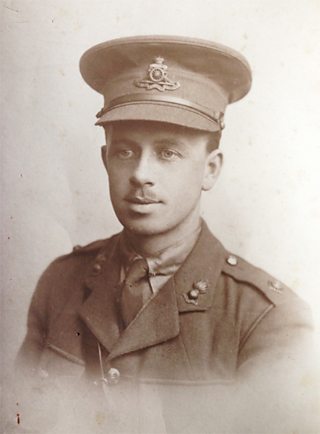
Lieutenant Percy William Laverick, courtesy of Ollie Hides
The fact that Laverick had been decorated meant that the first place to start was by searching The Gazette. A quick search of their database revealed that Laverick was mentioned three times: firstly when he was promoted to 2nd Lt in 1917, then on December 23rd 1918 he was attached to the 329th Siege Battery, and finally in 1919 came the citation for his Military Cross.
SUPPLEMENT TO THE LONDON GAZETTE, 11 JANUARY, 1919. page 629
Lt. Percy William Laverick, 329th Siege By., R.G.A.
For conspicuous gallantry and devotion to
duty. When in command of a half battery
in a forward position which was heavily
bombarded with high-explosive and gas
shell, he kept his guns in action and maintained
communication with headquarters.
After being twenty hours under shell fire,
he withdrew his guns in good order without
casualties, and only slight damage to one
gun. His cool judgement enabled him to
extricate his half battery from a dangerous
situation.
The text of this citation makes me feel proud and he isn’t even my ancestor.
Emotions aside, with this information it was now possible to narrow down when Laverick’s gallant deed occurred, which was towards the end of the war, taking into account the delay between the action at the Front and the War Office providing accurate details to be printed several months later in the Gazette. Regardless, I was determined to find the actual date and, if possible, the location.
Luckily, WW1 Officers’ service records were not subject to being bombed in the Blitz and Laverick’s service record was available at the National Archives under the reference WO 339/83760, which I quickly ordered for just under £40 because they have not yet been digitised and so are not available to view online. I knew it would take a while to arrive but when it did it should provide more details of his illustrious Military Cross.
Naturally Lieutenant Laverick was also awarded Campaign Medals, but his medal index card revealed that since he arrived in France on May 15th 1917 he was only eligible for the Victory and British War Medal and not the 1914-1915 Star.
Because Laverick was an officer the medal index card also provided his address at the time: 2 Spencer Mansions, Queens Club Gardens in West Kensington - which was quite a difference to his entry in the 1911 census. He was a 19-year-old sales engineer living at 97A Rye Lane, Peckham in south-east London with his 14-year-old brother Cecil Ebenezer Laverick, who sadly died on September 13th 1917 while also serving with the Royal Field Artillery.
The National Archives are currently undertaking the huge task of digitising all the WW1 war diaries. These diaries, which were kept in triplicate, reveal the minute details of the day-to-day occurrences and often even hour-by-hour developments.
After contacting the Royal Artillery Museum, my hopes were dashed when I learned that there was no war diary kept for the 329th Siege Battery.
But there was still a chance, since they formed part of the 28th Heavy Artillery Group, whose diaries were held both at the National Archives and at the Regimental Museum in Woolwich.
So on August 5th, Ollie and I travelled to Woolwich hoping to find the answers to the final two questions: exactly when and where did Laverick act so bravely?
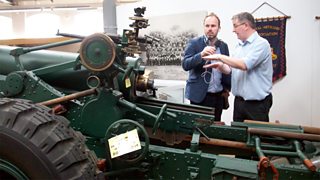
Ollie Hides talking to Paul Evans about the type of guns his great-grandfather was so keen to protect
Safely stored within the thick walls of the library housed within the museum are row upon row of boxes, each containing a war diary. With the necessary expertise of Paul Evans we were provided with a single box to work our way through, scanning for any sign of Laverick’s name.
And thankfully we were rewarded for our efforts.
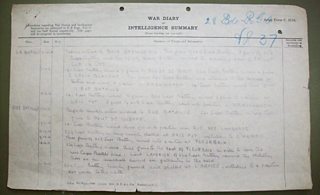
War Diary of the 28th Heavy Artillery Group, courtesy of the Royal Artillery Museum
The word “Eureka” doesn’t do justice to my feelings at that moment.
On October 11th 1918, while stationed east of Fleurbaix, Lieutenant Laverick received the MC as an immediate award for gallantry in the field.
Later in August, Ollie was able to travel to Belgium and drive to the place where the small hamlet of Fleurbaix existed in 1918, and also visit his the grave of his great-uncle Cecil Laverick.
Since the recordings were broadcast on BBC Good Morning Wales, Ollie has also received an incredibly personal letter discovered by Keith Charge whose grandfather served alongside Laverick in the RGA, which proves that brave men have a sensitive side to them.
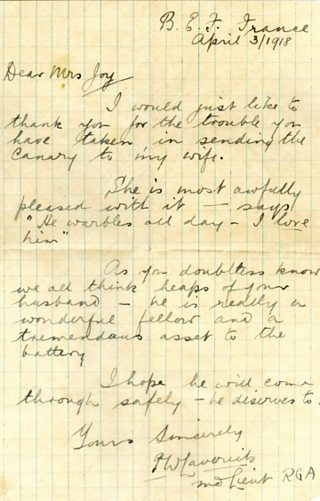
Letter from Lt Percy Laverick, courtesy of Keith Charge
Not everyone is not going to be this lucky when they research into what their grandfathers did during the war, but you will never know until you start searching.
