Gareth Jones has been a journalist for 31 years and has been making programmes for BBC Wales with the Queen’s Dragoon Guards since 2006. For his latest programme, The Welsh Cavalry: Last Tour of Afghanistan, he joined the regiment on their final tour in Helmand Province.
It’s been an extraordinary nine years. At times, it felt like I’d actually joined up. Since the winter of 2006, when I first started filming with the Queen's Dragoon Guards (aka QDG or ‘Welsh Cavalry’) I have been given unusually intimate access to army life. I’ve followed the same soldiers over four tours of duty and seen four commanding officers come and go (the last three have been younger than me, making me feel a bit old). I’ve got a feel for the rhythms of military life, what the generals call the ‘operational tempo’.
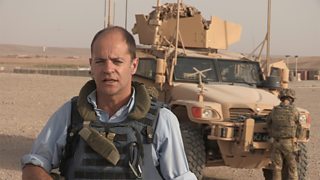
Gareth Jones with the Queen's Dragoon Guards in Afghanistan
Over the last 13 years the UK’s tried to fight wars in Iraq and Afghanistan at the same time and that meant the QDG could expect a seven month operational tour every two years or so. I would know when a tour was coming, because that’s when the exercises would start. Six months before departure the training got so intensive the men would hardly see their families. I would join them, in snow, rain or baking sun, on the firing ranges of Germany or west Wales and for the ‘final exercises’ on Salisbury Plain. The last few weeks before a tour were always difficult, as soldiers prepared to say goodbye to families or friends. And I would share their butterflies in the stomach, knowing I’d also have to leave my family behind to go and cover the fighting.
The best thing about it all has been sharing experiences, up close and personal, with the men themselves. The army has rarely insisted I stay in some kind of media tent with other journalists. They have let me live like a soldier most of the time, eating and sleeping out under the stars with them, travelling in their fighting vehicles and, most memorably, coming through a Taliban ambush with them. They say the friends you make under fire become friends for life.
Sgt Major Dan Brown talks about what motivates the soldiers he’s responsible for.
Does all this sound a bit cosy? Have I been captured by the army? Being embedded with the military is the only way you can cover certain conflicts these days. It’s too dangerous otherwise. Sadly, it’s much harder for journalists to operate independently without risking their lives or getting kidnapped. But this doesn’t mean you have to lose journalistic objectivity, fairness, or accuracy.
With heightened powers of observation and sharpened critical faculties based on a lot of reading and research beforehand, you can get beyond the highly-controlled situation you can find yourself in. You can see how I have managed this in the latest programme. One example: I asked to use military footage to explain how a night operation unfolded. The army were only too happy to provide it, as they believed it showed the QDG’s troops having a real effect on the enemy. However, as I point out in the film, they may well have had an effect but there could be another interpretation of the footage as it showed how elusive the Taliban can be no matter how hard and fast the British hit them.
The most unusual aspect of this project has been following the same soldiers over nine years and seeing army life through their eyes. I have got to know some real characters like Sgt Major Jason ‘Butch’ Davies, from Swansea. Butch had to pull out of the last tour due to an injury so unfortunately wasn’t in this latest film. Also absent was Tredegar boy ‘Jenks’, Ieuan Jenkins, who appeared as a seventeen-year-old raw recruit in the first series in 2006. I reported on how he nearly died when his vehicle overturned in Iraq and how he got hit by shrapnel in Musa Qaleh in 2009. That injury turned out to be a life-changer. It’s confined him to barracks ever since and he’s about to be medically discharged. At the age of 27 he’s only known a life in the army and has nothing else to go to at the moment. He’s bitterly disappointed.
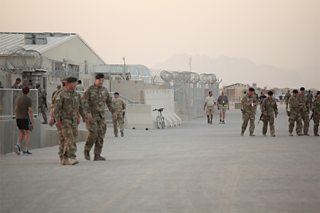
Camp Bastion in Helmand Province, Afghanistan
Much is made, rightly, of the fact that more than 600 British soldiers died in Iraq and Afghanistan and we are also familiar with some of the terrible injuries inflicted by bombs and bullets. But Jenks’s story also illustrates there have been injuries that, while not grabbing as much media attention, result in very dramatic consequences for the people affected.
I stay in touch with Jenks and the others, and will continue to whether they remain in the regiment or not. I don’t see this project ending after the first nine years. Who knows where the QDG, and the soldiers I have followed, will end up next.
The Welsh Cavalry: Last Tour of Afghanistan is on BBC One Wales on Monday, November 10 at 10.35pm.
