
A few weeks ago saw the Doctor Who team return to BBC Hoddinott Hall to record the soundtrack for the second half of the current season. I took the opportunity to talk to the thoroughly lovely Huw Thomas, our multi-award nominated senior audio supervisor and general Sound God, about his role with the orchestra.
LS: When an outside team, like Doctor Who, come to work with the orchestra, how much contact do you have with them before a session?
HT: Several weeks before a session I call the producer/composer to discuss instrumentation, and the type of sound required.I then decide on how many microphones, where they should go, facilities required and the number of staff needed.
LS: In comparison to a symphonic concert, how many microphones will be used for recording a soundtrack session?
HT: For a normal Radio 3 concert, I use around twenty mics,or up to forty for a larger orchestra with choir, giving a concert hall natural ambient sound.
A soundtrack needs to be more focused, intense and dynamic; TheDoctor Who/Wizards vs Aliens studio sessions use around fifty-five mics placed a lot closer to the instruments as the hall acoustic is less important. The largest project was Doctor Who at the Proms last year (BAFTA nominated) - it required around 160 microphones!
I prepare a comprehensive plan for my team known as a ‘rig sheet’ showing every single microphone - location, type, stand and circuit to plug up, plus any special information. Each mic is then tested to make sure it works, and is plugged to the right place.
Listen to BBC NOW's soundtrack for Doctor Who in this clip for Episode 11, Dark Water.
The Cybermen have invaded and the Doctor confronts Missy… Listen to BBC NOW's soundtrack for Doctor Who
You also can hear BBC NOW's soundtracks on the new Doctor Who game, The Doctor and The Dalek, and on the Wizards vs Aliens game, Magic Mayhem.
LS: How long does it take to rig and de-rig the studio?
HT: A normal concert rig takes about 2.5 hours. Soundtrack recording requires every player to hear a pre-prepared click track relating to the picture - to achieve this 80 pairs of headphones are also rigged. The additional requirements mean a soundtrack rig can take up to four or five hours.
De-rig can be as quick as 40 minutes for a small concert, but 2 hours for soundtrack - it's quite a workout, coiling cables and squatting to pick up all the headphones that are thrown to the floor at the end of the session!
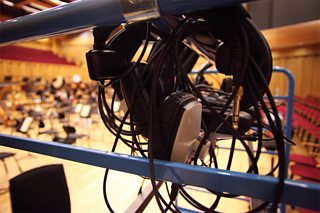
Headphones in BBC Hoddinott Hall. Photo: Brian Tarr
LS: What happens in the recording suite during a soundtrack session?
HT: The orchestrator prepares the music to be recorded in small sections of 30 seconds to three minutes. The click-track for each 'cue' has been loaded onto the multi-track recorder during the preparation. I set up the mixing desk with each mic routed to its own fader, and check that the multi-track computer is recording the right mic. The multi-track is run giving the players a 'count-in' to start playing, and the faders are adjusted to create the balance. This is repeated with each cue until the composer is satisfied.
LS: Tell us a little about the orchestra's recording suite
HT: The control room has the latest technology - digital mic amps in the hall, connected to the mixing desk in the control room via optical fibre. The desk has 42 physical faders, but works over several layers. It could take a couple of hundred microphones if needed!
The output can be recorded in stereo on CD, DVD, Compact Flash and multi-track. Programme is monitored on loudspeakers. If we are doing a live transmission we connect to the outside world via ISDN.
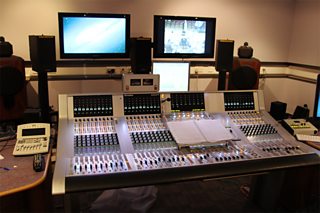
The mixing desk at BBC Hoddinott Hall
LS: Why do the panels above the auditorium in BBC Hoddinott Hall move?
HT: The hall has an adjustable acoustic, with remote-controlled acoustic 'duvets' fitted to the upper sections of the walls to absorb sound. The reverb time can be changed from 1.5 to 2.2 seconds and is changed to suit the repertoire.
LS: You are an important part of the orchestra’s touring team, what challenges do you face on the road/outside broadcast?
HT: Getting through the very long days without things going wrong! The sound team travels to and rigs a venue long before the orchestra arrives - we also have to find food, if there’s time!
We troubleshoot during rehearsal, and then ensure the concert sounds good and is recorded on several formats, just to be on the safe side. While the players go to the pub afterwards, we are left to de-rig - the bar is usually closed by the time we finish.
If the concerts are abroad, you are also dealing with strange locations, the language barrier and added problems due to the vast distances. And there’s usually no time for sight-seeing!
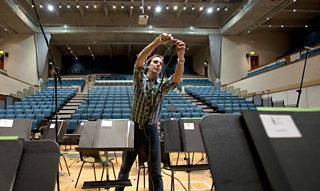
Huw Thomas rigging up a microphone
LS: What is your favourite type of project to work on, and why?
HT: I get so much pleasure from working with music, whether it's a small classical concert for radio, or a five-day remix for television; the work is different every day. Recent award nominations (Emmy, RTS, BAFTA, BAFTA Cymru) show that the work is of the highest quality.
LS: What was your route to becoming BBC NOW's Senior Audio Supervisor? What advice would you give to any youngsters wanting to train in your area?
HT: I had an interest in physics and music at school and on completing a music degree, I thought about becoming a professional trombonist, but decided on a career in broadcasting instead. I was lucky to join the BBC, and over the years have worked in TV and radio on news, sport, music, drama and education; finally specialising in music, and eventually, exclusively with BBC NOW.
Anyone wanting to get into the industry should aim for one of the music technology or Tonmeister courses at university. Unfortunately there are few job openings, so personal contacts and enthusiasm are good to have.
Find out more about a career in broadcasting by visiting the BBC Careers website.
