
Last autumn I was asked by BBC Radio Wales to help return a very special set of World War One items to their original family. It turned out to be quite a simple search task but was a true pleasure to be able to complete, and it unearthed a fascinating story.
Amongst the items were some very precious and personal letters, a diary which had been logged daily chronicling the 1914 -1918 war and a series of unusual and quite possibly unique photographs of Mesopotamia beautifully mounted in a bound leather album.
These imprint items were being held by Matthew Barraclough in County Durham who had found them amongst his father’s possessions when clearing his house. But they did not belong to either Matthew or his father, in fact it was more a case of his grandfather, Henry Barraclough, simply being their custodian until such time as they could be returned.
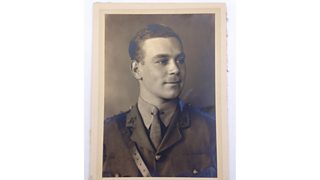
The photographs had been taken by Captain Barraclough’s batman Private Harry James Meredith.
During World War One a 'batman' was essentially an officer's uniformed servant or orderly. In addition to his normal duties as a solider, the batman was responsible for the officers clothing and kit and also in preparing and serving meals. The duties varied depending on the officer's rank and role.
There is anecdotal evidence of continuing close relationships between officers and indeed these items are proof of such a relationship.
Upon receiving the items from Matthew I immediately set about scanning each letter and reading through the beautiful copper plate hand-written diaries to gather valuable information to enable me to piece together Harry Meredith’s family history; with the ultimate aim of tracing forward and locating a living member of his direct family who could then take the items home.
Luckily for me Harry Meredith was incredibly diligent and wrote down everything in great detail. Shortly after conscription started he attested on May 24 1916 and then enlisted in Brecon later that year into the 4th Battalion of the South Wales Borderers.
He served for three years and six months before being discharged on March 11 1919. During which time he travelled extensively, including visiting the Hanging Gardens and Ruins of Babylon, which must have been a true wonder for a boy from South Wales. Harry even made a note of his mileage! Travelling a total of 6636 miles in Mesopotamia and 464 in India.
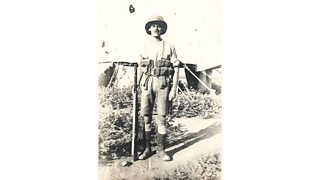
Harry should have been at least aged 18 when he attested although as we know from experience this was not always the case
So I started by looking for Meredith births with the first initial “H” indexed around 1898. Not knowing whether Harry was his real name or if it was Henry or Harold.
But luck was on my side again when I discovered an entry in the first quarter of 1898 for a Harry James Meredith who was born in the Newport registration district. This seemed like a good possibility since the various letters had also been sent from an address near Newport.
Knowing that all those who served during WW1 have now died I also searched the death indexes and found an entry in 1994 which matched the date of birth. Ordering a copy of this death certificate for just £9.25 provided me with the unequivocal information that I was desperately hoping for... that Harry’s death had been registered by his son; John.
Amongst several loose photographs was one of "Mr & Mrs H.Meredith" and I found a possible marriage entry in 1924 to Patience Williams in Pontypool.
In a letter dated 1926 Harry talks about his son and the birth indexes I found the birth of John H.Meredith in Pontypool, whose mother’s maiden name was Williams.
Incredibly, Harry’s son John Meredith, now aged 89, was still living at the same address in Griffithstown where he had registered his father’s death twenty years before.
John now has all of his father’s precious military memorabilia safely stored back in his home.
I've suggested that one day he takes them along to the South Wales Borderers regimental museum
